Saturday, April 6, 2013

Crab eating macaques during Chek Jawa guided walk

For the first time I get to meet Mr Crab Eating Macaque up close at Chek Jawa today, at the monthly Naked Hermit Crabs free guided walk.
Crab eating macaque
Waking up to a grey sky in the morning and with NEA's weather animation showing massive storm clouds passing by the southern parts of Singapore all the way to Batam, it was a relieve that we will not be hit by heavy rain. The weather was rather cooling this morning as I head out for Pulau Ubin with the other guides from the Naked Hermit Crabs and my 4 students to Chek Jawa.
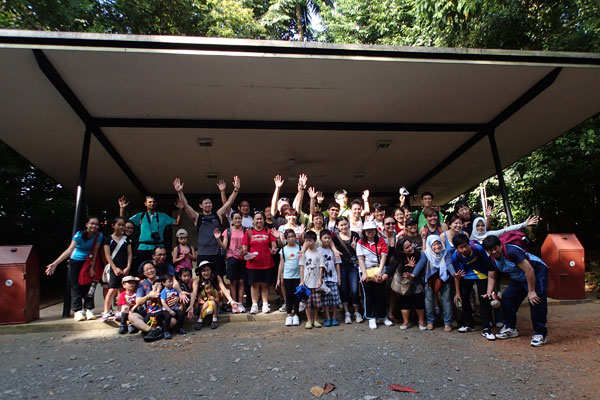
Family group photo at the coastal boardwalk.
The children and parents enjoyed themselves.
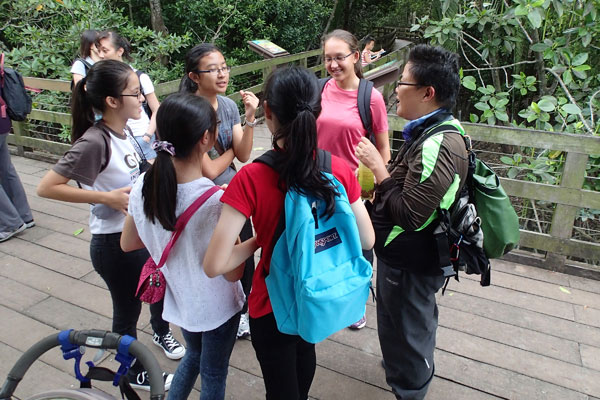
We has a rather small turnout today, probably because of the wet weather in other parts of Singapore or simply just did not turn up based on the assumption of "it is going to rain". There were about 20 visitors  to start with for the guided walk. As soon as we were about to start our walk, the sky drizzle some rain.
That spoilt our group photo taking moments and we just did a brief introduction at the sheltered information kiosk.
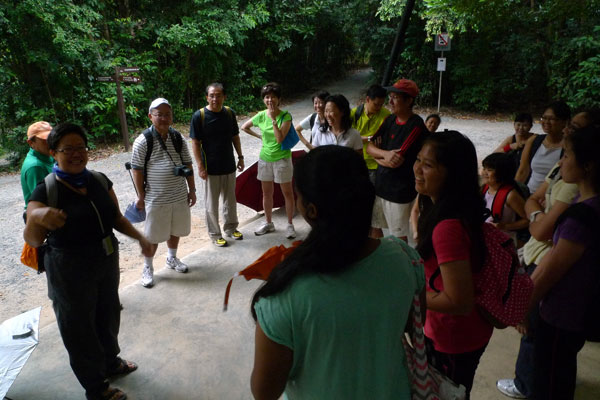
Short briefing with the visitors.
The drizzle lasted for a short while and the humidity kicked in. I started off with a group of 8 adult visitors and it was great sharing stories with them. Sometimes guiding adults can be fun as I can share many interesting information with them and I also learnt new information from them. There is never an end to understanding our nature's fauna and flora.

At the base of the Jejawi tower, my sharp eyed adults already started asking about the mud mounts, the crabs and they also spotted the blue spotted mudskipper.
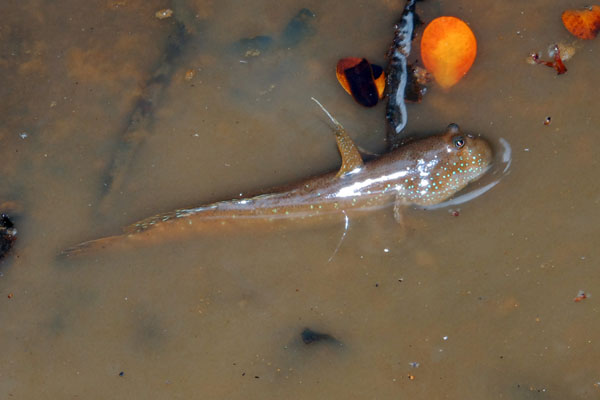
Blue-spotted mudskipper
It was through today's trip that I actually got a better observation of the blue-spotted mudskipper. I had initially mistook it for another type of mudskipper. 
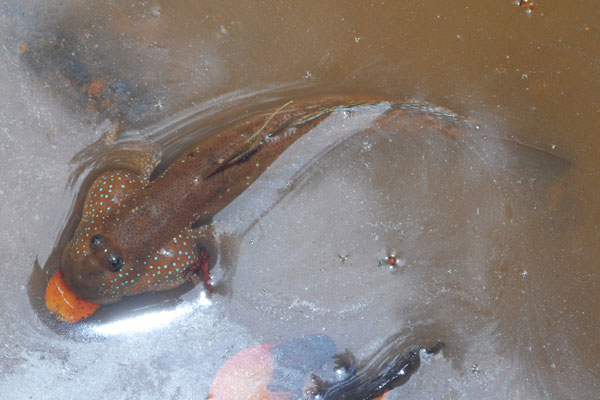
Blue spots by the sides, especially near the check area.
While looking at the tree climbing crab, I shared with them that the other common name for the crab is the vinegar crab because of the pickling method used by the Teochews in the past. It is not common to know of adults who have tried this before, but a few of the adults in my group actually knew about this dish. I personally have tried it before but pickled in dark sauce, and I think I ate about 2 to 3 of it.

A family of 12 with children joined us along the boardwalk and gradually, I turned my focus in engaging the children. I felt so bad leaving the adults on their own but they understood the problem I was facing. The children were great helpers at spotting animals. They were able to spot many crabs for me and always eager and excited to find more animals.
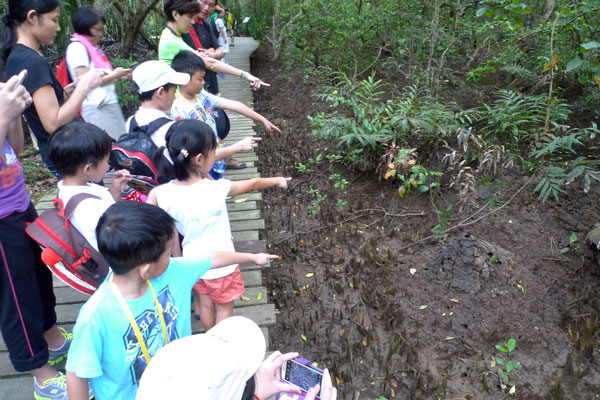
"There, the crab!"
The children spotted many tree climbing crabs, tiny fiddler crabs in the mangrove, orange fiddler crabs at the coastal area and they were surprised to check out the resident mudskipper that is "always present" behind the mangrove rest shelter.
[Image taken from the walk on 10 Nov 2012]
This mudskipper was clever enough to build its home right behind the rest shelter. Every trip, it allows visitors to look at it comfortably while resting in the shelter.

The bonus for today's trip was being able to see 3 crab eating macaques on a sea hibiscus tree at the boardwalk junction where the bakau tree is. The children got really excited on hearing that there were "monkeys" nearby. Luckily I was able to manage their excitement and everyone got a good look and took great photos of the macaques. One of them was feeding on bits found on the carapace of a horseshoe crab while a bigger macaque looks like it had some kind of fruit or seed. The bigger macaque even walked up a hanging branch above us and sat there. It was a great encounter.
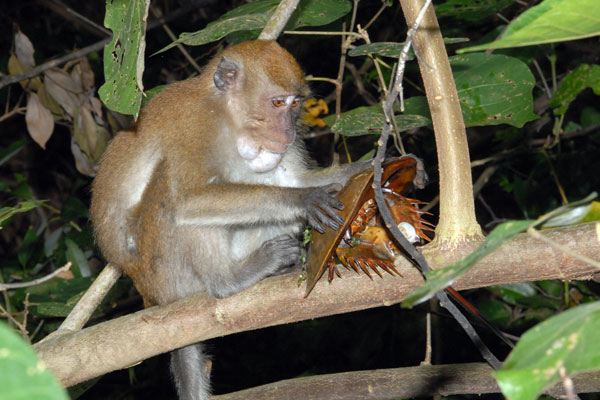
Picking from the carapace of a horseshoe crab.
Bigger macaque holding onto some kind of fruit or seed.
Moving up to the branch above us.
Near the coastal shelter, everyone was mesmerised by a huge school of fish circling round the boardwalk pillars. My children visitors got creative and they looked through the spaces between planks on the boardwalk to see the fish since the railing was too high for them to be able to see the fish.
Looking at the fish through the spaces between boardwalk planks.
Amazing and happy children in my group.
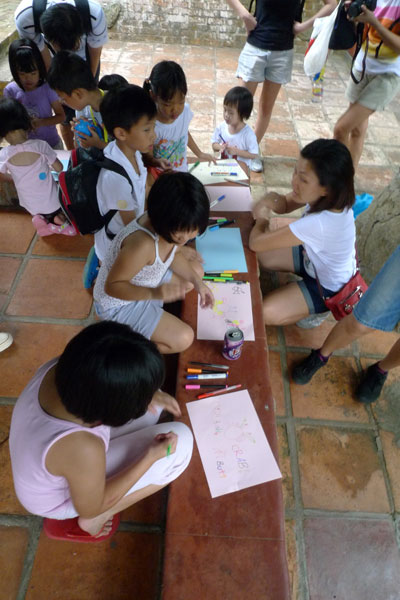
At the end of the walk, the children spent some time doing up their guest book drawing. They are wonderful and great artists, demonstrating great memory, details and imaginations.


How can I forget about my 4 students who joined us today on their first experience being a nature guide. Sharina and Sarah H. followed Ria's group while Sheyenne and Alex follow me. Today, they are tagging along with the Naked Hermit Crab guides to learn how to conduct nature guiding. They picked up many interesting information and hopefully, they will start guiding slowly in the next session.
Left to right: Sharina, Sarah Hyder, Sheyenne and Alexandra
Great thanks to the guides who helped today: Ivan, Ria and Pei Yan.
Great welcome to our young guides: Sharina, Sarah H., Sheyenne and Alexandra.

The Naked Hermit Crabs conducts free guided walks at Chek Jawa and Pasir Ris mangrove.
For more information about our walks, dates and sign up form visit the Naked Hermit Crabs blog

Friday, March 29, 2013

Guiding at Pasir Ris Magorve with the Naked Hermit Crabs

The Naked Hermit Crabs are back on the guided walk at Pasir Ris mangrove!
Despite the heavy downpour in the western part of Singapore, it was relatively dry at Pasir Ris Park. Organising my first guided walk at Pasir Ris mangroves for the year, I saw a turnout of about 30 visitors  of various ages. It was heartening to see our past visitors joining us for the same walk again.

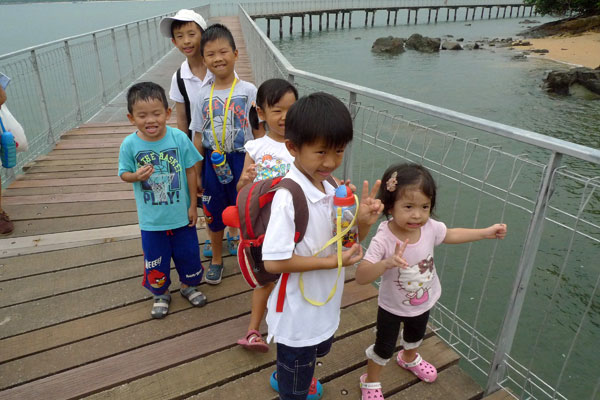
It is great to see families bring their children out to experience nature.
Children observing a snail on the underside of a leaf and asking all kinds of questions.
We were blessed with good weather on this session as the thick clouds approaching Pasir Ris decided to hold it and passed by for the whole evening. :)

Even the adults are enjoying themselves in the walk.
Ley Kun guiding one of the groups.
At the start of the mangrove boardwalk, one of the orchid plants planted by NParks was flowering. It was one of the few orchid plants NParks planted on a tree, next to where big Tiger Orchid plant is located. Unfortunately, I forgot to take a picture of the pretty orchids.

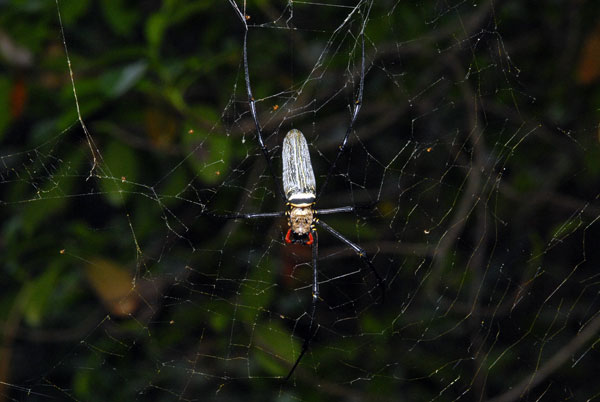
Shortly into the walk, I spotted a golden orb web spider (Nephila pilipes). This poor female spider's web looks quite damaged and she lost two legs on her right.
Female golden orb spider
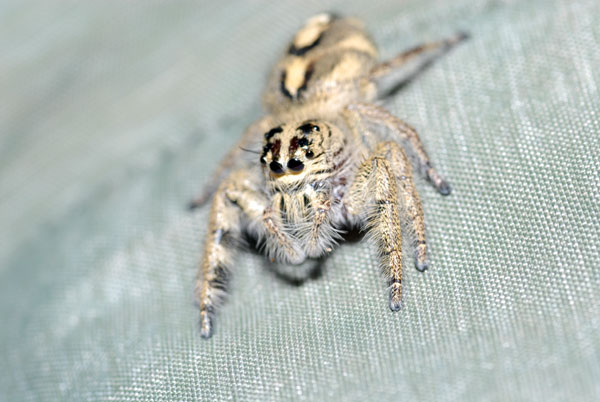
Another spider we encountered during this walk was the heavy jumper (Hyllus diardi). It got the children screaming and squirming as Jerome helped to bring the spider closer to the children.
Heavy jumper
People on a free guided tour of Pasir Ris mangroves by the Naked Hermit Crabs
Visitors looking at the spider while I was taking photos of it.
(Photo by Ria Tan)
How lucky, some children wanted to see an inch worm and we found one!
People on a free guided tour of Pasir Ris mangroves by the Naked Hermit Crabs
Looking at an inch worm

The other animal that got the children squirming was a mealy bug, which Ley Kun found.
Mealy bug
What are the visitors pointing at?
"Looking at this!"
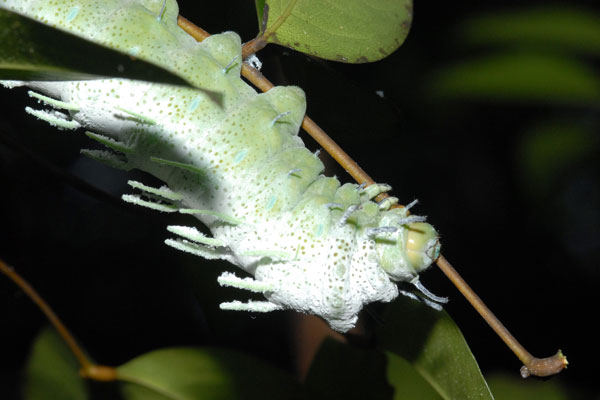
Oh... it was an atlas moth caterpillar.
Overview of the caterpillar
Closeup on the head of the caterpillar
It is easy to recognise a atlas moth caterpillar based on its size. It is a huge caterpillar. It was a kind gentleman on the boardwalk who alerted us about this caterpillar. He was also taking pictures of it. The atlas moth does not have a mouth piece. It can only feed during the caterpillar stage and a single atlas moth caterpillar is capable of wiping out leaves of a young plant. When the caterpillar morphs into a moth, its objective is to look for a partner to mate and lay the egg before it dies.

Over at Ley Kun's group, they saw a juvenile malayan water monitor lizard peeking out of a crab hole. We wonder what it was doing inside the hole?
Peek-a-boo
The giant mudskippers were plentiful as usual in the mangrove having their own activities. Some were moving around, while some has a scary mud spa.
Giant mudskipper moving out from its hole
Mud spa mudskipper
At the end of the walk, our visitors were treated to a lovely and tranquil view of Sungei Tampines. We saw some of the resident grey herons flying towards their nests further downstream. Some visitors spotted a water monitor lizard lazing on a tree and then a swimming one at a later time. High up on a tree, Sankar and this group spotted an uncommon woodpecker.
The water monitor lizard made a great model for drawings
Grey heron flying
Woodpecker
On this trip, we had 5 girls from CHIJ Katong Convent who are on a nature guiding program in becoming a nature guide for the Pasir Ris mangrove guided walk. At the end of the walk, Ria spent some time talking to these girls.
Having a chat with Ria.
Future nature guides with their lovely guestbook drawings.
(Left to Right: Claudia, Cheryl, Kristine, Erynn and Charmaine)
Our visitors were also spent some time working on their guestbook drawings and usually the children are the most serious one working on it.
Here's some images of what our visitors have expressed:


Guiding the visitors for this walk, we have Ivan, Ley Kun, Ria, Pei Yan and Sankar.
Also a great welcome to our young nature guides of Pasir Ris mangrove: Claudia, Cheryl, Kristine, Erynn and Charmaine.

For those who are interested to join us for the Pasir Ris mangrove walk, the next session is on 20 April 2013. Do sign up through this online form.

Saturday, March 2, 2013

Mud lobster sighting and 8 new wild boar piglets at Chek Jawa

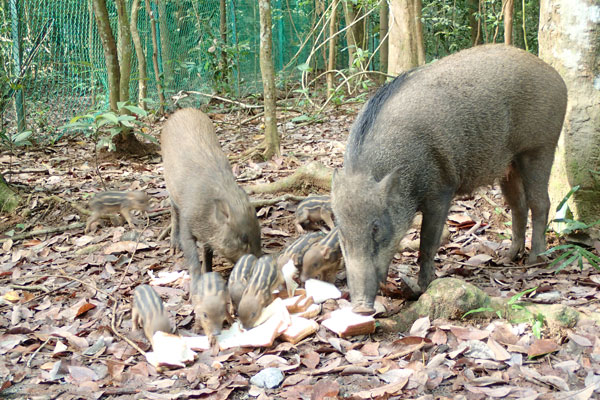
Today at the entrance to Chek Jawa, the guides and visitors were greeted with two adult wild boars and 8 piglets born very recently. The piglets are so small and cute!
2 adults and 8 piglets feeding on bread.
After two months of break for the volunteers from the Naked Hermit Crabs (which felt like super duper long break), the free Chek Jawa guided walk has resumed. In this first guided walk for the year, the guides and visitors were treated to many interestes critters in Chek Jawa.
Visitors for the guided walk
We have about 50 visitors today, plus 4 of my students who are on an experiential program in becoming a nature guide.

Here's the video of the wild boars and the 8 piglets we saw at the entrance.

My usual route brings my group through the left trail of the coastal forest into the mangrove. At the entrance to the mangrove boardwalk, I could not locate the star fruit tree. The tree was trimmed and I was unable to find the tree with the flowers. We then walked up the Jejawi tower to get a better overview of Chek Jawa.

Back down on the boardwalk, one of the visitors in Ria's group spotted a mud lobster!
Mud lobster
It was a very rare treat to the visitors who were nearby. For the 3.5 years I have been guiding, this is actually my first time seeing a mud lobster. Two of my students got to see it on their first visit to Chek Jawa. How lucky they are. This was the only pose I got of the mud lobster after patiently waiting with my group for it to appear as it went into hiding with so many people looking at it. There were too many people at the spot when it first appeared and I couldn't take a picture or a video of it.

The sighting of the mud lobster made my day and a great way to start the mangrove section. Mud lobsters are very shy creatures that live deep in the mud. They hardly come out of their burrow, even during night time.

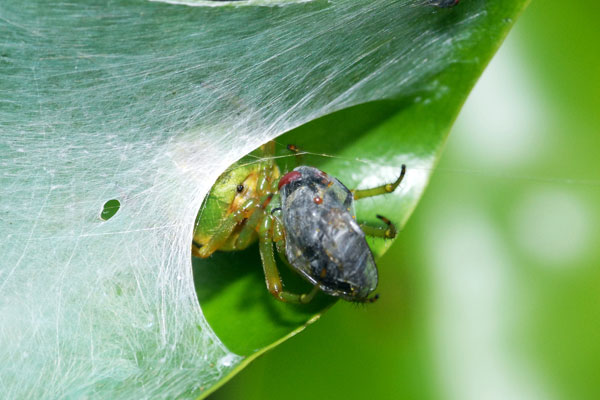
A father in my group pointed out a spider housed on a leaf to his son. It it was clearer to see what it was  with my macro lens.
Spider with it's food.
My young visitors are really good at spotting small critters. It takes some time for our eyes to get used to the colours in the mangrove environment and soon enough, many little critters start appearing in front of you.

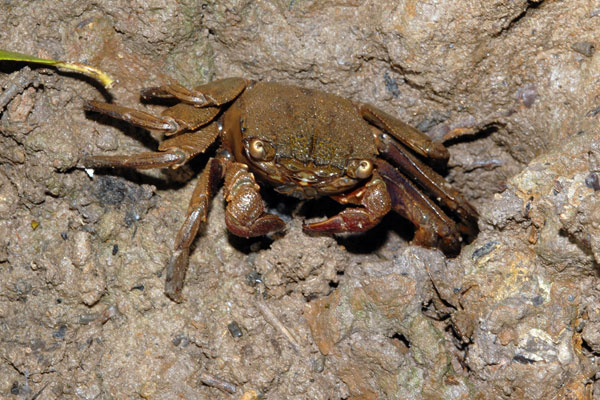
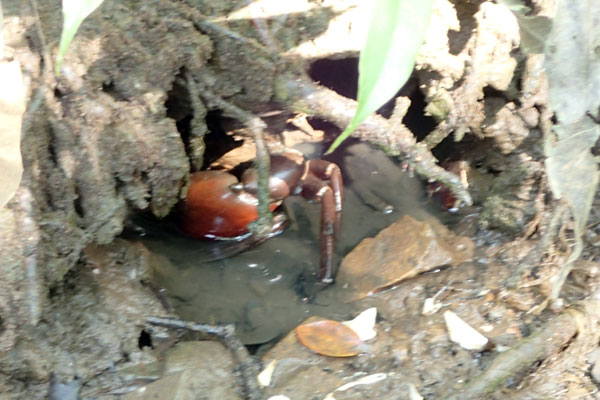
They were able to point out the mudskippers, the tree-climbing crabs and the fiddler crabs in the mangrove. Even the adults are doing an impressive job at spotting. One of them actually spotted a mud crab hiding in a hole under a tree.
Mudskippers
Fiddler crab in the mangrove
Tree-climbing crab
Mud crab in a hole under a tree.
Armed with my big camera and macro lens, I was able to show the children and adults in my group how the tiny blue fiddler crab looked like.
Tiny blue fiddler crab
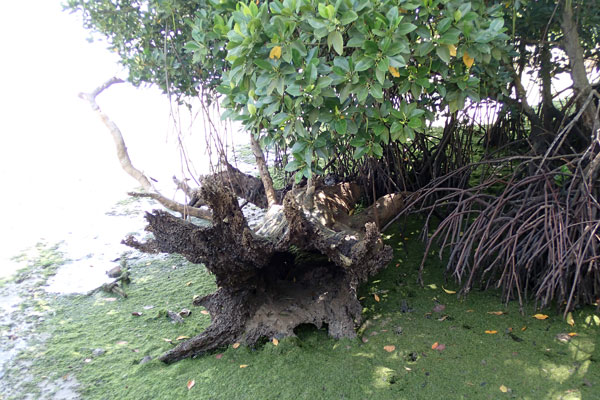
Along the coastal boardwalk, my visitors were treated to more fiddler crab activities next to the Bakau tree at the boardwalk junction. It seems that the dead mangrove tree that used to stand on the intertidal area has decayed badly and is washed up next to the Bakau tree.
Washed up dead tree
It used to be a subject where many landscape photographers like to use for landscape shots from Chek Jawa. I could only locate one Infra-Red shot with the tree in my online gallery.
The dead tree in the middle.
No otters were sighted today but the sighting of the mud lobster was a more than enough replacement for it.

Other guides for this trip: Chay Hoon, Jia Ling, Ley Kun and Ria.
My students on training: Ca Lin, Isabel, Sarah Ooi and Vindhya.

Tuesday, February 12, 2013

Stunning sunset with critters of St. John's Island

While exploring the shores of St. John's Island, everyone suddenly paused at where they were and started admiring the beautiful sunset, bidding goodbye to the second day of the lunar new year.
Sunset at St. John's Island
We were lucky to be on the outer edge of the water snake that visited from the northeastern side and turned in the clockwise direction on the boundary of mainland Singapore. At the beginning part of the trip, we experienced mild drizzle.
It was not longer after I started explore when I saw my first critter - a reef bristleworm (Eurythoe complanata). It looked like it was out hunting for food.
Head of the reef bristleworm
On a colony of blue coral (Heliopora coerulea), there were many tiny crabs coming out to feed. The crabs looked similar to the smooth spooner crab (Etisus laevimanus), but of much smaller size. They were out feeding on the surface of the blue coral.
Blue coral
Tiny crab 1
Tiny crab 2
Somewhere near the blue coral, I took a photo of this.

This is actually a fire anemone (Actinodendron sp.). I thought it was a species of soft flowery coral on shore and when I was editing the photo. It was Kok Sheng who surfaced that it could be the fire anemone after looking at the white stripes with spots at the bottom of the photo and oval shaped tip tentacles. Luckily for me as I did not try to touch it on shore. The fire anemone causes a nasty sting when touched. Phew and WOW!

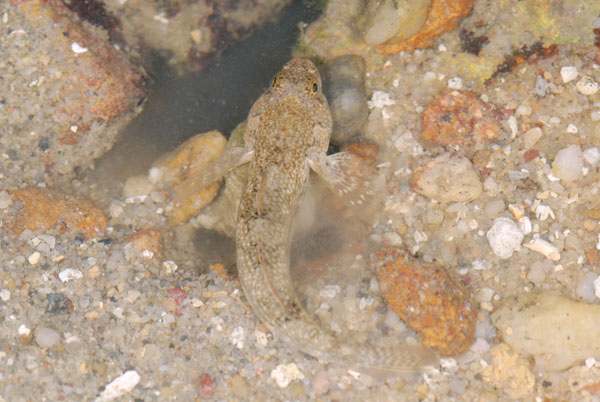
There were many gobies in the shallow water and they were kind enough to stay still for me to take a photo of them. They are not easy to spot sometimes as they blend very well with the colour of the sand, thus making it difficult to shoot them.
Goby 1
Goby 2
Goby 3
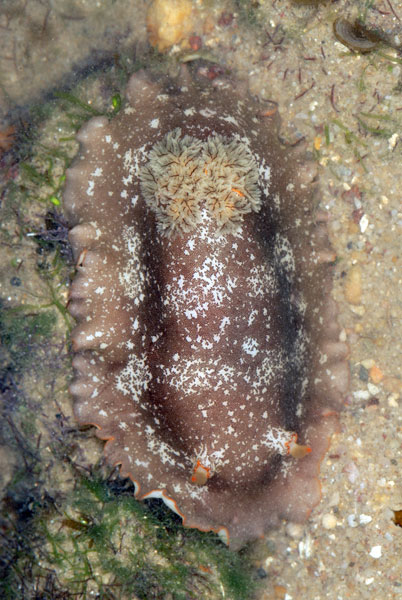
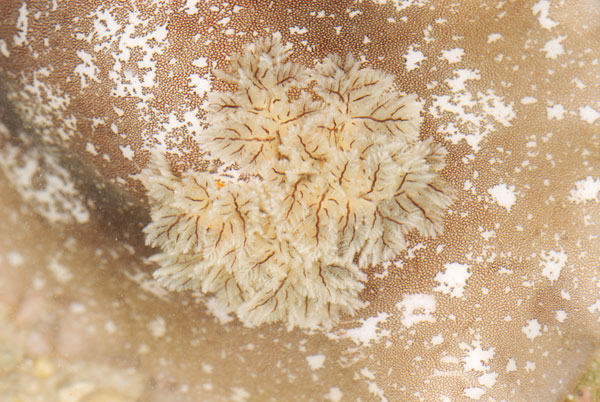
Tse-Lynn brought her son, Ethan, to visit the shore with us today and he helped to find a pair of platydoris nudibranch (Platydoris scabra). As mention by Ethan, the platydoris nudibranch has a fine rough surface.
Platydoris scabra - Dorsal view
Close up of rhinophores
Close up of feathery gills
Trying to flip back, showing the tiny oral tentacles
Underside view
Here's a video of the platydoris nudibranch moving.

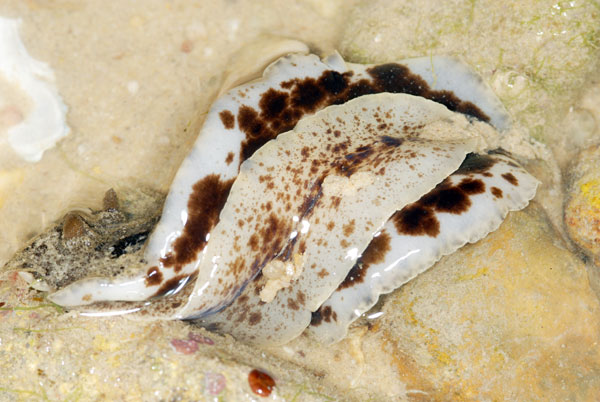
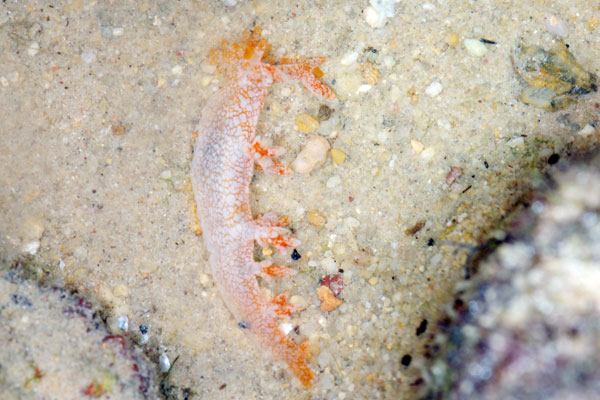
Ria found another type of nudibranch just as she was flipping a rock, the spotted foot nudibranch (Discodoris lilacina). I found it tricky to shoot this nudibranch as it colour patterns is very close to the sandy area.
Dorsal view,  rhinophore on the left.
Underside view
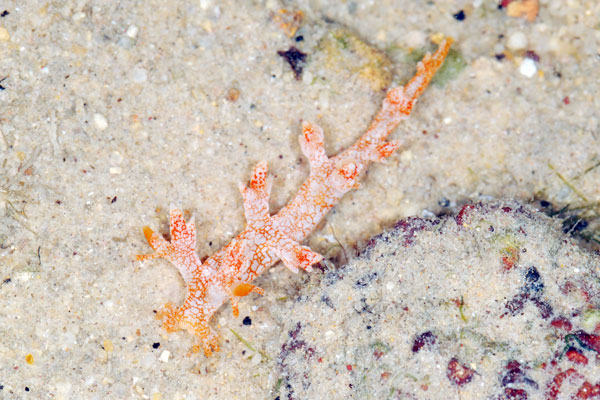
Ria also found the starry mouthed nudibranch (Bornella stellifer) while she was exploring the lagoon.
Head-on view
Dorsal view
Side view
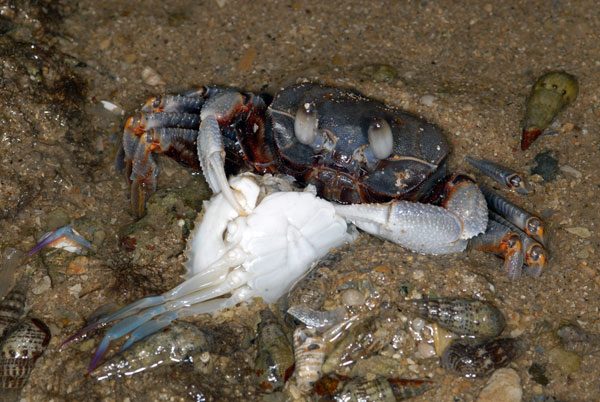
Moving on to the lagoon, the horn-eyed ghost crabs (Ocypode ceratophthalmus) are out hunting and enjoying their crabby meals. I saw two ghost crabs feeding on crab. One was feeding on a swimming crab and the second was feeding on a moon crab and it left bits of the pincer and arms on the shore.
Feeding on swimming crab
Feeding on moon crab
Broken remains of the moon crab on the shore near the ghost crab.
Here is a video of the second ghost crab feeding on the moon crab.

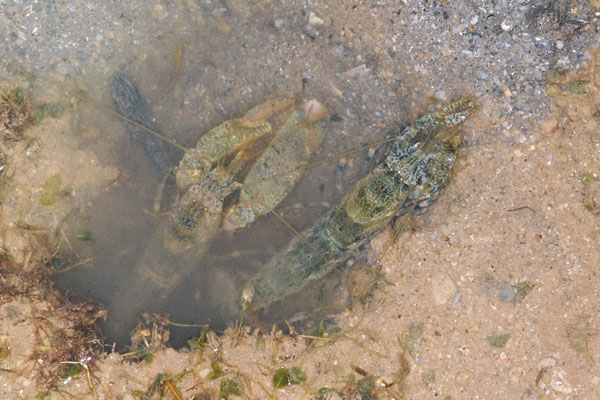
This trip was my first time seeing two snapping shrimp coming out of their borrow. Are they a mating pair? 
Usually we see only one actively beautifying its burrow entrance with a goby outside. However on this trip, I actually saw two of them coming out from the same hole. How interesting. One of the snapping shrimp when back into the burrow when it sensed my presence while the other stayed out a little longer. Both are ornamented snapping shrimp (Alpheus sp.)
Two snapping shrimp from the same hole
The smaller snapping shrimp outside the hole
In the patch of seagrass in the lagoon, Kok Sheng spotted a pipefish.
Pipefish
Head shot of the pipefish
Ending off this post, here is a panorama shot of the beautiful evening sunset at St. John's Island, with the reef in the foreground.


Posts by others on this trip:
Mei Lin - Psychedelic Nature
Kok Sheng - CNY Day 2: St John's Island
Ria Tan - Surprises at St. John's Island

LinkWithin

Related Posts Plugin for WordPress, Blogger...