Showing posts with label Terumbu Semakau. Show all posts

Saturday, May 25, 2013

First Predawn Reef Survey for CMBS at Terumbu Semakau

It has been 6 days since the Southern Expedition for the Comprehensive Marine Biodiversity Survey (CMBS) started. Yesterday was my first time stepping into the base camp for the expedition, meeting familiar and new faces. I am involved in CMBS as a volunteer since Dec 2010 as a regular volunteer. The Southern Expedition is the second expedition event I had participated in, with the first at the Northern Expedition held in October last year.
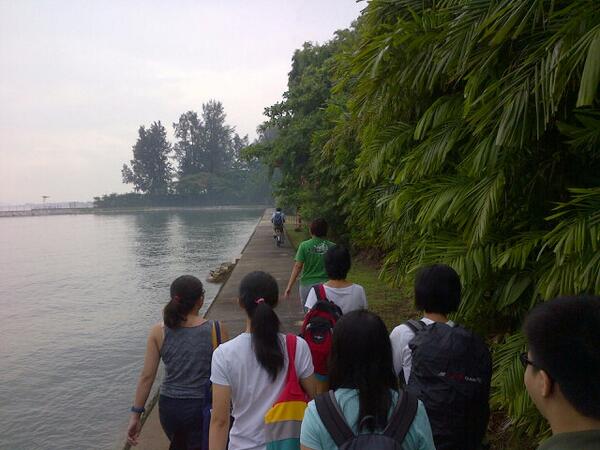
Prof Peter Ng takes special transport to base camp, a foldie.
Image from my twitter.
This morning at 3am, a group of volunteers and scientists gathered at the dinning area to get ready for the first predawn reef survey. With two boats from Summit Marine System, about 18 of us landed safely at Terumbu Semakau, a submerged reef just to the north of Pulau Semakau, Singapore's only landfill location.
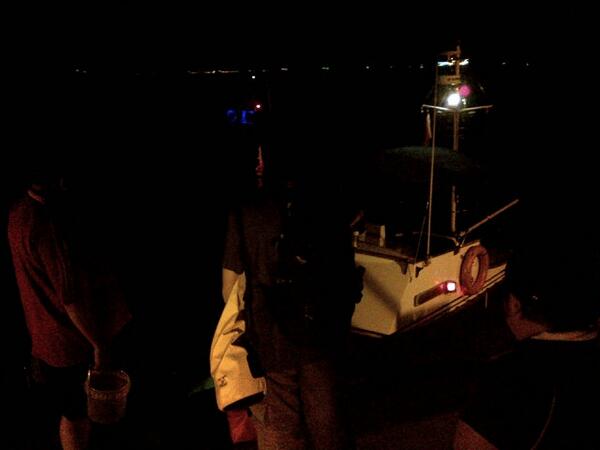
Getting ready to board the boats.
Image from my twitter.
Armed with pails, many containers of various sizes, fishing nets, small brushes, tweezers and gloves, the experienced group of people quickly moved onto the reef in different directions and started working.

Right at the location where we left our personal floatation devices, a Burrowing snake-eel (Pisodonophis crancrivorous) showed itself, very curious at the human presence. I was not even ready with my big camera to take photo of it.
Burrowing snake-eel
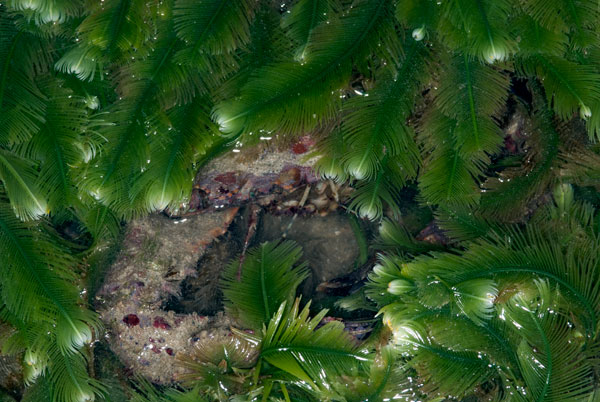
In a nearby patch of Delicate feathery green seaweed (Caulerpa sertularioides), a sneaky crab takes a peak to check me out.
Crab hiding under dense Delicate feathery green seaweed
Very well camouflaged on the reef are these little shrimps, which I am not sure of its identity.
Shrimp with red markings.
This morning, Rene found two types of stinging anemones - Haeckel's anemone (Actinostephanus haeckeli) and the Fire anemone (Actinodendron sp.) These two anemones are able to deliver a nasty sting when touched.  We have to be very careful at what animals we are handling when out on the shore.
Haeckel's anemone with visible area near oral disk.
Haeckel's anemone, with tentacles and visible body column.
Haeckel's anemone, closeup of tentacles.
Fire anemone
One of the interesting findings would be this Leathery sea fan (Family Gorgoniidae) with a wire-like central support through the structure.
Leathery sea fan with polyps extended
Leathery sea fan with wire-like central support.
Seeing the False clown anemonefish (Amphiprion ocellaris) on the Giant carpet anemone (Stichodactyla gigantea) never fails to excite me. We usually refer the  False clown anemonefish as "Nemo", based on the Disney Pixar's movie 'Finding Nemo'.
False clown anemonefish on a Giant carpet anemone.
As we have already identified the False clown anemonefish, there was no need to collect the fish for research purpose. Dr Daphne Fautin has also reminded us not to collect these fish as they are equally important to the anemone as it the host to them. A false clown anemonefish lives on a specific anemone for life and is not able to survive if transferred to a different anemone host. So it is important not to collect any animals from their habitats for personal rearing.

As the sun rose from the city's skyline, the first reef survey ended as everyone waits patiently for the dinghy to pick us up in groups before heading back to base camp.
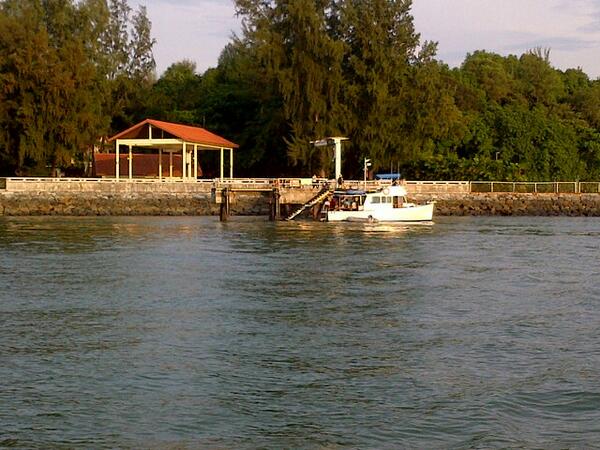
Back at base camp.
Image from my twitter.
I will be doing another reef survey tomorrow morning.

For more happenings on Day 6, check out the Mega Marine Survey blog: Sponge Explosion on Day 6 of the Southern Expedition.

Thursday, November 15, 2012

Magnificently Terumbu Semakau

We are blessed with good weather today at Terumbu Semakau. It was rather hot and sunny, very different from what I experienced yesterday at Labrador rocky shore.

The word "terumbu" describes a reef that is only visible at low tide. Hence "Terumbu Semakau" refers to a submerged reef next to Semakau Landfill. You can get a better visual idea from this image.

This is my first time visiting a submerged reef on a late afternoon and the experience is very different. The animals are so alive and difficult to photograph. Not to worry, I still managed to get some good images of the animals I saw on the reef.

The sky was very clear as we set off from Marina at Keppel Bay on a boat by Summit Marine. Alex, the owner of the boat is a very nice and friendly man whom we are very grateful to have very time we go out on an amphibious landing trip to the southern shores.
P1020002
View from the lobby at Marina at Keppel Bay
P1020004
On our way to location
I've only managed to photographed 2 crabs. The blue swimming crab (Thalamita sp.) and the hairy crab. There were many crabs seen but they were too active and alert. Many of the crab were out feeding on the reef.
DSC_0088
Blue swimming crab
DSC_0091
hairy crab
There were many fish hiding in under sponges, sargassum seaweeds and swimming about playing hide and seek with us. Many of them dart into hiding quickly while some camouflaged among plants and animals.
Some of the fish seen were chequered cardinalfish (Apogon margaritophorus), yellow-banded damsel fish (Dischistodus fasciatus), seagrass filefish (Acreichthys tomentosus).
DSC_0095
Chequered cardinalfish
DSC_0100
Seagrass filefish
I also saw some pretty marine slugs and flatworms.
At one location, I saw 3 black-margined nudibranch close to each other. Were they trying to mate?
DSC_0096
Black-margined nudibranch (Glossodoris atromarginata)

DSC_0098
Black-margined nudibranch (underside)

P1020009
3 of them at one spot.
2 pretty flatworms: Fine-lined flatworm (Family Pseudocerotidae) and Persian carpet flatworm (Pseudobiceros bedfordi)
Fine-lined flatworm
Fine-lined flatworm
Persian Carpet Flatworm (Underside)
Persian carpet flatworm (Underside)
Persian Carpet Flatworm
Persian carpet flatworm
Ria managed to find the tiger cowrie (Cypraea tigris) at the location where it was seen during the pervious trip here. There was a request from the Raffles Museum of Biodiversity Research for a specimen of the tiger cowrie. I'm glad we found it in this trip. Sadly, the animal refuse to loosen its grip in the container for me to take a better picture of. I'll just have to make do with it in the container.
Tiger Cowrie
Tiger cowrie in the container
There were many magnificent anemones (Heteractis magnifica) on Terumbu Semakau and some had their body column stretched as the tide moves out. The magnificent anemones attach themselves to large boulders of dead corals or solid objects, which could of a height from the ground. When the tide goes out, the numerous tentacles on the oral disk causes the animal to fall downwards. In one of the magnificent anemones, I saw a tiny anemonefish. My guess is the tomato anemonefish (Amphiprion frenatus), looking that the dark patch after the stripe.
P1020012
A huge colony of magnificent anemone
P1020014
How the anemone attaches itself to the solid object
P1020013
One of the magnificent anemone retracts into its body column
Magnificent anemone with false anemone clownfish
Can you spot the tomato anemonefish?
Here's a video of the mangificent anemone.

We also saw the fire anemone (Actinodendron sp.). The fire anemone can deliver a painful sting when touched. We should not touch any animals we are not familiar with.
P1020025
Fire anemone
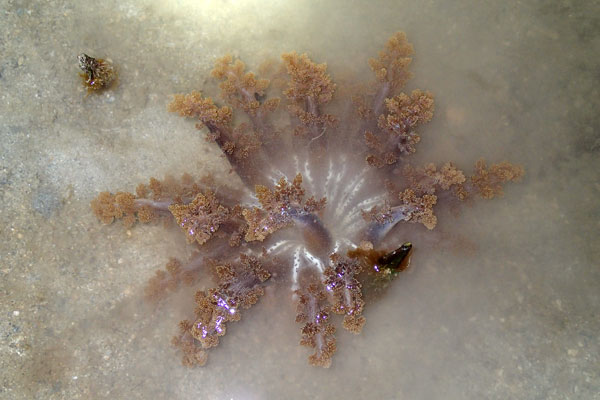
Ria also found a upsidedown jellyfish (Cassiopea sp.) stuck in a shallow pool. A video of the jellyfish shows how it swims in the water.

Towards the end of the trip, Kok Sheng found a fluted giant clam (Tridacnidae squamosa). A GPS reading was taken to mark the location of the giant clam.
P1020037
Giant clam
Giant Clam
Close up of the giant clam,
Throughout the trip, I saw a variety of soft and hard corals.
There were asparagus flowery soft coral (Family Nephtheidae), Long-stemmed flowery soft coral, torch anchor coral (Euphyllia glabrescens), lettuce coral (Pavona sp.), brain coral (Family Mussidae), small goniopora coral (Goniopora sp.)
P1020007
Left: Asparagus flowery soft coral
Right: Long-stemmed flowery soft coral
P1020026
Damaged branches of asparagus flowery soft coral?
P1020011
Torch anchor coral
P1020015
Yellow tiny goniopora coral
P1020016
Brown tiny goniopora coral
P1020022
Lettuce coral
P1020024
Brain coral?
As the sun starts to set, the tide slowly starts to turn. This is an indication for us to leave the reef.
P1020032
Setting sun on Terumbu Semakau
P1020038
Beautiful sunset on Terumubu Semakau
While waiting for the dinghy to make a second trip to the reef to bring us back, Kok Sheng found an alicia anemone (Alicia sp.). The anemone has a beautiful name but it has nasty stings. It has pretty pink lines on its tentacles.
P1020042
Alicia anemone
It was a great trip with good weather, though the return journey to the marina was rather choppy.
Today is the second day of the evening shore trips for this month. There is St. John's Island trip tomorrow and Pulau Hantu on Saturday. Hope the weather stays this good.


Other posts about this trip:

LinkWithin

Related Posts Plugin for WordPress, Blogger...