Showing posts with label Semakau. Show all posts

Friday, July 17, 2015

Quiet Pulau Semakau South

This is Pulau Semakau, the southern island where our incinerated waste is shipped to. The aerial image shows the actual intertidal area of Pulau Semakau.
Aerial shot of Pulau Semakau
We had a great sunrise over Pulau Semakau this morning.
Behind the mangroves of Pulau Semakau, where the birds began to wake up to a new day and the herons are flying in to feed, the Sun peeks up gently with its golden glow.
Peeking sun behind the mangroves of Pulau Semakau
The magnificent sunrise this morning send the large golden yoke up to the sky.
Rising golden yoke
The break of dawn sends many animals in the intertidal back into hiding. They are becoming more visible to aerial predators such as the terns, who were actively out hunting in a shallow lagoon in rather close proximity to me. I just stood on the spot and enjoy the "painful" moments of the birds head diving into the lagoon to make their catch. 
Apart from the aerial predators, the larger water predators are also out feeding, as I caught a glimpse of the black-tipped reef shark (Carcharhinus melanopterus) swimming by at the edge of the shore.
Before that, we had a good working hour in the dark, where animals were less skittish.
Andy came across a fire anemone (Actinodendron arboreum), which has a nasty sting. I took some photos of it and left it alone.
Fire anemone
Closer look at those stinging tentacles of the fire anemone
A suspicious clam-like opening beneath the sand reveals a beautiful strawberry cockle (Fragum unedo), which I had initially mistaken it as a heart cockle. On one side of the cockle, it looked like a heart shape, or some may see it as wings of an angel.
Strawberry cockle, placed back where it was found
Side view
The other side
"Angel's wings", "The heart"
"The butt"
Nearby, Marcus spotted a brown sea cucumber (Bohadschia vitiensis) with is sticky white cylindrical tubes (Cuvierian tubules) being released, clearly showing its objection with us disturbing it.
Brown sea cucumber
Releasing its sticky white cylindrical tubes
Let's play spot the animal game: Can you find the animal in this picture?
Who am I?
Can't find it? Let me zoom in slightly.
No? Let's go closer.
It is actually a decorator crab and this master of disguise crab had decorated itself with sand, seaweeds and seagrass. Here is a better look at the crab when it is on the sand.
Decorator crab
Since it is the durian season, a small durian sea cucumber (Stichopus horrens) was spotted on the shore.
Durian sea cucumber
As the sun rose and the animals went to hide, I got a bit bored and tired and went back to the departure point and noticed the soldier crabs (Dotilla sp.) are out busy making fine sand ball art on the sandbar. The crabs are in various sizes and I noticed that much bigger ones are more colourful. It is very difficult to spot these tiny crabs from afar but once you are near their holes, you will be able to see movements as the crabs retracts into their burrows upon sensing incoming movements.
Soldier crab almost about to drop the sand ball
Side view
This soldier crab is bigger than the rest and less sensitive to motion. It stood motionless for us on the sand.
This long weekend, we will be exploring various parts of the shore of Pulau Semakau. The shoreline is just too long for us to over in one trip, so we had to break it up into parts.

Come back tomorrow for another intertidal adventure from another part of Pulau Semakau.
Posts by others:
Ria - Checking up on Pulau Semakau South

Sunday, February 2, 2014

Northern Beauty of Semakau

It was my first time checking the northern reef of Semakau. It was also the team's first time covering the whole reef of Semakau through a team effort.
Pink line marks the reef coverage the team covered on this trip.
Another team check the submerged reef next to Semakau's western reef, Terumbu Raya.

Saturday, February 1, 2014

Oil spill reaches Pulau Semakau

On 29 January 2014, the Maritime and Port Authority of Singapore (MPA) released a media statement about a collision between the departing Hong Kong-flagged chemical tanker, "Lime Galaxy" and the arriving China-flagged containership, "Feihe" in the evening at about 2.7 km, south of Jurong Island.

The media statement reported that "Feihe" sustained damages on her bunker tanks, resulting in some spillage of bunker fuel. Oil spill response companies were activated to support in the clean up efforts.

It is not revealed the exact location of the collision as Jurong Island is rather large but the image below shows the possible locations, mapped out by Ria Tan (wildsingapore).
Possible locations of the collision, mapped by Ria Tan.
The following day, 30 January 2014, MPA released another update about the collision: Collision between Lime Galaxy and Feihe - update 1

Sunday, October 6, 2013

Cephaly, Fidderly and Tape Flowery at Semakau

It was a rather hot day today as we journey to Pulau Semakau for another intertidal survey session. The team had visited this part of the shore a few months ago on National Day.

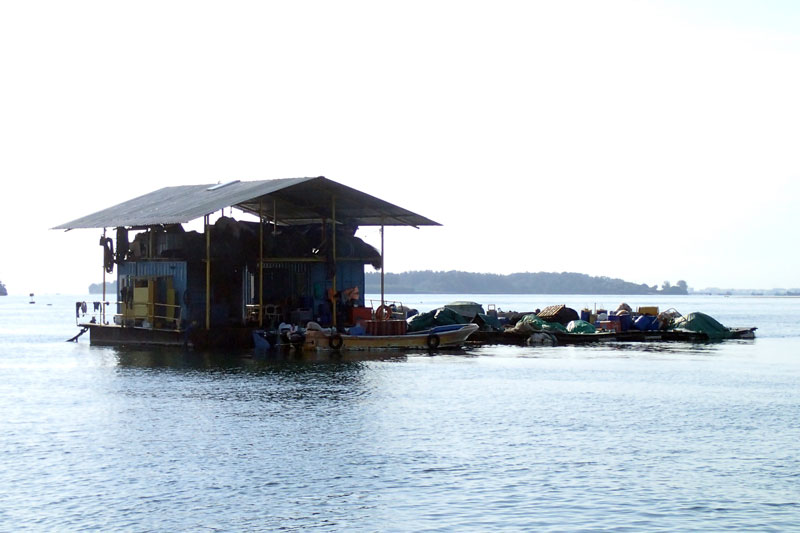
We passed by quite close to the fish farm next to Semakau. There is a barge right next to the fish farm loaded with stacks of bags which may be fish food. On the barge (right side on the photo), there seems to be a large rectangular metal container used for incinerating things. I could see smoke coming out of the rectangular container and smelled something being burnt.
Anchored barge with stacks of white sacks.
Neatly constructed shelter
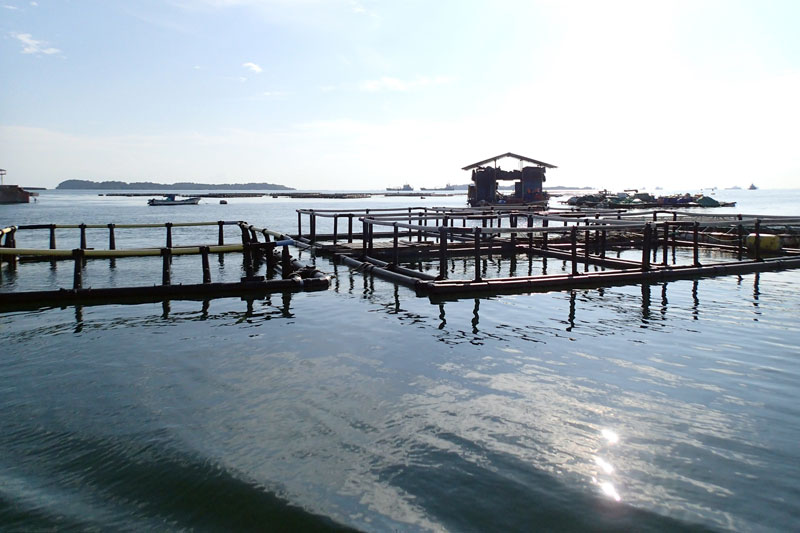
The structure of the fish enclosures in this fish farm is very different looking than the northern fish farms.
Fish enclosures.
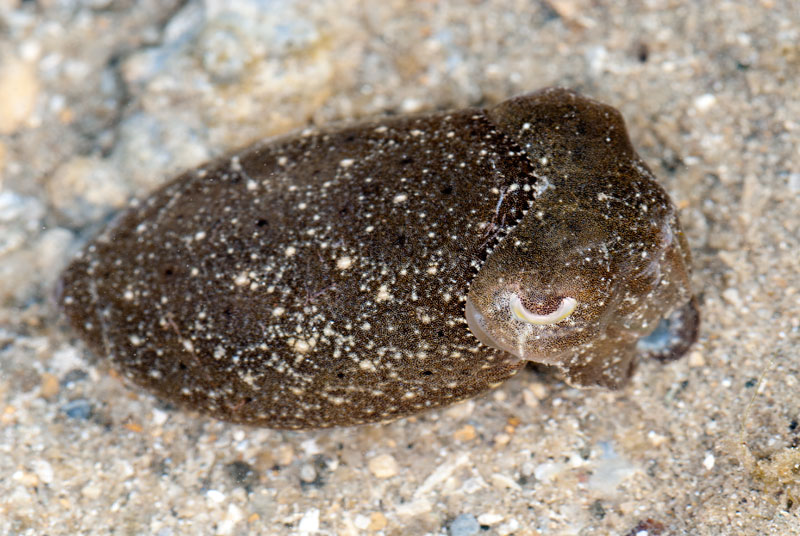
Upon landing on the shore, Ivan spotted a cuttlefish about the size of my palm. It was not easy to get the cuttlefish to show its tentacles.
Side view of the cuttlefish.
Cuttlefish tentacles.
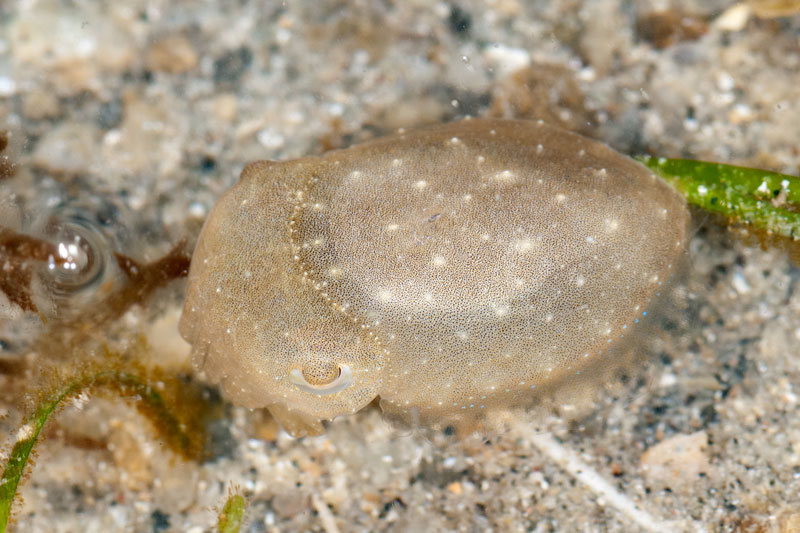
Chay Hoon spotted a small cuttlefish among the seagrass blades. The seagrass meadows provides small shelter space for growing animals.
Front view
Side view
Ivan was a great observer today. He also spotted an arrow-head spider crab (Menatheius sp.)
Arrow-head spider crab
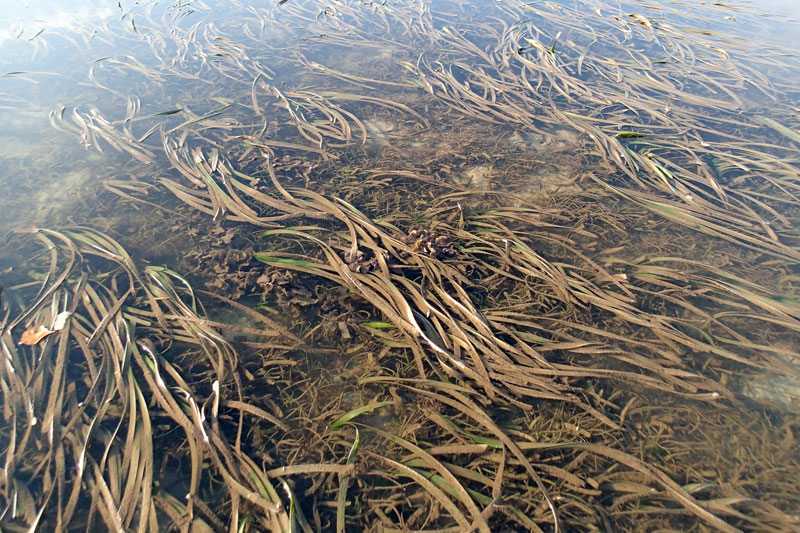
As the team made their way to different parts of the shore to check, I headed towards the river mouth to explore. Along the way, there were patches of very long tape seagrass (Enhalus acoroides). I used 'very' because most of the tape seagrass we monitor and usually see are rather short and burnt at the ends.
Very long tape seagrass
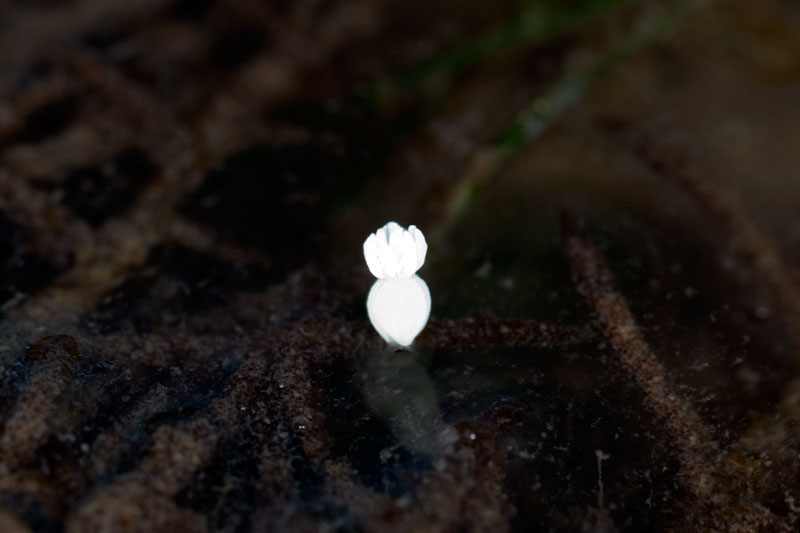
What's more exciting about these tape seagrass is that some of them releasing male flowers! It is so tricky to photograph the male flowers as they are small and white like tiny styrofoam bits. The camera tend to over expose the flower.
One male flower of tape seagrass.
There are no magical powers involved to make these male flowers stand. One end of the male flowers of the tape seagrass is hydrophobic (repels water), which allows the flower to 'stand' upright on water surface or even wet fingers.
More flowers on tape seagrass blade.
I think the male flowers looked like tiny standing teeth.
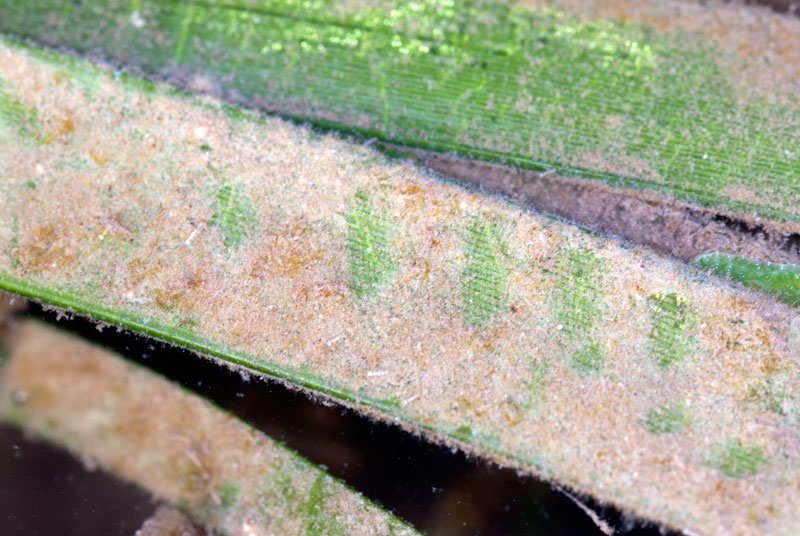
I have also started noticing bare spots on the epiphyte (small plant which grows attached to another plant) covering the seagrass blades. Animals feeding on the epiphytes?
Feeding marks?
As I head nearer to the river mouth the habitat changed from a sandy, seagrass meadow to a slightly muddy substrate with breathing roots sticking out. I am approaching the mangrove area.
Pneumatophores of Sonneratia tree
By the banks at the river mouth, it is stunning to see marine animals settling comfortably. There were clumps of tape seagrass on the river bed. As I was bending to take a closer look at the marine life on along the bank, a pair of eyes looked back at me.
"What interesting eyes you have."
It was the Pearl conch (Strombus turturella) looking at me.
On the water surface there were a few pygmy squids (Idiosepius sp.) swimming around.
Pygmy squid
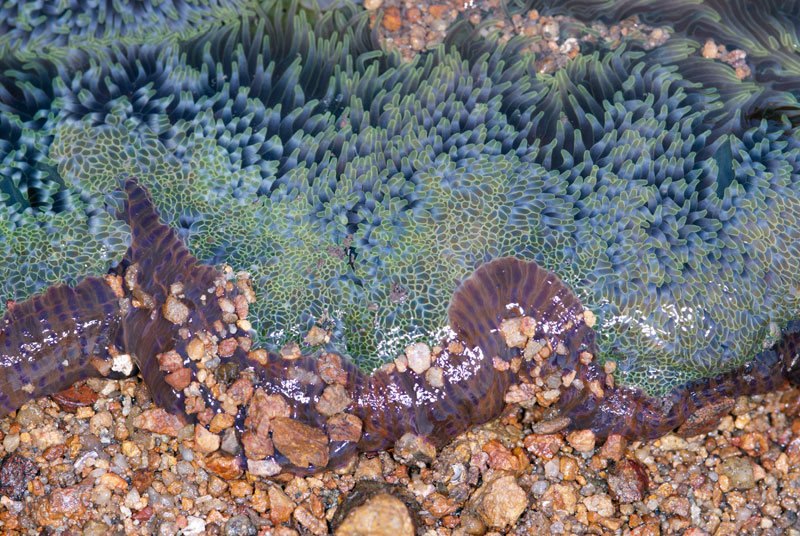
There were also some individual giant carpet anemones (Stichodactyla gigantea) along the bank and they can be found next to the rock wall slope on the bank.
Giant carpet anemone
And some yellow-banded damselfish (Dischistodus fasciatus).
Yellow-banded damselfish
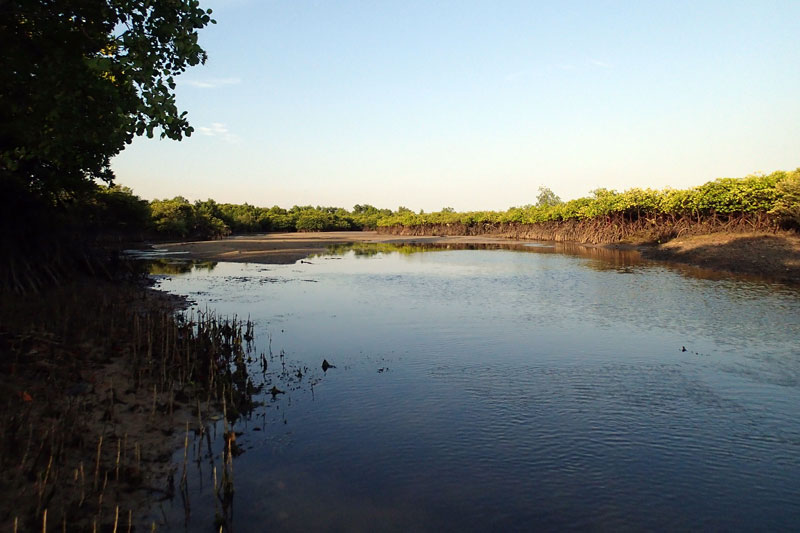
As I walked further up the river, the tranquility of the mangrove slowly reveals itself to me.
Where the river flowed from.
On the rather firm mangrove ground surrounded by some Sonneratia and Rhizophora trees, the orange fiddler crabs (Uca vocans) are out busy feeding. They are very sensitive animals and requires patience to photograph during daytime.
Male orange fiddler crab
Female fiddler crabs (how many can you spot?)
How many fiddler crabs can you see here?
The dead mangrove tree provided a lot of details for artistic shots.

An eagle flew past.
Brahminy kite eagle?
The roots system of the Sonneratia tree is not as simple as you think.
Sonneratia tree root system
Back to the sandy shore, I came across two upsidedown jellyfish (Cassiopea sp.). One was "upsidedown".
Upsidedown jellyfish
Upsidedown, Upsidedown jellyfish
As the sun begins to set, it was time to leave the shore.
Sunset on the Semakau's shore
This probably marks our last trip for the year till about next March as the tides are not low enough for us to visit our shores.

Posts by others on this trip:
James with photos on his Facebook.

LinkWithin

Related Posts Plugin for WordPress, Blogger...