Showing posts with label Tanah Merah. Show all posts

Thursday, June 18, 2015

Seagrassy surprise at Tanah Merah

Between Tanah Merah Ferry Terminal (TMFT) and the National Service Resort & Country Club (NSRCC) Sea Sports Centre, there is a pretty much sheltered corner which is hardly explored. Many cyclists and joggers use the available park connector running along the East Coast Park and the Changi Coast Road canal to get from East Coast Park to Changi Village. However, none seemed to take notice of what this protected area has to offer in terms of marine biodiversity.

This morning, a small team, lead by Kok Sheng, explored this stretch of shore.One of the scariest task is to cross the wide canal with fast flowing water at low tide. I made a partial attempt and turned back, noting with regret much later that the other side of the canal seems more fun.
Upon reaching the sandy shore, we started exploring the the water edge while waiting for the tide to recede. We were quite excited to see seagrass patches but as the tide receded to its lowest for the morning, we realised how wide and diverse the seagrass area was. We recorded 5 different species of seagrasses: Spoon seagrass (Halophila ovalis), Needle seagrass (Halodule univervis), Noodle seagrass (Syringodium isoetifolium), Sickle seagrass (Thalassia hemprichii) and a small Tape seagrass (Enhalus acoroides).
A small clump of Tape seagrass. Hope more will grow from it.
Thicker blade of the Needle seagrass
Noodle seagrass
Sickle seagrass
With a thick seagrass meadow, there are plenty of hidden gems hiding among the seagrass blades.
One of the most intriguing observation was the presence of numerous tiny sea cucumbers.
Tiny sea cucumber 1
Another tiny sea cucumber
More tiny sea cucumbers. Notice that they can be found inside such small marine trash bags found on the shore.
There were a few haddon's carpet anemone (Stichodactyla haddoni), which I came across, and one of them had a of five-spot anemone shrimp (Periclimenes brevicarpalis) couple.
Haddon's carpet anemone, with a female five-spot anemone shrimp at the top right.
Female five-spot anemone shrimp
Similar to the seagrass patch next to Tanah Merah Ferry Terminal, this seagrass patch is full of the tiny dubious nerite snails (Clithon oualaniensis). These pretty tiny snails comes in various shell design and it is impossible to find two with the exact same design. They are hanging out in any possible locations on the shore.
On seaweed
On broken crab pincer
Hitchhiking on a hermit crab
Hiding among the seagrass blades also was a crab eating another crab.
Crab eating another crab
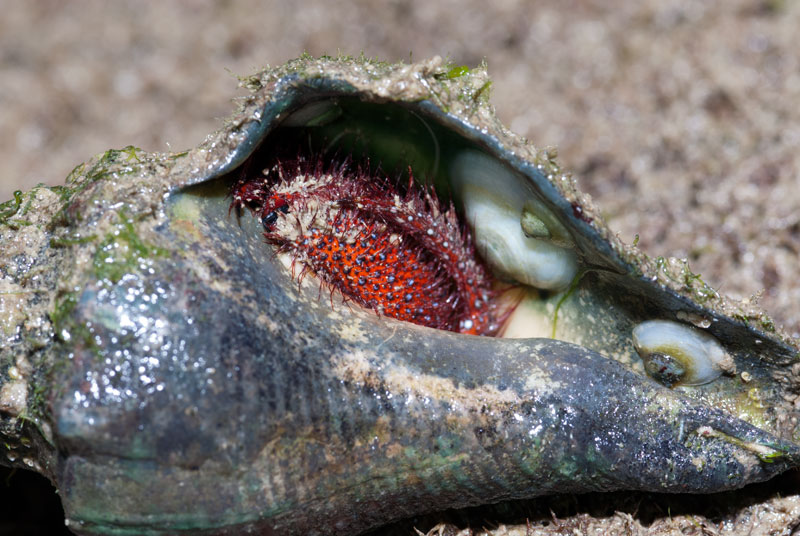
The greatest find on this trip would have to be this suspicious looking shell as I wade deeper in the rather murky waters. it turned out to be a Baler volute (Melo melo)!
Melo melo, sumberged
This is one of the rare times that I actually saw a live Baler volute. I'm really lucky today. Kok Sheng told me that this is possibly the first record of this snail along the East Coast, outside of Changi area. This snail is highly hunted for food by shore goers :(
Underside of the snail
Overview of the Baler volute
On a floating marker nearby, a crab without pincer clings onto the base tightly. It looks like a stone crab. The poor crab has some stalk barnacles attached to it's legs.
Crab without both pincers
Goose barnacle?
On the sandier high shore, I came across a common sea star (Archaster typicus).
Common sea star
Also critters like shrimp, small goby and a pebble crab.
Shrimp
Looks like a whip coral goby
Pebble crab
Lastly, how can I forget the numerous hermit crabs on this shore, some with interesting shells.
Hermit crab in a button snail shell
Hermit crab in a conical shell
Hermit crab in conical shell, underside
This orange-striped hermit crab has chosen to go against the norm and used a land snail shell as its home.
Till the next time I am back!
Posts by others:
Kok Sheng - FB and blog
Ria Tan - Seagrasses taking over sandy artificial shores

Tuesday, September 24, 2013

Marine animals crowd at Tanah Merah on a beautiful sunset

Tanah Merah has one of few quiet hidden shores tucked away from the hustle and bustle of urban pace.
It is surprising to see how well the Ribbon seagrass (Cymodocea rotundata) has settled very well on this shore and is expanding its coverage area.
Spread of Ribbon seagrass
[Photo by Ria Tan]
The Ribbon seagrass on this shore is so thick that they form a thick seagrass carpet when the tide goes down has the strap-like grass blades fall and intertwined with each other.
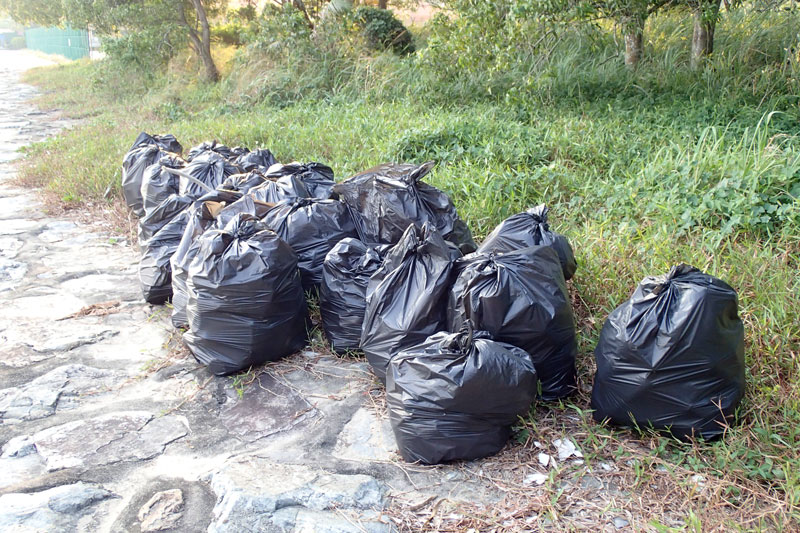
Before heading to the shore, we came across many filled black trash bags. 
Trash bag from ICCS
Seems like a group had cleaned up this shore as part of the International Coastal Cleanup Singapore (ICCS) event. September is the month of international coastal cleanup and volunteers around the world spent the third Saturday of September cleaning up their coast. The site I visited today is Tanah Merah Site 7 and this site was cleaned up by ITE Colleage West (School of Engineering). The data collected from this site can be viewed here.

However there is an endless stream of marine trash brought in by the incoming tides each day and by the time we visited the shore after the cleanup event, we found more empty bottles washed up to the high water mark. Where did these trash come from?
More trash along high water mark.
As we moved down to the shore, we found more bits of trash scattered on the shore.
Trash scattered on the shore.
Right in front of the seagrass patch next to the seawall, Ria noticed a large Garlic bread sea cucumber (Holothuria scabra).
Garlic bread sea cucumber next to the seagrass patch.
Shortly after, I found more of them nearby.
Darker version?
The Ribbon seagrass provided food and shelter for many tiny shelled animals. The tiny hermit crabs are so small and cute looking.
Tiny hermit crab
The little blobs on the seagrass blades are actually the Dubious nerite snail (Clithon oualaniensis). They may look like some boring tiny snails but on a closer look, these snail shells actually come in various patterns.
Two Dubious nerite snails with different shell patterns
We were treated with beautiful sunset on this quiet shore with ocassional sounds of plane taking off.
Sunset on Tanah Merah shore
As the sun begins to set, all the animals come out to play. There were plenty of fish and they were all swimming around me. Night time is the best time to photograph fish as they are less active.
Large school of fish
With more carefull observations,  the Black cardinalfish (Apogon melas) actually starts appearing.
Black cardinalfish
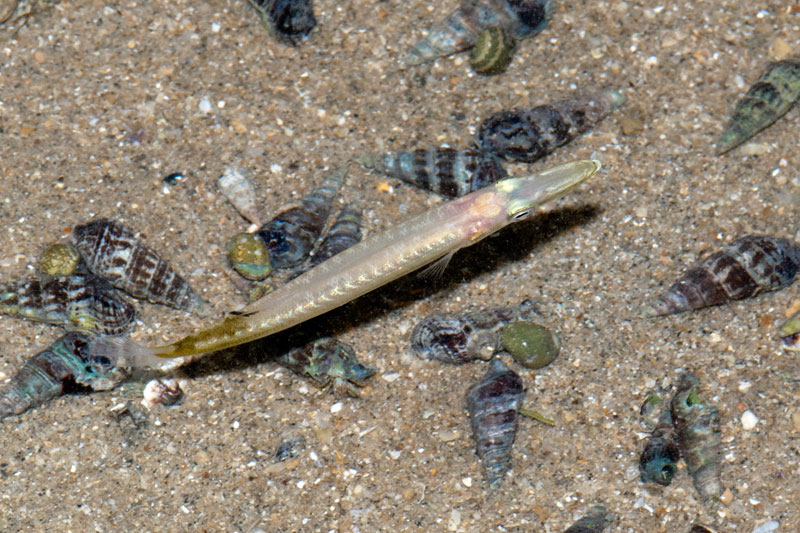
On the surface the Broad-nose halfbeaks swim leisurely near me while a small juvenile Barracuda tried to avoid me in the shallow water. 
Blackish broad-nose halfbeak
Another broad-nose halfbeak with different colour.
The small juvenile barracuda looks rather similar to the broad-nose halfbeak but it has larger eyes with the upper jaw only a little shorter than the lower jaw.
Juvenile barracuda
On the rocky seawall, there were different types of small shrimps moving around. I am not sure what these shrimps are. Some of them are very well camouflaged.
Unknown shrimp 1
Can you spot the shrimp?
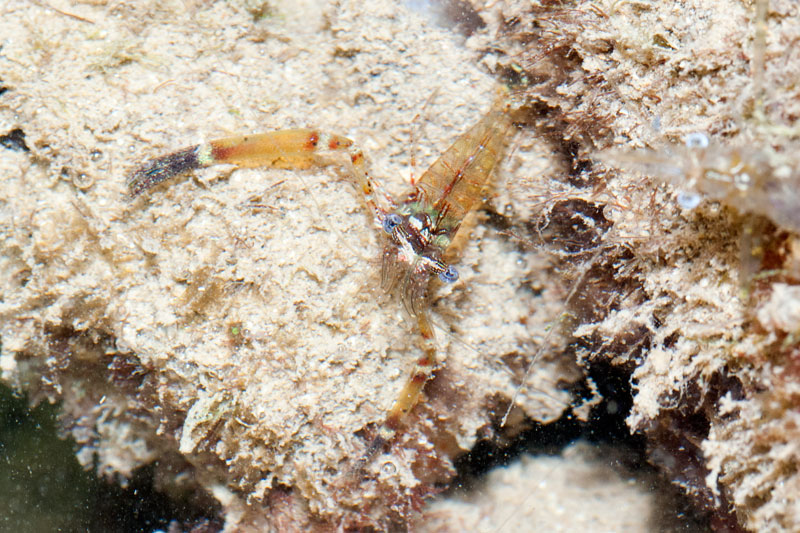
While on the sand, I spotted this unusual shrimp with a small band of red just behind its eyes. However the red band is not permanent. After handling the shrimp for a while, I noticed the red band fading away. How interesting!
Unknown shrimp with interesting red band behind eyes.
Ria mentioned that the Saron shrimp can be found at the rocky area along the seawall, but I had never seen a saron shrimp myself before so I was not able to spot any during this trip. After the trip, I learnt how to look out for them.

Ria them showed me a Spotted orange hermit crab (Dardanus megistos). Unfortunately, the hermit crab got tired of emerging from its shell by the time it was shown to me. I only got an image of it hiding in its "home".
Spotted orange hermit crab
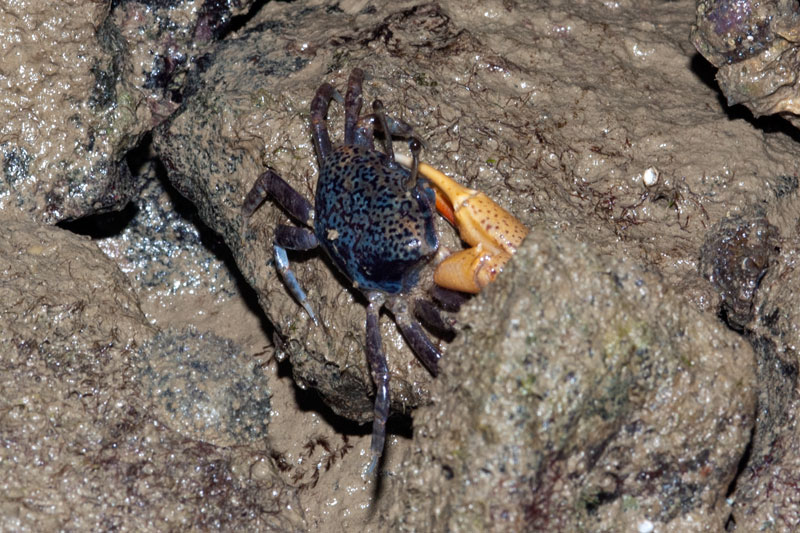
The highlight find for this trip would be a lonely Fiddler crab (Uca tetragonon) moving around the rocky area. 
Fiddler crab, front view
View of the carapace
Thanks to Ivan Kwan, who alerted Ria that the fiddler crab might be similar to the one Kok Sheng saw at Sultan Shoal Lighthouse in 2008. Could there be more of this fiddler crabs that are hidding under the rocks?

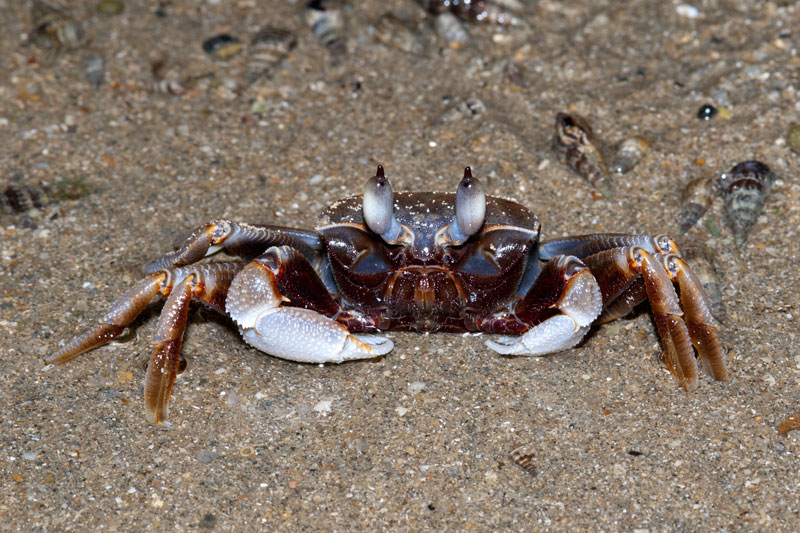
As we end the trip in darkness, the nocturnal hunting animals starts appearing. Can you guess what animal this is?
Who am I?
It is actually the Horn-eyed ghost crab (Ocypode ceratophthalmus) and they live in burrows near the high water mark. They are swift moving crabs, which gives them the name 'ghost crab'.
I am a Horn-eye ghost crab.
This may be my first survey trip at this shore but I am loving it at the animals that can be found here.
For my next trip to this shore, I shall attempt to look for Saron shrimp myself!

Post by others on this trip:

LinkWithin

Related Posts Plugin for WordPress, Blogger...