Showing posts with label RMBR. Show all posts

Tuesday, September 10, 2013

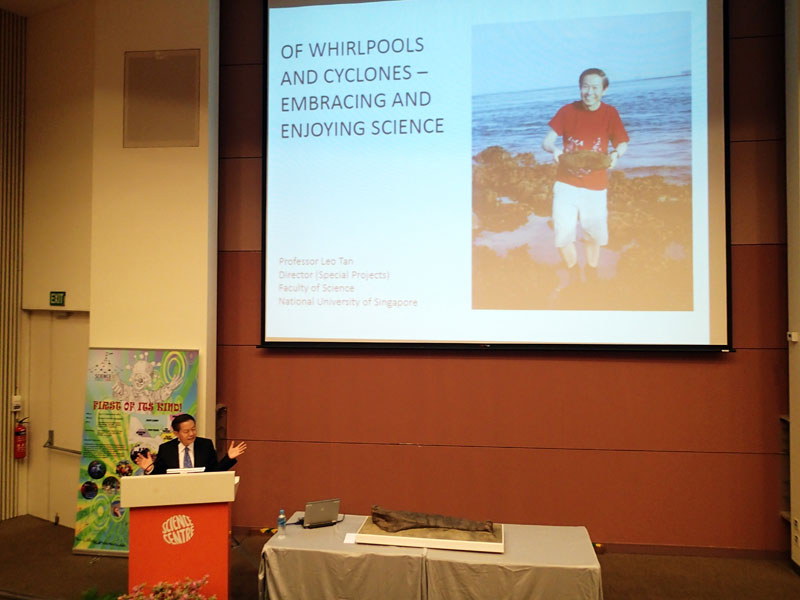
Of Whirlpools and Cyclones - Embracing and Enjoying Science by Prof Leo Tan

This morning, I attended a distinguished science lecture series organised by the Science Teachers Association of Singapore (STAS) and the Singapore Science Centre. This happened to be the first lecture series organised by STAS. The guest speaker to kick start the inaugural lecture series is Professor Leo Tan.
The first Distinguished Science Lecture Series.
Prof Leo Tan is a professor of Biological Sciences, Director of Special Projects, Faculty of Science, National University of Singapore. He is also a Fellow of the National Academy of Science, Singapore.
The topic for today's lecture is "Embracing and Enjoying Science".
"Of Whirlpools and Cyclones - Embracing and Enjoying Science"
Prof Tan shared with the audience about the many difficulties and challenges he faced in the world of science since he was an undergraduate till now and he describes them as whirlpools and cyclones.

He first talked about the meaning of science for different groups.

Then Prof Tan shared about the challenges he faced from the life of an undergraduate to PhD  at University of Singapore. Then, Prof Tan had a dream. His dream was to become a marine biologist. Marine biology was not well developed at the then University of Singapore that time and the job prospects was minimal but Prof Tan did not give up on his dream and he persevered.

When Prof Tan became a lecturer at the university, he was asked to teach topics outside of his area of study. The audience of science teachers could relate to this very well as we often face this challenge in schools. This is especially true when teaching lower secondary students as the syllabus covers the 3 sciences (Biology, Chemistry and Physics) and science teachers would have to teach at least one science out of their specialised science(s). Prof Tan did not object to these assigned lectures. He took it up as a challenge to read beyond his field and this made himself indispensable in the department.

At the same time, he lost his research site at Tanah Merah due to land reclamation for Changi Airport's second runway and all the marine animals got buried under the sand. Furthermore he witnessed the lost of many beaches around Singapore as industrialisation began and land reclamation happened in full force to expand Singapore's land area.

In this first part, Prof Tan highlighted a few lessons learnt.
  1. Be courageous, persevering and imaginative
  2. Believe in what you do 
  3. Be curious, passionate, resilient, questioning, risk taking
  4. Create value
  5. Make mistakes
  6. Rally allies
Of the points he covered, I remembered two points deeply - questioning and make mistakes. Questioning in terms of "Why", "How", "What". With continual questioning, either at yourself or others, there is a strong will to get the answer to the questions and this is how many people succeed. Though the process of obtaining the answer may be of great challenge, difficulty and may not be instantaneous, you will eventually get the answer. Asian parents like to ask their children "Have you...." or "What did you....", which does not allow children to think deeper in their reasoning or answers. Why not change to "Why does it happen this way?", "How is it possible." or even "What happens if I do it this way?"

Everyone makes mistakes and there is nothing wrong with making mistakes. Each of us grow and develop ourselves through the mistakes made. Prof Tan made a very valid point in this talk, "Make mistakes, but never make the same mistakes again. Make NEW mistakes.". It is through new mistakes that you and I realise that certain methods, procedures or technique is not acceptable or does not work in various context. And we understand from our mistakes where we have gone wrong and try to improve ourselves. It may take a very long time to reach the end point but in every tiny step is a learning experience that can benefit yourself and/or everyone around us and eventually it will lead us to the end point.

Prof Tan's first whirlpool experience happened when he was asked to lead the Singapore Science Centre. It was a whirlpool for Prof Tan as the Science Centre then was not well established and many did not recognise the value of it. The public did not think highly of learning science in a non-formal manner.
First whirlpool - Leading the Singapore Science Centre
However Prof Tan took up this challenge and viewed Science Centre as a new platform for learning and enjoying science in an unconventional way. The Omni Theatre and Planetarium was built under his leadership and activities such as science fairs, projects, camps and demonstrations were organised to create experiential learning for visitors. Prof Tan valued partnerships of public, people and private industry. I learnt that Science Centre grew in popularity as a place for learning and enjoying science not through hard selling and publicity, but through word of mouth of visitors and it is a very powerful tool.

His second whirlpool came after serving 10 years at the Science Centre and was asked to lead the National Institute of Education (NIE) where he served for 18 years. In NIE, he created new beginnings for the professional development of teachers, introduced the Bachelor's degree in Education (Science or Arts), changing mindsets of staff and paradigms of teaching/ learning among others.

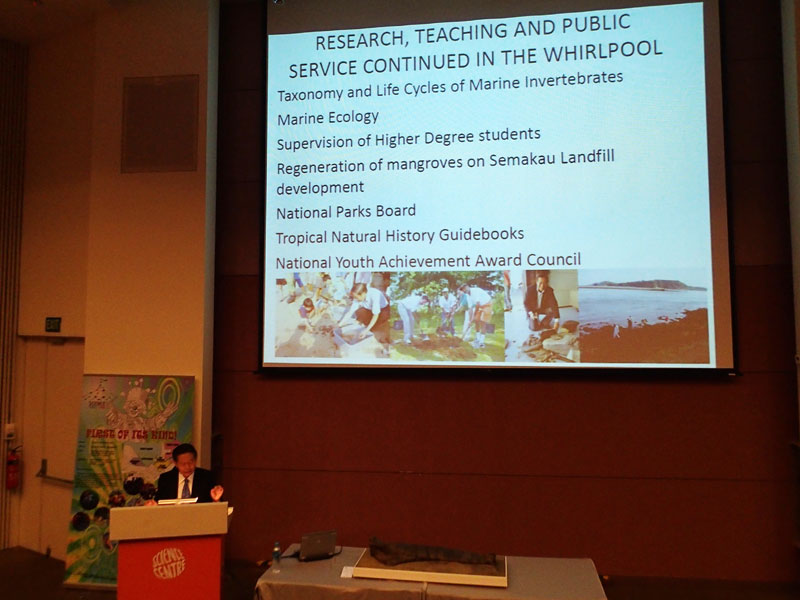
The whirlpools continued as Prof Tan was asked to serve in other organisations and handled other responsibilities or projects. I could understand that despite being thrown into whirlpools after another, Prof Tan had always believed in himself and think about the positive things he is going to achieve each day at work. He was able transform the whirlpool into his playground.

Everyone has a dream. The dream may change from time to time, or new dreams are formed when the old dreams gets fulfilled. At each part of the journey, Prof Tan had a dream. Currently, he is working on fulfilling one big dream that he had - restoring the Raffles Collection.
"I had promised myself in 1974, when I was appointed Lecturer in Zoology
at the then University of Singapore, that one day the Raffles Collection
would regain its rightful place in Singapore's heritage, culture and education.
I am happy I could, with the help of fellow Singaporeans, deliver on the promise."
He then shared the history of Raffles Museum of Biodiversity Research (RMBR) since it was established in 1823. There was a period of time from 1972 to 1988 where Raffles Museum was "Homeless".
Journey of RMBR
The current location of RMBR at the Faculty of Science, NUS is getting too small for its growing population of specimen collections. Furthermore the public gallery could only display a tiny fraction of the museum's collections. With the new Lee Kong Chian Natural History Museum in construction, the museum's collections will be housed in a larger building where more specimens can be displayed for public viewing, including three dinosaurs which Prof Tan and his team fought very hard to raise money to purchase them.

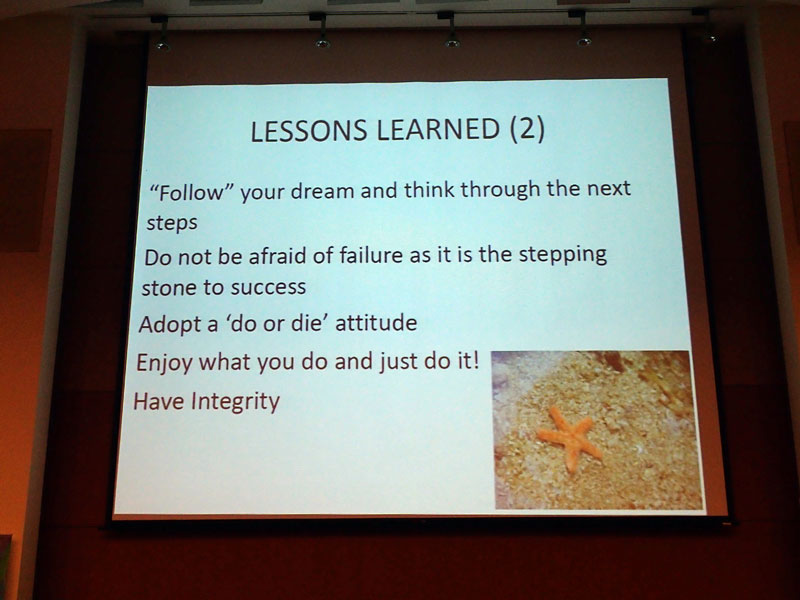
So, part two of lessons learnt:

  1. "Follow" your dream and think through the next steps
  2. Do not be afraid of failures as it is the stepping stone to success
  3. Adopt a 'do or die' attitude
  4. Enjoy what you do and just do it!
  5. Have integrity
Towards the end of the talk, Prof Tan gave some "advice" to his audience of science teachers:

  • Ignore the standard texts
  • Read journals, prints and online media
  • Discuss the issues
  • Learn by doing (experiential learning)
  • Undertake projects, summer programmes, field work, internships, etc
  • Share stories
  • Ensure your students reflect and think
I think I need to work harder on some areas. In December last year, I did a Teacher's Work Attachment with RMBR and you read about it here. I must say that it takes great effort to excite students close to the same level as you have about doing something, but it is not impossible. There will be students who will never show the slightest interest in your very passionate sharing with the class. They are not in the same interest frequency as you are. This year I tried exposing my class to Singapore's marine biodiversity through verbal sharing and videos. I just have to talk about the interesting parts/ facts or observations and I would say that majority of them enjoyed it. Some may have be inspired by the sharing I did in class.

On the parting note, Prof Tan commented to the audience, "I have a new dream... I hope you have one too!"

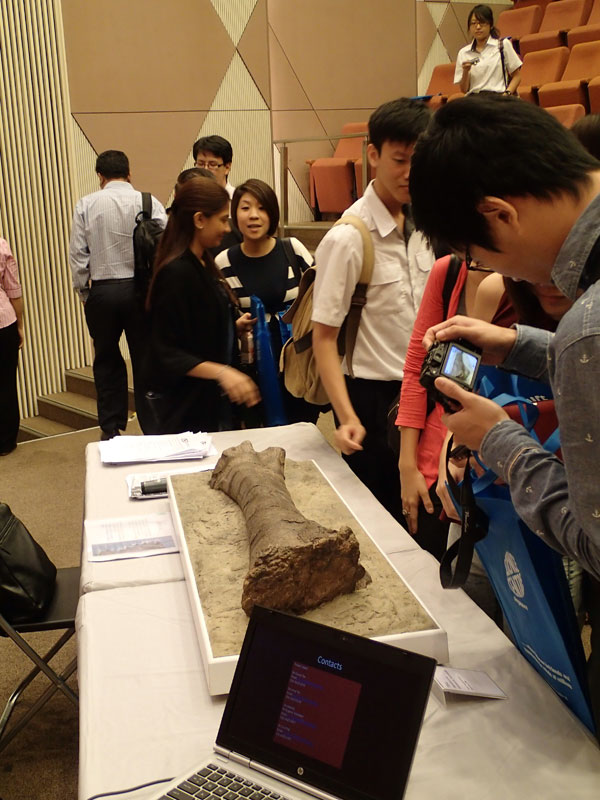
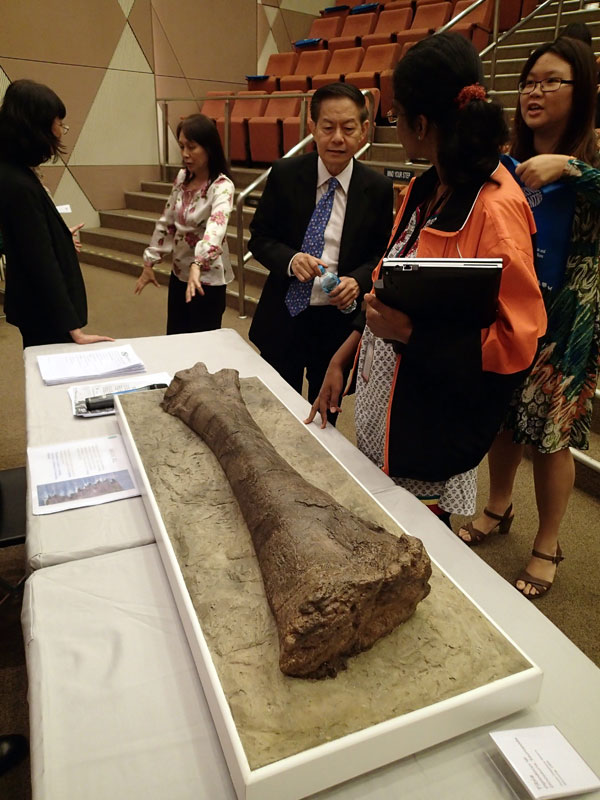
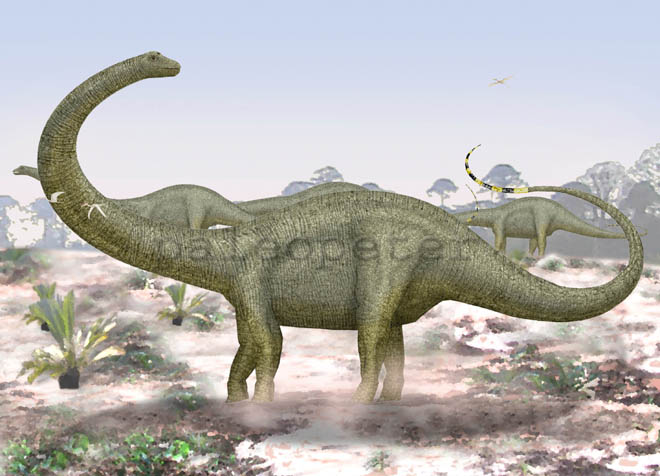
At the end of the talk, everyone is welcomed to feel and take photo of the dinosaur bone on display. The bone on display is a Tibia bone of Diplodocus sp. (Dinosauria, Sauropoda) from Howe-Stephens Quarry, Wyoming, 1994. It is a 160 million years old bone, much older than the one I helped to assemble in the museum's public gallery (65 million years).
Having a feel of the bone
Taking photos of the bone
Scale of the tibia bone
This is probably how the dinosaur looked like.
Illustration of Diplodocus sp.
It was a very inspiring talk by Prof Leo Tan.

Actually, I did not know about this talk until  Dr Tan Swee Hee from RMBR emailed to inform me about this talk by Prof Leo Tan. I was not a member of STAS so I did not receive information about their Distinguished Science Lecture Series. After the talk, I found out that there was a reason to why Swee Hee informed me about the talk - they had a photo of me speaking to the President at the recent Festival of Biodiversity in one of the slides.

Unfortunately, I did not have a photo of that slide but the image used was something similar to this.
Speaking to the President during the recent Festival of Biodiversity 2013.
As I am typing this post, his comment sets me thinking... What is my dream?
I do have one in my mind now and this dream was set after my work attachment ended - I would like to work at the Lee Kong Chian Natural History Museum.
Whether this dream will come true or not is not a big deal. Remember, THINK POSITIVE!
Of course, I have other dreams and they are kept somewhere in my mind. Some dreams may have been lost, some require deeper retrieval and some may need some modifications.

What is your dream?

Monday, December 31, 2012

My work attachment at RMBR

While my colleagues are already enjoying their long deserved holidays, I set aside two weeks of my holidays for a MOE Teacher's Work Attachment programme. I have chosen the Raffles Museum of Biodiversity Research (RMBR) for my work attachment programme.

My work attachment period was 3 - 14 December 2012.
I chose RMBR as it was one of the places which I was interested to find out how specimens, after collected from sites, are processed, preserved, document and kept in a biodiversity museum. Furthermore, the work description posted for this organisation allows me to work with the available specimens to create educational materials.

However the museum's gallery was closing soon in view of the big house moving to the new Lee Kong Chian Natural History Museum, set for completion in 2014. There was not much of a need to create educational materials at the moment.

I spent my two weeks of work attachment in the wet collections section of the museum, helping out Siong Kiat, the wet collections' curator. Wet collections refers to specimens (mostly marine animals) that requires storing in preservation liquids such as ethanol and formalin (formaldehyde). Majority of the specimens I worked with are stored in 75% ethanol.

Here's the blog post from RMBR about my work attachment stint with them.
Image capture of the blog post.
Apart from the days of working in the wet collections research room, I got a chance to help change the dinosaur bones in the public gallery. Here I am with the leg bones of the triceratops, after changing and ready for viewing.
Triceratops' leg bones
The biggest takeaway from this work attachment is understanding better the importance of the type specimen. A simple way to explain type specimen can be found from the Smithsonian National Museum of Natural History:

In taxonomy, the science of identifying, naming, and classifying species, the primary type specimen (or sometimes a series of specimens) serves as the scientific name-bearing representative for any animal or plant species. A secondary type specimen is a specimen of the type series other than a primary type. A primary type is the objective standard of reference for the identification and naming of species.
Type specimens are important to scientists that study the classification of organisms and to all studies of comparative biology.

In any natural history museum, the value of the museum is actually determined by the number of type specimens it has, not the number of valuable exhibits. The number of type specimens tell other scientists how active the museum is in scientific research.

There are a few kinds of type specimen: Syntypes, Lectotype, Paralectotype, Holotype, Paratype, Hapantotype, Neotype and Allotype. More information about each kind of the type specimen can be found on the International Commission on Zoological Nomenclature.

Is it boring doing very similar things each day at the museum?
Nope, I was able to look and examine in closer details the specimens collected from various sites, which most of them I have been to.

Was it enjoyable doing working at the museum?
Sure it was, I had a lot of fun in the museum.

Would you like to do it again if there was such opportunity?
Yes. And if I have the time, I won't mind volunteering.

Saturday, May 19, 2012

Raffles Museum of Biodiversity open house 2012

It's the day!
Today is the Raffles Museum of Biodiversity open house 2012.
Today's open house is one of the many programs from the National Heritage Board's Children Season 2012, a series of various museum programs for children to enjoy the fun of visiting the museum.

I reached the museum as early as 09:15 and a small quiet crowd was already going through their public gallery guided walk. I went to register for my 10:00 behind-the-scene guided walk. It was a slow long wait.
Nearing 10:00, the crowded started to arrive slowly. The level 3 lift lobby was starting to get crowded. So was the corridor leading to the museum as the various activity booths were being setup (masking making, face painting and mini excavation).
The participants gathered around the RMBR volunteer holding the signage to "Behind-the-scene".
One of the children participants bought the book "Private Lives: An Expose of Singapore's Mangroves" and he was so eager to read about it.

Shortly past 10:00, the group was lead to through a door in the museum and we entered the specimen collection area.


Behind-the-scene guided tour (10 pm)
This tour brings participants to a special area of the RMBR that is out of bounds to public on normal museum opening hours. This place houses the rest of the speciemens not in display in the museum.
The first station is the dry specimen on birds. The volunteer told us that the birds are preserved with only their skin and feathers. They have to carefully slice a opening along the bird's breast. The muscle must not be cut so as to prevent any bleeding. She then showed us how the bird is kept in "kachang-puteh" wrappers (newspaper rolled up to a cone) when doing fieldwork.

The group also took a look at the dinosaur bones at are kept in this room.
Dinosaur bones
Triceratops sp. (Left leg only)
The second station brings us down the narrow and steep staircase into the insect room.

Here we see the butterflies, beattles, bees and many other insects.
Insects station
Children are great participants as they are very observant and they ask all sorts of questions. They also like to tell and share with everyone what they know.
A child sharing some comments.
I learnt that the wing tip of the Atlas Moth has a pattern that looks like the head of a snake.
Atlas Moth speciemen
Wing tip of the Atlas Moth
Next is the molluscs station where we saw a few specimens collected from Semakau. The station guide told us that the scallops meat we eat are mostly fan clams. We usually eat the muscles of clams but actually the other parts in the clam can be eaten too.
Molluscs specimens on display
Then we went back up the same steep, narrow staircase to visit the mannmoth collection where we saw the tiger skin, the skull of tapir, the plantain squirrel, smooth coated otter and the palm civet cat.

Our final stop is the specimen conservation and restoration station. Kate was at the station restoring a turtle specimen. She pointed out that she found very old newspaper when restoring the turtle on the right. Restoration of the specimens are important to remove rusting wires, conduct patch works, colour restoration and cleaning the interior of the dry specimen. This job requires many disciplines such as biology, art, dentistry, sculpturing as the restorer has to replace the missing parts and perform touch ups to the specimens.
Explaining using a completed turtle
Kate showing the shell of the turtle she is working at.
Left: Complete turtle
Right: Turtle in progress
The newspaper used to stuff the complete turtle.
With that, we end our guided tour in 1 hour.

After that, I went to the registration booth to find that there are spaces for the crabs workshop at 12:00 and so I signed up for it.
Along the corridor leading to the museum, the on-going whole day activities are already in action:
Masquerade station
Face painting station
Excavation station
All About Crabs workshop (12 pm)
The crab workshop was held in a cosy small room located somewhere behind the museum.
On the table, there are live and dead displays of crustacean specimen.
The first organism that caught me was the coconut crab from Chirstmas Island. It is a very fierce crab and its pincers are capable of snapping finger bones.
Coconut crab
There was also the vampire crabs on display. The crab is known as vampire crab because of its red eyes.
Vampire crab
At the crab workshop, we learnt how to identify the gender of crabs, the survival of baby crabs and we were introduced to some of the common crabs, prawns and shrimps.
Packed room for the crab workshop with many specimens on display.
Packed till right beside the speaker
Specimens were being passed around to allow the participants a better view.
Pass the crayfish to guess the gender without seeing the underside
This is (male/female)...
Some participant was very attentive and taking down notes. That's a very curious child.
Busy jotting down notes
The workshop ended with children activity. The children were tasked to draw an image of a crab. They can look through the microscope to look at the details to help them in their drawing or they can draw by simple observations. The children can name their own crab drawing and they get a magnet in return for their effort.
Parents helping their children with the microscope work
Crab drawing by observation
Crab drawing by studying the parts using a microscope
Crab drawing by creativity
At 15:00, it was time for the animal pottery workshop!

Animal pottery (3 pm)
At the animal pottery, it was full of children. I was the only big children there (daddies and mummies not counted). One of the volunteers told me that someone wants her to say "Hi" to me but she forgot the person's name. I was in the animal pottery room early as most of the the participants were out at other workshops or tours. So the volunteers and I admired Chay Hoon's cute looking models made from jumping clay. Chay Hoon sure has good crafting hands. They look so cute!
Mini friendly T-Rex 
 Sea star
Big tummy friendly T-Rex
There were dinosaur samples placed on the working tables as a reference.
Dino sample
As the theme for this year's open house in on dinosaurs, the workshop did pottery on dinosaurs.
Our first dinosaur was the sauropodS. Sauropods have long necks and tails. They are herbivores.
The kids really had fun kneading, pulling and shaping the clay, and then finally putting the eyes up.
Chay Hoon guiding the participants on the pottery
Everyone busy modelling their dinosaur
Chay Hoon assisting in some touch ups
Adding the eyes
The second dinosaur my table did was the tyrannosaurus Rex (T-Rex). It was a difficult process to make my T-Rex look like a T-Rex. Mine turned out looking like Elmo, as what one of the mummies told me. I joking told the children at my table not to put the T-Rex with the sauropod together in the box as the sauropod will disappear by the time they get home. Well, the children were too busy with their clay to understand the joke. At least Chay Hoon and the volunteers understood my joke.
We had a lot of fun at the animal pottery workshop. The starting step in all animal pottery is always the same.
Looking my animal pottery, my end products faired no where near the expert.
My sauropod, T-Rex and sea star.
The children started playing with their dinosaurs.
March of the dinosaurs
Soon the workshop came to an end and I found the sample dinosaurs on the table ended up in a staring game.
2 party staring game
An audience joined in and got itself dazed
The public gallery
The public museum was a cooling place for me to enter once in a while to avoid the scorching heat. Thankfully there were big fans placed around the corridor areas. The museum was buzzing with activities as the public enters for visits, guided walk or merchandise purchases. I bought many items from the merchandise booth.

In the museum, they have put up a dinosaur exhibition and part of Twinky's leg was on display. Look at the size of the legs versus the man.
Part of Twinky's leg
Skull cast of 'Apollo'
The dinosaur exhibit section
This will be RMBR's last open house. They had wanted to do more open house sessions but time wasn't on their side.

The public gallery of the Raffles Museum of Biodiversity Research will remain open till April 2013. However  the stored collection will be closed for inventory taking, packing and settling outstanding matters in preparation for the house moving to the Lee Kong Chian Natural History Museum, scheduled to be completed in 2014. The new natural history museum will showcase 10 times more exhibits than what we see in the current RMBR.

I look forward to the new natural history museum in 2014.

LinkWithin

Related Posts Plugin for WordPress, Blogger...