Saturday, August 18, 2012

My first visit to Lazarus Rocky Shore

First trip to Lazarus in the early morning at 5 am. It was total darkness.
The team split up into 2. Ivan and Kok Sheng went off to explore a 1km long artifical lagoon while the rest of the team headed out to the rocky shore on Lazarus side.

While crawling and/or sliding down the rock wall, we were greeted by the land hermit crabs.
Land hermit crab
This rocky shore is really rocky. We had free foot reflexology from nature.

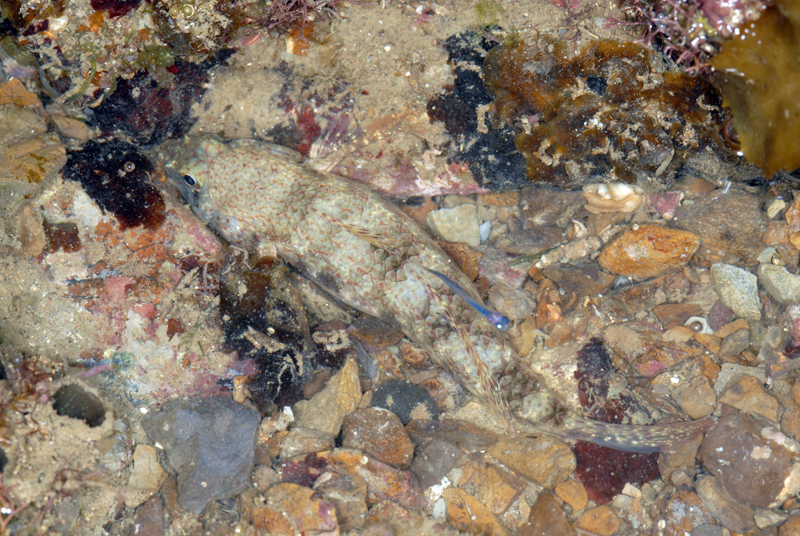
In the numerous shallow pools I saw near the low water mark, there were shrimps and gobies.
Shrimp
Goby
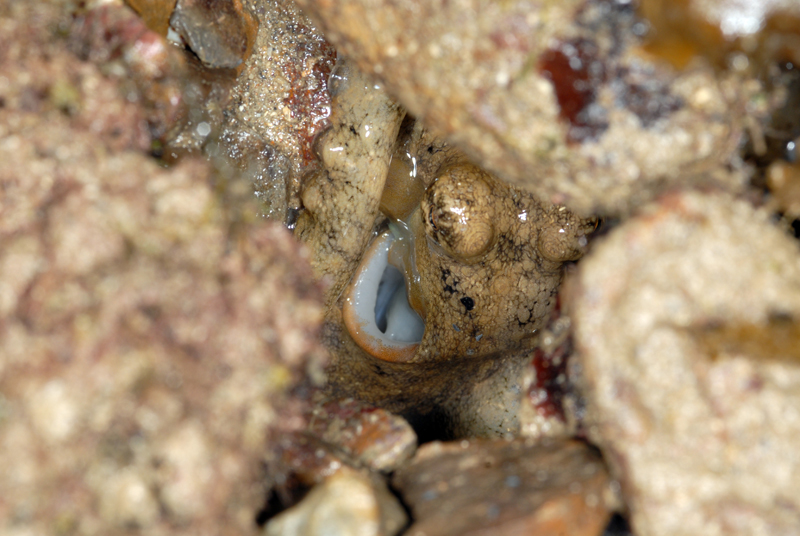
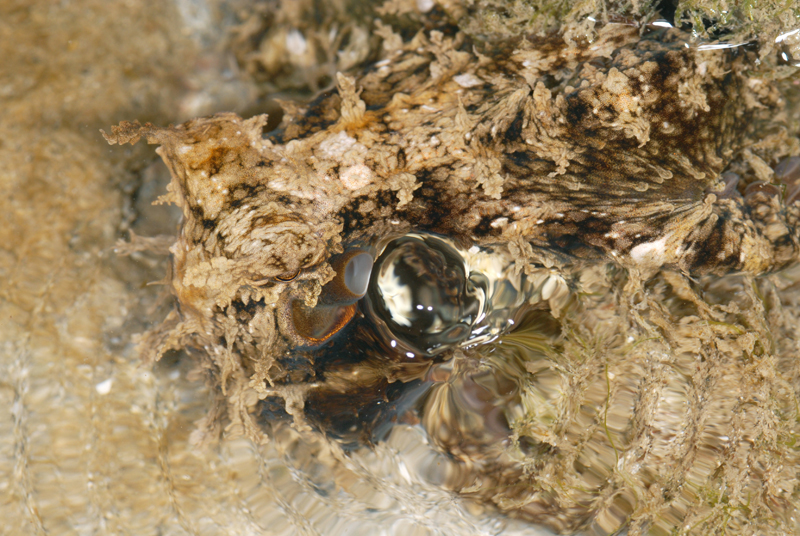
My first slug finding would be this onch slug (Family Onchidiidae). In fact, the onch slugs can be commonly seen on this shore. This is my first time seeing the eyes of the onch slug from my photo. I did not turn over the onch slugs I saw to check for identification.
Onch slug
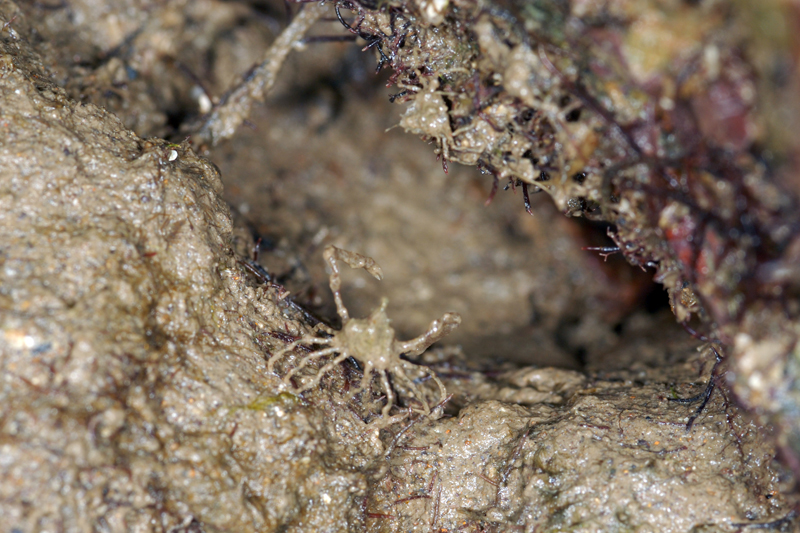
Thanks to this onch slug, I saw an arrow-head spider crab (Menatheius sp.). It was really tiny. Actually there was two and I only saw the other when I collected the first spider crab. I also confirmed that there were two spider crabs at the same location when I edited my photos. See if you can spot the two crabs.
Arrow-head spider crab
Also plenty on the shore are sea slaters (Ligia sp.).
Sea slater, top view
Sea slater, front view
While taking pictures of the sea slaters, a fly stopped by to clean itself. What a place to clean.
Fly
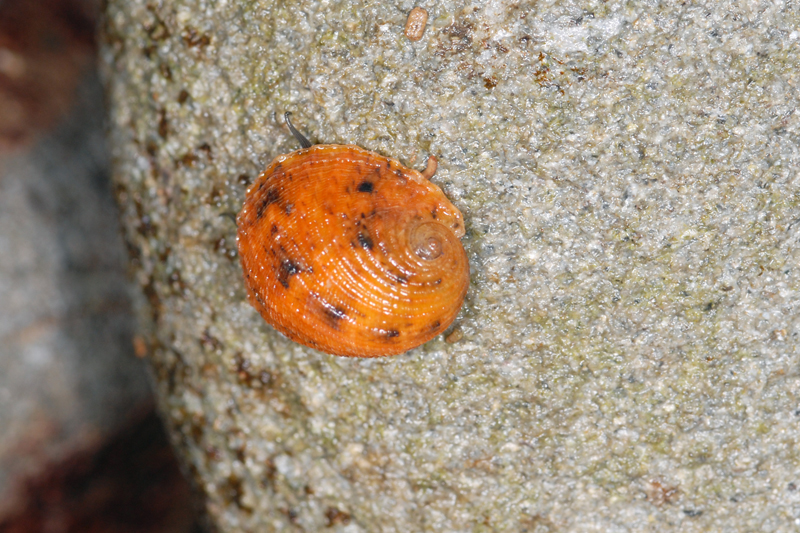
There were many types of snails seem on the shore. However I only took pictures of the nerite snails (Family Neritidae). We also saw congregations of different snails at various spots. Not sure what they are doing.
Different snails gathering
Nerite snail, front view
Nerite snail, underside view
Nerite snail with orange shell
Mating nerite snails?
Nerite snail, moving.
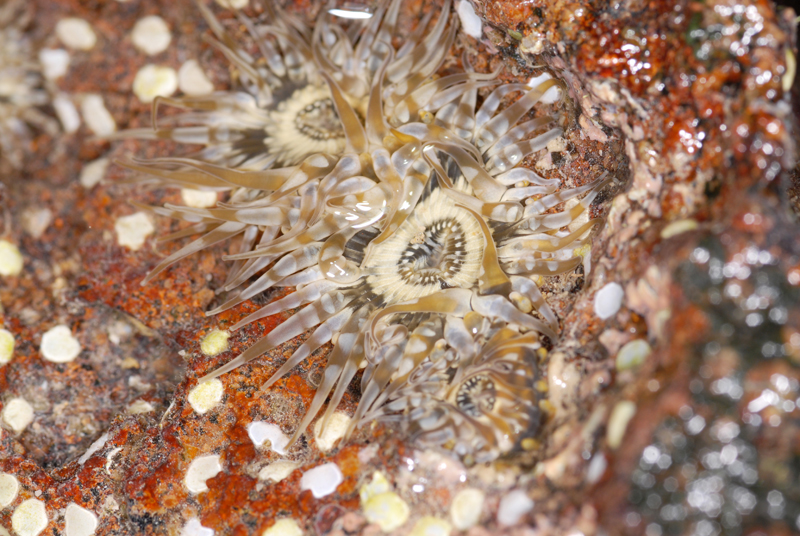
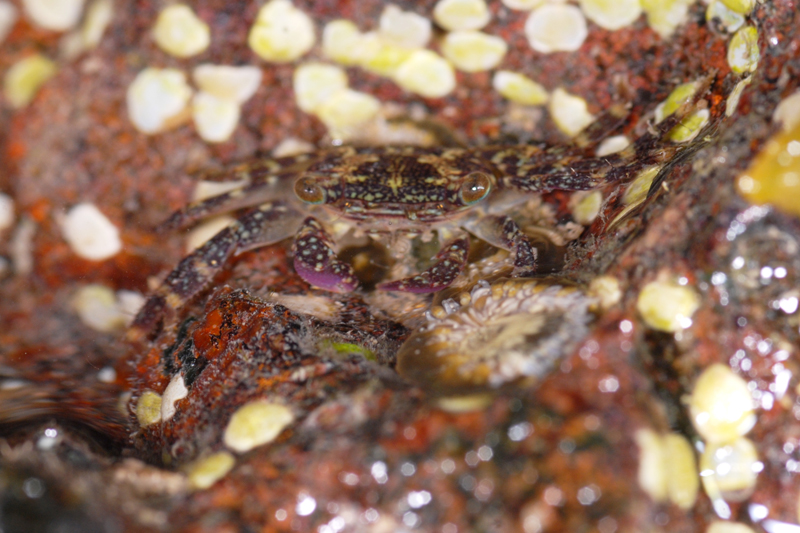
Andy found a boulder with many pools of trapped sea water. These pools contain many life when we took a closer look at each of them. Many of the pools were covered with little white dots. They are eggs of the nerite snails. We also found many tiny anemones in these little pools.
Anemone with nerite snail eggs.
More anemones
Tiny purple climber crab feeding in one of the pools.
Some crevices on boulders provided a hiding place for the marine spiders (Desis martensi). I observed that they have a cover above them, which closes when the spider retracts. You can roughly guess the entrance structure from this image.
Marine spider
Octopus never failed to miss my eyes. I see them on almost all shore trips. In today's trip, I saw two octopus. The first octopus was of a medium-large size while the second octopus was of medium size. I only managed to take pictures of the first octopus (will explain why later).
Fat tentacles of the octopus. I thought it was stranded.
Octopus frantically spurting water.
I saw a few fish, some of which I could not identify. There were a lot of tropical silverside (Atherinomorus duodecimalis) swimming on the water surface and it gave a electric blue reflection when our torchlights shine on them. It was not easy to take pictures of them as they are constantly darting around, but I happened to capture one of them.
Rather large fish. A tropical silverside nearing the tail of the fish.
This fish seems confortable on very shallow water with constant waves flowing in and out.
Brown sweetlip (Plectorhinchus gibbosus)?
Around this point onwards, my two little Nikon SB-R200 speedlights decided to go on early Hari Raya holiday as the batteries were low in energy. Time for me to keep my camera set and focus on looking at things. No flash means no light to shoot the subject in darkness. My torchlight does not provide enough light to light up the animal properly.

The highlight of today's trip would be two special findings.
Finding 1
A large chiton (Class Polyplacophora). This is my first time seeing a chiton and it has to be so large. Most chitons found on our shores are tiny ones.
Possibly Acanthopleura gemmata.
We found this chiton on the boulder that Andy showed us. I noticed this patch with plate-like scales and suspected that it could be a chiton. Jose came and told us it should be a chiton. Now comes the tricky part. Chitons wedge themselves tightly onto the surface and it is very difficult to remove them.

We had no tools with us, but I remembered that I had my swiss knife with me. Tada!
So three people standing at the boulder, trying to pry a chiton off. Andy took over the job as I had my complicated camera setup hanging in front of me. Using the blunt side of a knife, Andy find a lose side to insert it into and gently lift the knife up (like how people open oysters). He had to work around the chiton to loosen the suction of the chiton. Jose holds a container below it, waiting for the chiton to drop in. I supplied light for the work to be carried out.

Finding 2
I noticed a greenish object with interesting blue lining on the heavily coated with silt surfaces. On close look, it was moving. At first I thought it was some kind of anemone.
Mysterious critter
I used a smaller knife blade, scrape it off the surface and put it in a small container. Then I filled it with some sea water. The sea water washed off the silt and the animal was in a ball shape. Still could not identify it so I left it in my plastic bag. When we all gathered to sort our collections, I noticed that this animal is actually a slug. Ria took a photo of it when she was processing it at home.
The actual look of the mysterious animal.
[Photo by Ria]
On my facebook, Chay Hoon commented at this is actually the emerald stiliger slug (Stiliger smaragdinus). Thank you Chay Hoon for the identification.

A quick google on this slug tells me that this slug feeds on sea grapes (Caulerpa racemosa) and it retains the colour pigments in the digestive system. That explains for the green in this slug.

This part of the shore on Lazarus Island is really rocky and there is a lot of silt being deposited. The built up of silt causes the surface to be slippery and muddy to walk on. The free foot reflexology was really good and my feet were very tired when we got back to the rock wall for the climb.

There are two ways to get to Lazarus Island. The first method would be taking the ferry service to St. John's Island and walk over using the island link. The second method would be to alight at the Seringat-Kias pontoon by private ferry charter.

Ria explained to us that Seringat-Kias used to be two separate submerged reefs (Seringat and Kias). Reclamation of these two reefs provided an extension of Lazarus on the western side with a C-shaped 1km artificial lagoon which Ivan and Kok Sheng explored.


It's the last season of shore trips before everyone takes a break and some of us gets busy with other work. Tomorrow, we are going to Cyrene reef.

Posts by others on this trip:
Ria - Special finds on Lazarus Island
Kok Sheng - Exploring a new stretch of Seringat-Kias

Saturday, August 11, 2012

Singapore Got Wildlife, Meh?

This is a great video to show your students or anyone about Singapore's wildlife, done by David Tan, Jocelyne Sze and Eunice Soh.


A community project based on the contributions of Singapore's naturalist community, this documentary explores a simple question that Singaporeans often ask - "Singapore got wildlife, meh?" and sheds some light on the amazing animals found in Singapore, from the elusive common palm civet to the elegant blue-spotted fantail ray.This is also Singapore's first ever crowd-sourced nature documentary, bringing together the photos and video footage volunteered by nature enthusiasts from all over Singapore to tell the story of Singapore's surprisingly rich natural heritage.

Singapore got wildlife meh?
YES! DEFINITELY!

The Naked Hermit Crabs celebrates Singapore National Day at Chek Jawa

It was a great long weekend, from Thursday till Sunday for all government schools (that includes the teachers). Why?
It is Singapore's 47th Birthday on Thursday, 9 August.
On this National Day weekend, the guided from the Naked Hermit Crabs are delighted to celebrate Singapore's birthday with visitors, local and foreign, the wonders of Chek Jawa through the free monthly public guided walk.

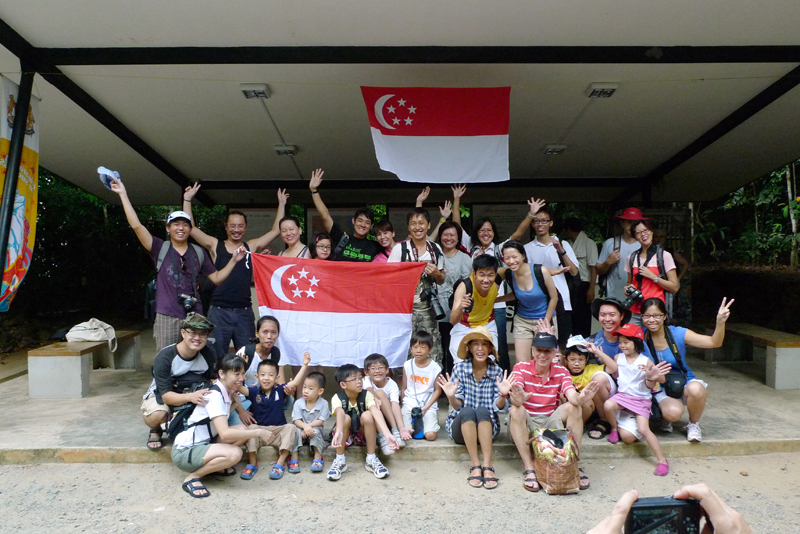
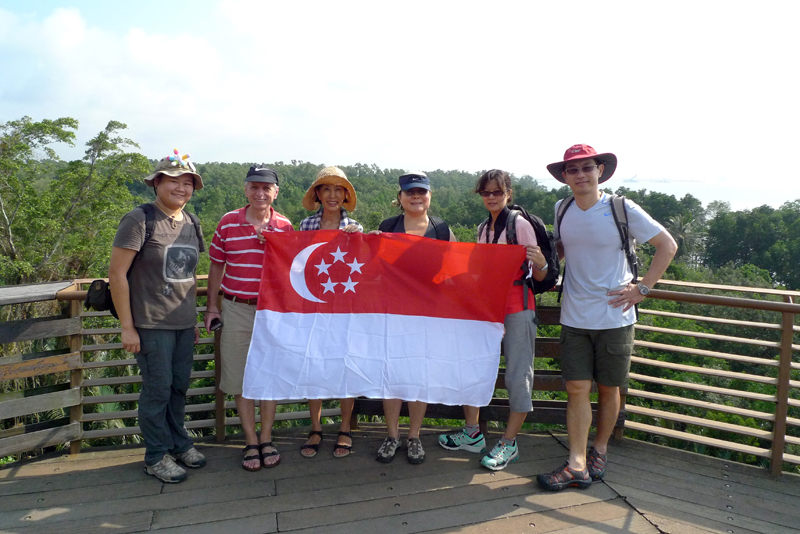
Of course, we have a group photo of the visitors with the national flag of Singapore.
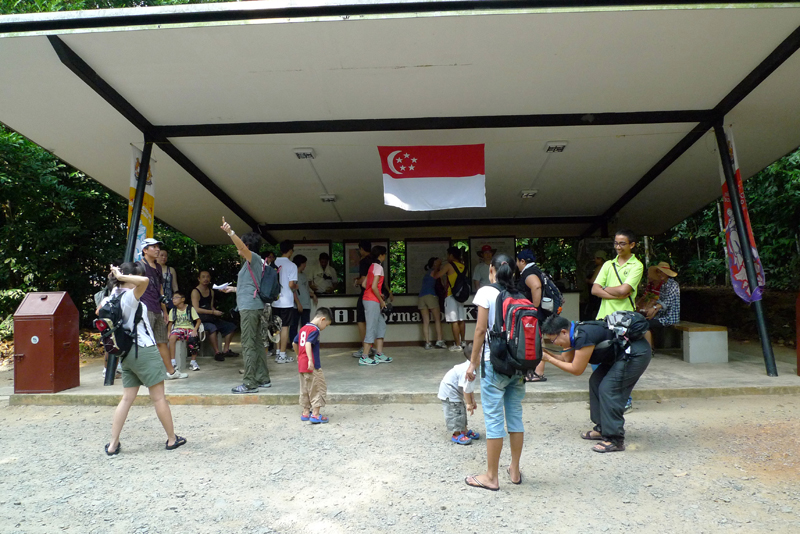
Even the information kiosk for visitors at Chek Jawa has the flag hanging up proudly.
Flag at the information kiosk
Once we alighted at the entrance of Chek Jawa, we were attracted to the rubber tree with a container full of harden latex. Looks like someone has drop by in the early morning to tap this tree.
An example to show rubber tapping at the entrance to Chek Jawa
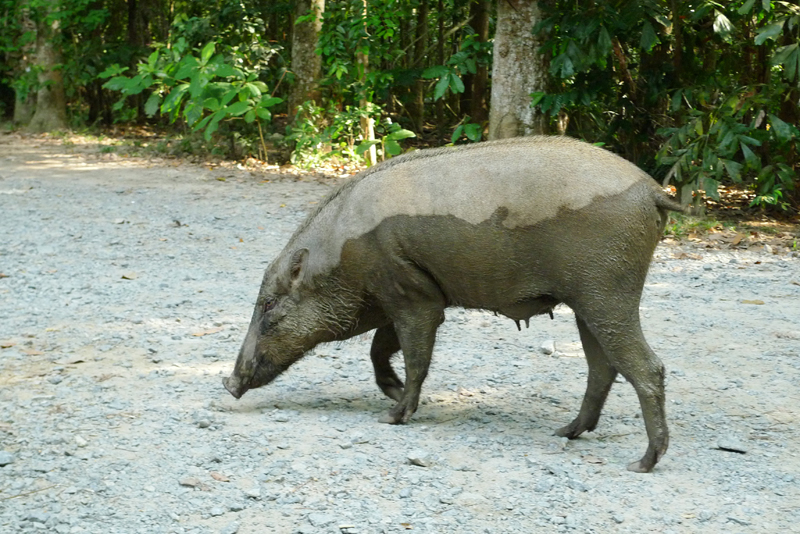
Soon after the group of wild boars came out from Chek Jawa's entrance. It seems that they went for some mud bath as the lower half of their body is wet and rather muddy.
Wet markings on the lower half of the body
It is interesting to see how well coordinated they were with out speech. Ria as just asking where the piglets are and then, poof, one piglet walked out some distance after we saw the first pig. Then more piglets streamed out of the forested area on the left of the gate. It was quite funny. 

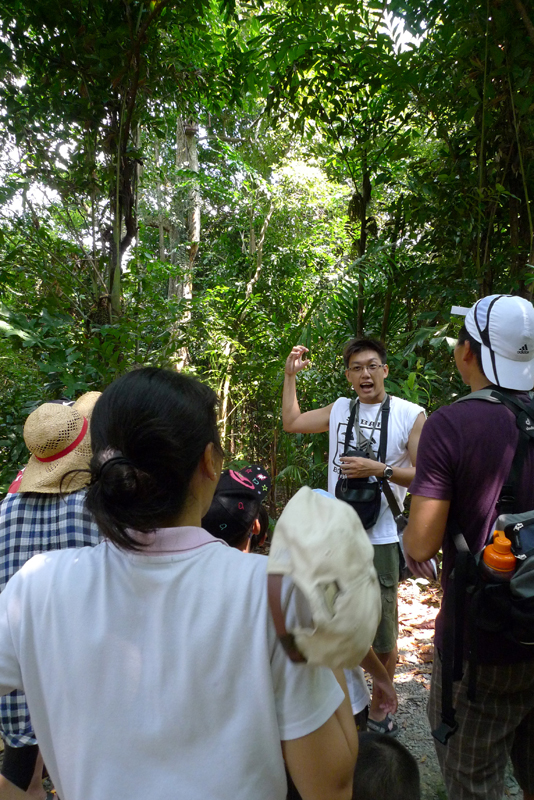
We have about 30 visitors (adult and children) today with 6 guides. I had the opportunity of guiding a group of 5 but shortly after the Jejawi Tower, I only had 2 visitors left. Luckily we had a group at the top of the Jejawi Tower.
My group and I.
It was a nice guiding session and I shared my knowledge with the couple from Switzerland. I found out from them that they have been residing in Singapore since March due to work commitments and they find that there are lots of things to do in Singapore. Hope they continue to explore more natural parts of Singapore.

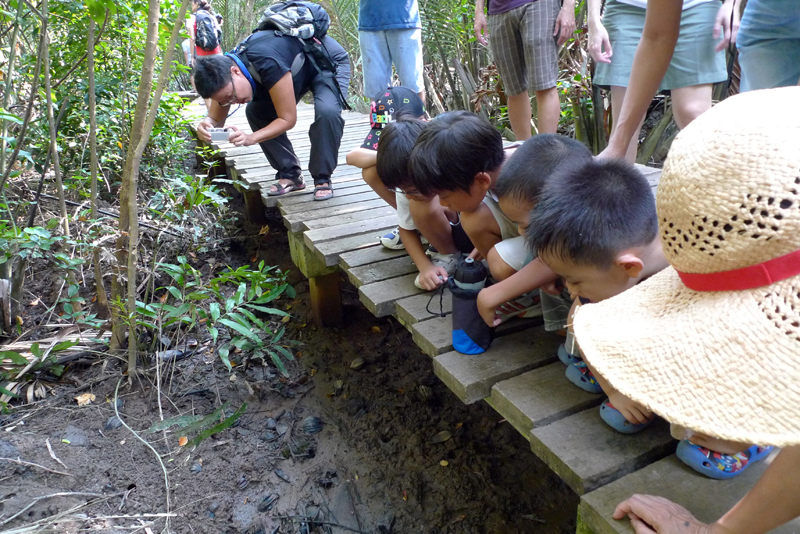
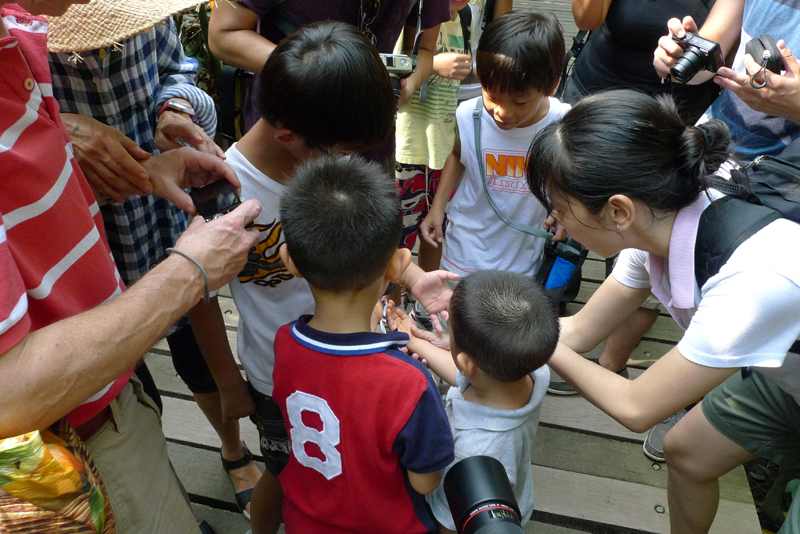
Along the boardwalk, we had great help from the children in spotting animals in the mangrove habitat. They are always excited about any animals they can find despite the numerous times they have seen them.
Children are the best spotters.
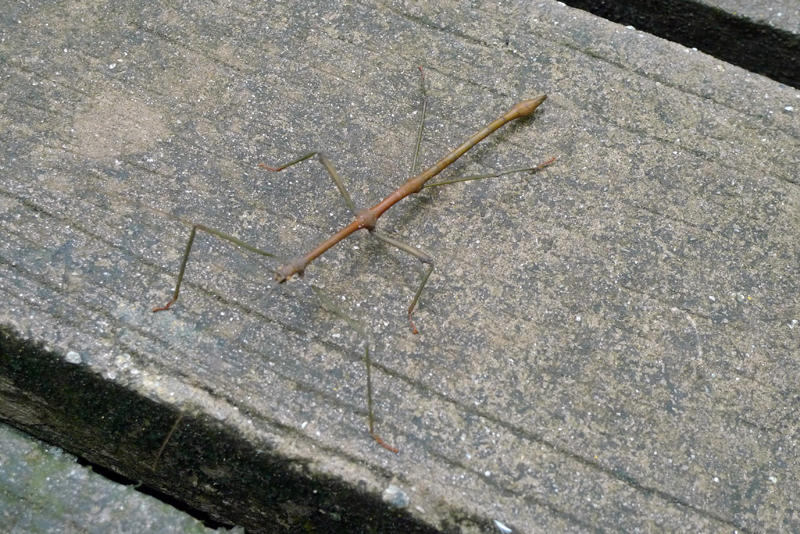
Then I came across a stick insect on the boardwalk. It had probably fallen off from one of the plants nearby. They children got very excited about the stick insect. I would consider this as the special finding for today.
The stick insect on the boardwalk.
The children are so eager to have a feel of the stick insect.
On the mangrove, I spotted a small male mangrove dwarf dragonfly (Raphismia bispina). This dragonfly is classified as uncommon and I have not been seeing them for a very long time. During the last guided walk, Chay Hoon found a female species for me. So I am very heartened to see that they are back in Chek Jawa. (My camera is unable to zoom in close to the dragonfly.)
Male mangrove dwarf
As we reach the coastal side of the boardwalk, we met Marcus and his team conducting the site recee for the upcoming International Coastal Cleanup Singapore (ICCS). Ria took the opportunity to get Marcus to explain to our visitors what the ICCS is about while the guides take a short break.
Marcus sharing about ICCS to our visitors
On the coastal boardwalk, the sun cast shadows on the sand.
My swiss visitors on the right.
Over at the hornbill station, Ivan shared about the oriental pied hornbills (Anthracoceros albirostris) to our visitors and how the nesting boxes helped to encourage reproduction, providing useful information for researchers.
Ivan talking about the hornbills
As usual all visitors are invited to create a guestbook page for us at House No. 1. I was too tired from the heat to take pictures.

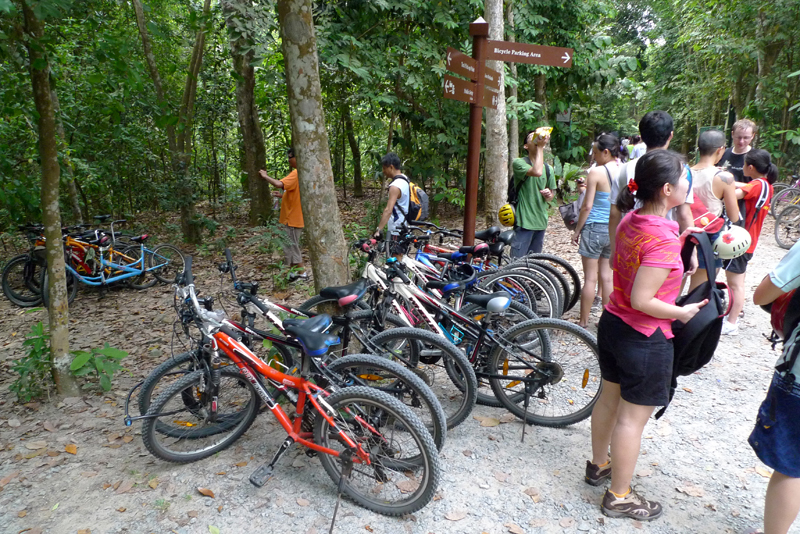
While leaving Chek Jawa, we noticed that there is a hugh number of cyclists today. The bicycle parking lots could not accomodate all the bicycles and visitors have improvised and placed their bicycles against trees.
Makeshift bicycle parking lots.
After a great lunch, Ivan spotted a lower jaw belonging to a wild boar tied up on a tree trunk. Great documentation for his Monday Morgue page.

It was a great day at this month's Chek Jawa guided walk though it was rather humid on the National Day Weekend.

Next weekend is the last series of morning low tide sessions. Then in September comes the ICCS on one of the Saturdays. In late October would be the expedition for the Comprehensive Marine Biodiversity Survey.

Saturday, August 4, 2012

Sharks, stingrays, cushion stars and many other critters fun at Beting Bemban Besar

After 2 weeks, it is the morning low tide sessions.
The first weekend trip in this session brings us to Beting Bemban Besar (BBB, Triple B).
So where is this Beting Bemban Besar? Let me show you the map...
Image by WildShores
From the above map, Beting Bemban Besar is located off the west side of Pulau Semakau, Singapore's landfill island. It is a submerged reef. The updated Google Map not longer has our submerged reefs labelled but we can still see the reef outlines from the satellite image.

Triple B is the largest submerged reef I have visited so far and it is my first trip here. The rest of the team have visited Triple B before and today, Ria decided that we should visit the northern end of the reef. On the boat, Ria discussed with Alex from Submit Marine where our landing point will be.
Image by Rene Ong
Landing in darkness is very tricky as we can only depend on our torchlights to tell us where and what we are stepping on. The tide was still quite high and it was about knee heigh when we landed. We couldn't even see any highest point on the reef. From the dinghy, we could see that the sargassum seaweeds (sargassum sp.) have started to bloom.

I could only wade around and trying to get further inwards in the darkness and wait for the tide to recede. The other team members had swimming cameras with them so they have already began taking pictures underwater.

My first find was a small patch of carnation coral (Pectinia sp.) with bleaching ends.
Carnation coral
More about corals later.

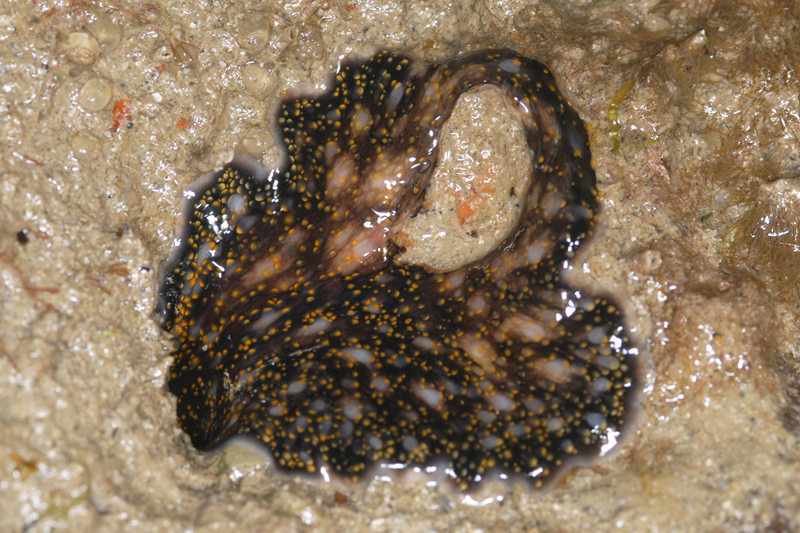
The only flatworm I saw for this trip was the spotted black flatworm (Acanthozoon sp.). It was observed to be entering a hole.
Spotted black flatworm
From the image, it seemed to have a hole on its body?
The team saw a few giant carpet anemone (Stichodactyla gigantea) and we found the false clown anemonefish (Amphiprion ocellaris) in a few of them. In fact, I saw 5 of them in this trip.
First two very shy clown anemonefish
A less shy anemonefish
I believe this is a baby anemonefish. It was quite small when I saw it appear for a while.
In the dark, the octopus are out hunting.
Octopus lying on the sand surface
Octopus blowing water
Octopus swimming away
In a shallow pool, I found a kite butterflyfish (Parachaetodon ocellatus). It was really shy and it went into hiding when I shifted position. This was the only picture I got.
Kite butterflyfish
As the first light emerges, transforming the sky from black to light blue, a flock of white bellied sea eagle flew from Pulau Sudong to Pulau Semakau. The flock consisted of adult and young eagles, calling out for each other as they flew over Triple B.
An view of the eagle flying by.
Along the way, I happened to chance upon a common sea star (Archaster typicus). It looked quite lonely moving around by itself. There could be more common sea star and perhaps they are staying put under the sand.
The common sea star
Underside of the sea star, showing the mouth.
Tube feet on its arm
As more light emerges, the sky is shown with beautiful reddish light streaks.
Light streaks revealing
There were two sponges which I documented. One of them is the 'hairy olives' sponge (Stelletta clavosa), which I call it the cactus ball, and the other is the lumpy pink sponge (Haliclona cf. baeri).
'Hairy olives' sponge
Lumpy pink sponge
The giant carpet anemones were very beautiful and I finally manage get to do a better observation of the underside. The body column has pink dots.
A fold of the giant carpet anemone, showing the underside.
Overside of the anemone, showing a part of the oral disk (in yellow).
Some parts of the reef is covered with many different types of sponges.
Other types of sponges
Then the sun revealed itself in the horizon and rises slowly. It created a beautiful sight and colour on the reef.
Sunrise
Beautiful reflection of the sunrise on the reef
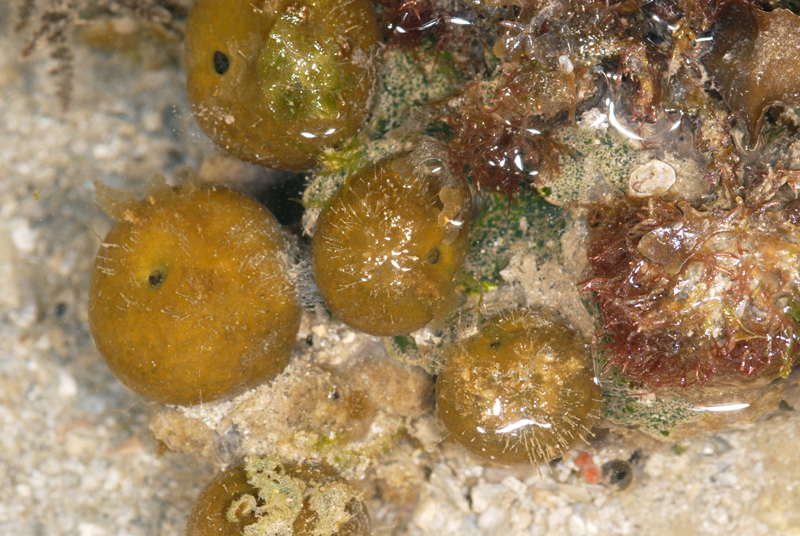
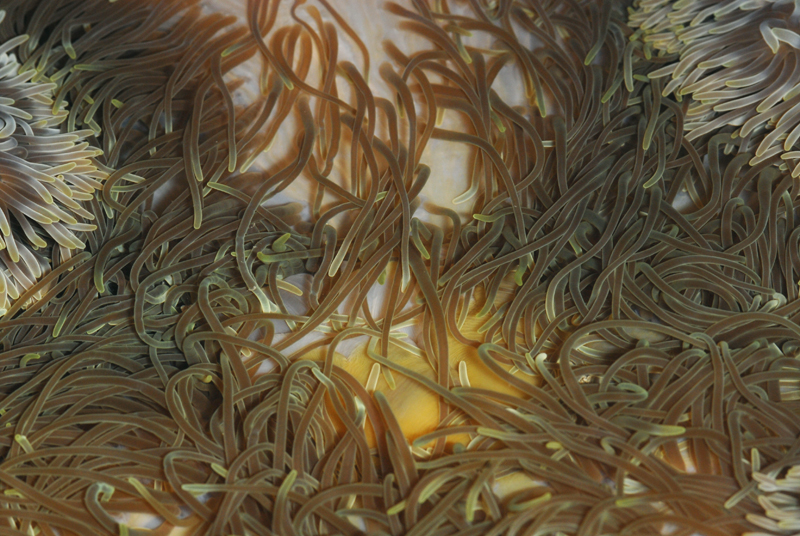
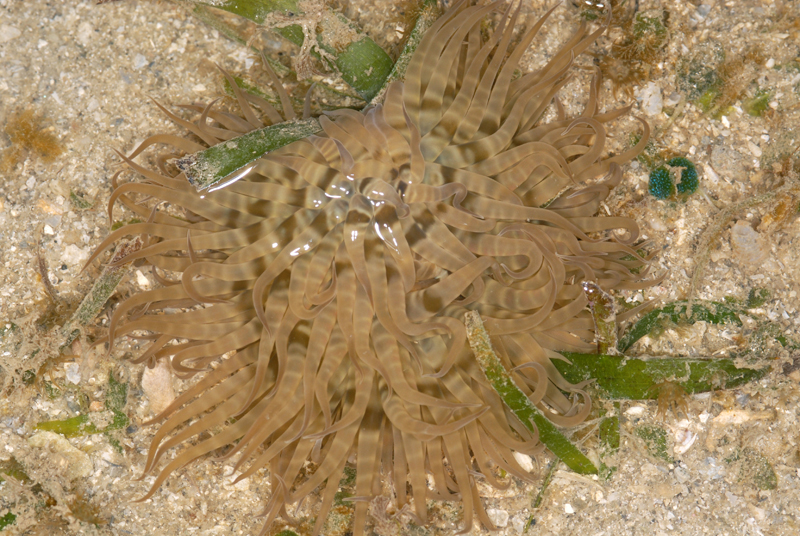
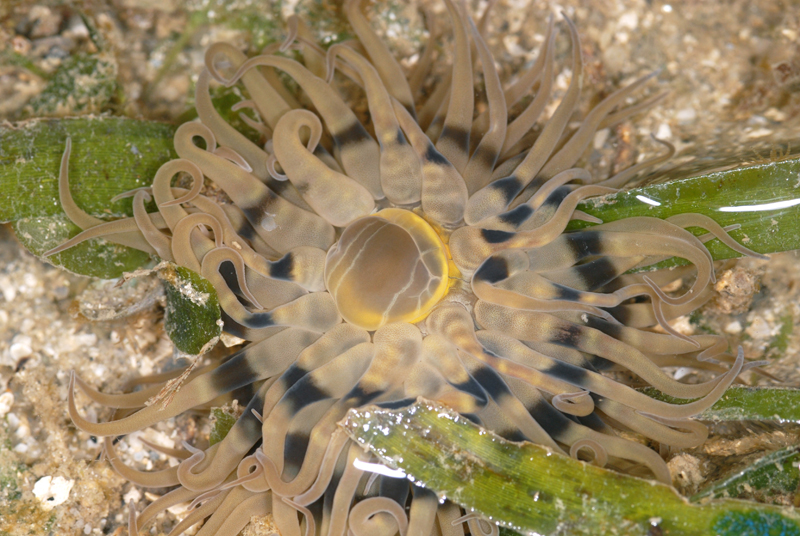
On a grassy part of the reef, I saw two swimming anemone (Boloceroides mcmurrichi). These are the biggest swimming anemone I have seen so far. One of them shows a part of it with yellow base. Pretty view. The swimming anemone, from the larger ones, have a dark ring band on the base of each tentacle.
The largest swimming anemone I saw.
Another swimming anemone with its oral disk.
Then I came across a big synaptid sea cucumber (Family Synaptidae) with large feeding tentacles. The body is long and soft with four rows of bumps along the length of the body, separated by four lines.
Closeup view near the feeding tentacles
Wider view of the sea cucumber
Nearby, I found a Pearl conch, a.k.a. Gong-gong, (Strombus turturella (canarium)). It leaped and gave me a fright when I move the shell. It is an alive snail. I felt how powerful its muscular elongated foot is.
Gong-gong snail
There were many solitary fan green seaweed (Avrainvillea erecta) scattered on the reef and most of them, I noticed, were of "T" shaped.
Solitary fan green seaweed
Rene found the orange-spotted gymnodoris nudibranch (Gymnodoris rubropapulosa). This nudibranch is a voracious predator as it eats other nudibranch. Rene got a video of a mating pair.
Orange-spotted gymnodoris nudibranch
The most special find of the day was the cushion stars (Culcita novaeguinea). I actually saw two cushion stars, thanks to Ria and Kok Sheng for finding them. Kok Sheng saw 4 cushion stars! By this time, taking photos was rather tricky as the tide has turn, bringing in brown substances and floats on water surface making it challenging to take clear pictures of submerged objects.
Cushion star 1, top view
Close up of the mouth
Cushion star, underside
Cushion star, side view
Cushion star 2, top view
Close up of patterns
Closeup of mouth
Closeup of arm
Tip of the arm, showing some tube feet
Side view
Time for corals...
There were many corals spotted and my objective was to document those that showed signs of paleness and bleaching. However there are so many other pretty corals on this reef. I will let the pictures so the talking.
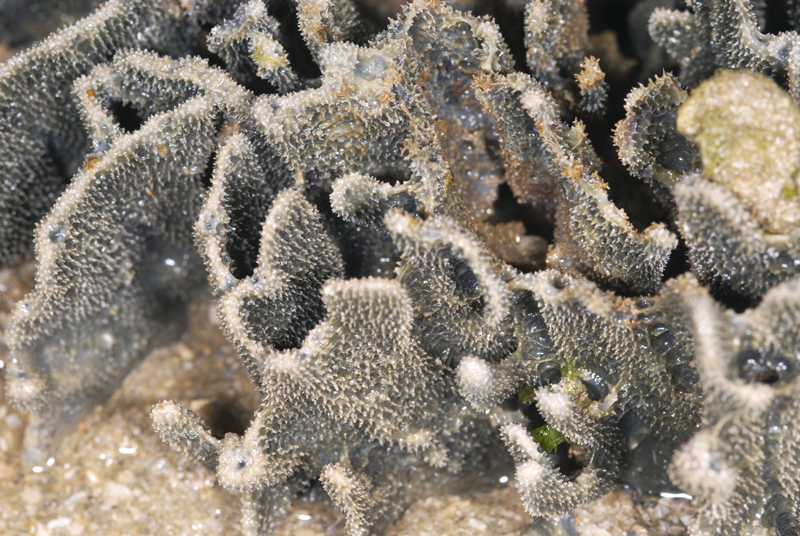
Lettuce coral (Pavona sp.)?
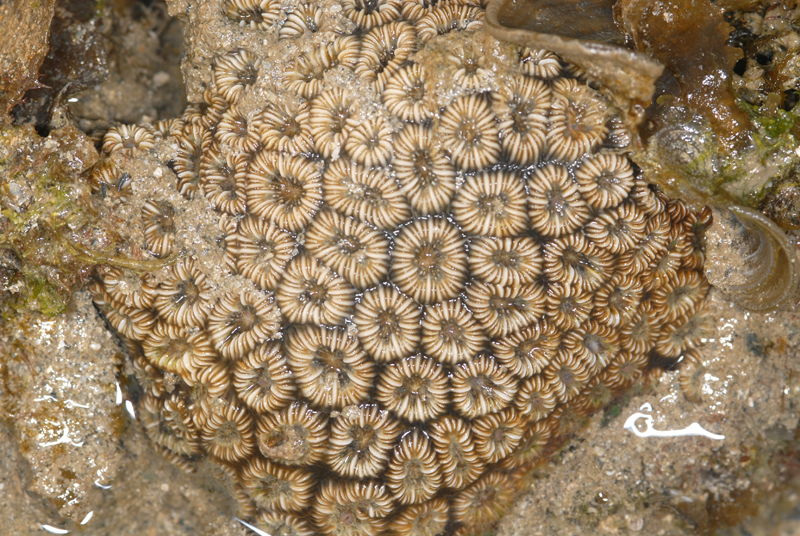
Zebra coral (Oulastrea crispata)
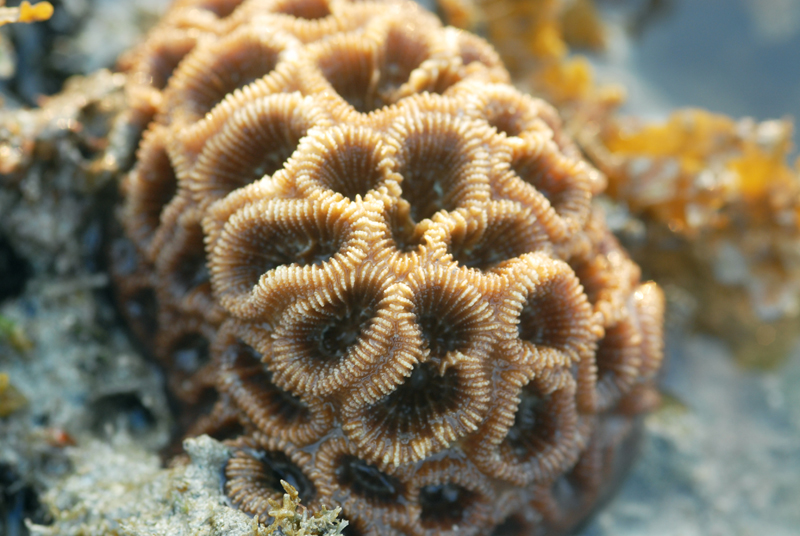
Favid coral 1
Favid coral 2
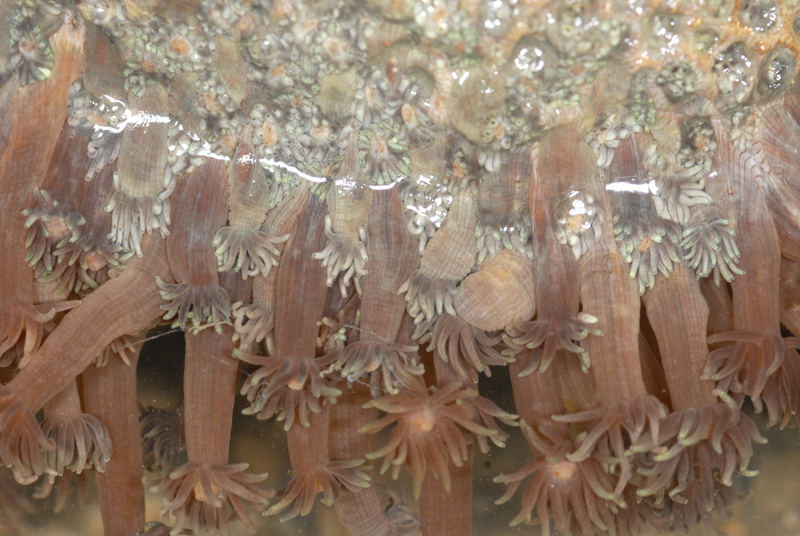
Anemone coral (Goniopora sp.)
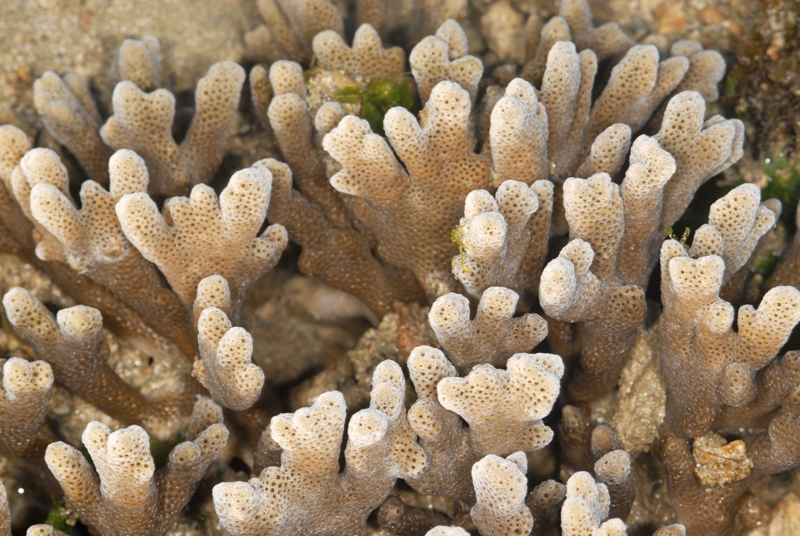
Branching pore coral (Porites sp.)
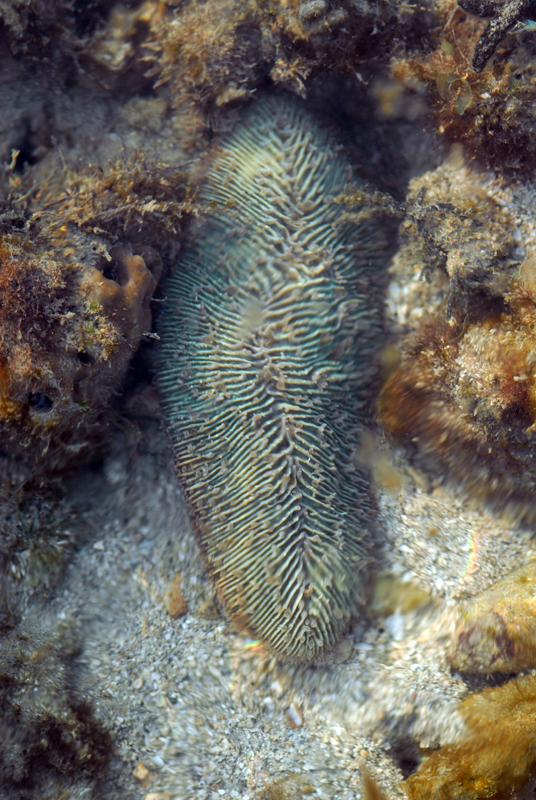
Tongue mushroom hard coral (Herpolitha limax)
Cabbage brain coral (Trachyphyllia geoffroyi)
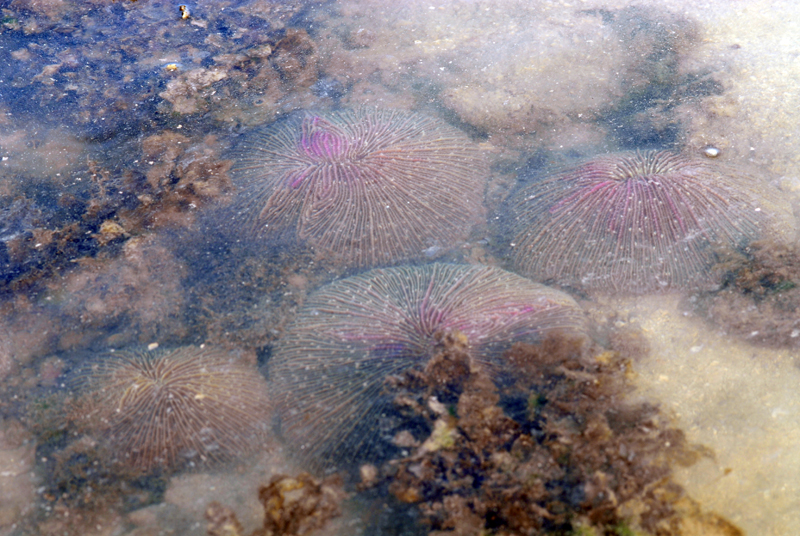
Circular mushroom hard coral (Fungai sp.)
I counted 9 of them on this patch.
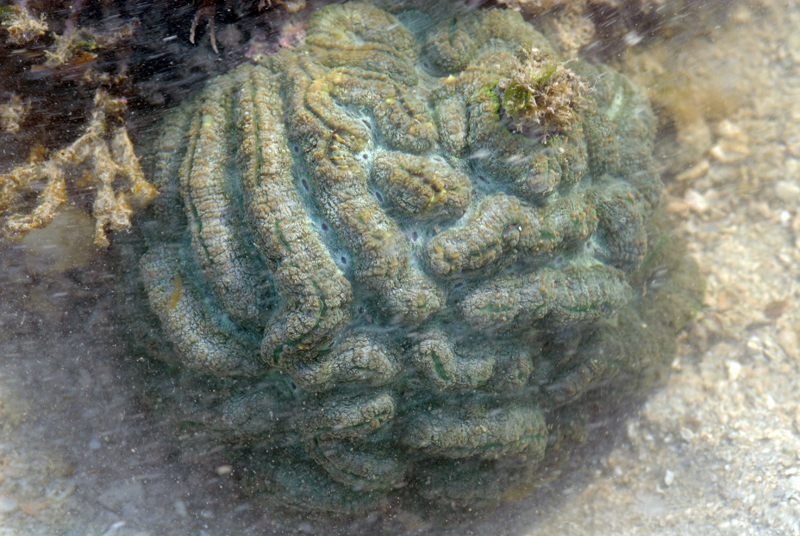
Grooved brain coral (Symphyllia sp.)
Through out the trip, there were many of these little net like structure. I thought it was some kind of fishing net. It turned out to be the lacy red seaweed (Martensia elengas)
Lacy red seaweed
What would be the best way to end the trip by being able to see 3 black tip reef sharks and 3 blue-spotted fantail ray (Taeniura lymma). Well, I did not really see the whole shark. I only managed to get a glimpse of the body. Same goes for the fantail ray. In daylight, they are very sensitive to movements.
Fin of the black tip reef shark
A glimpse of the blue-spotted fantail ray
It was a great trip having seen so many interesting things Triple B.
Soon the tide was coming in fast and we had to leave this wonderful place.
Ria also blogged about her trip on WildShores.

My next trip will be two weekends later.
Weekday trips are difficult for me to attending. I am a school teacher working from 7:20 am till about 2 pm - 5pm. I have tried once and I was zombified by mid morning. Not a good feeling when you are trying to stay awake and teach at the same time.


LinkWithin

Related Posts Plugin for WordPress, Blogger...