Tuesday, September 24, 2013

Owl, snakes and spiders at Pasir Ris Mangrove Boardwalk

It was a great trip with the Naked Hermit Crabs at Pasir Ris Mangrove Boardwalk. After a long break from Pasir Ris, the guided decided to conduct a free guided walk during this September school holidays. Despite a small group everyone saw amazing animals in this short 1 hour walk.

Located with a short walk for Pasir Ris Park Carpark C is a patch of replanted mangrove that has flourished along the banks of Sungei Tampines, and even on the coastline near the river mouth.

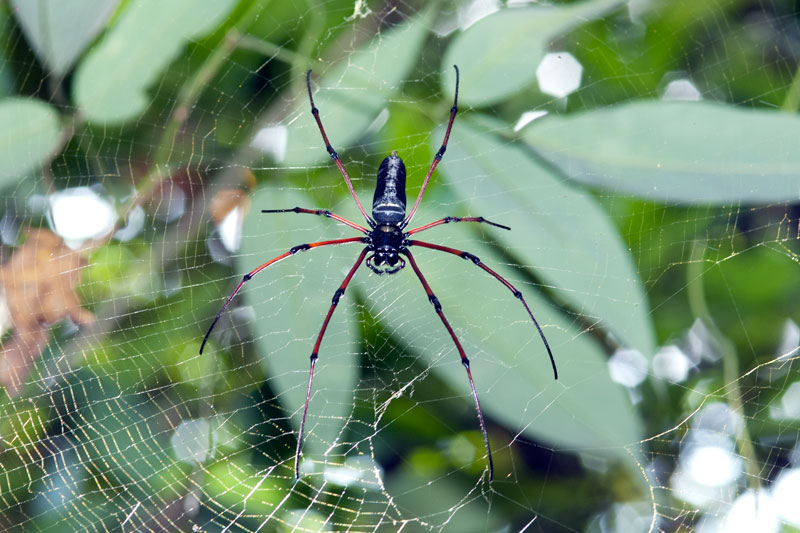
The visitors were looking forward to spotting animals as they entered the nearest entrance to the mangrove boardwalk. Little did they know that an golden orb spider is looming just above their parents' head.
Golden orb spider
I pointed out this rather large spider and almost gave everyone a fright. Alyce shared with the group that the supporting silk by the sides are not sticky and requires the least amount of energy from the spider to be produced. She also show us how taut the silk is and you can actually gently feel how firm the silk thread is.

Even before the walk started, the visitors has a warm up treat of seeing a flying lizard on the tree trunk next to the meeting point.
Flying lizard
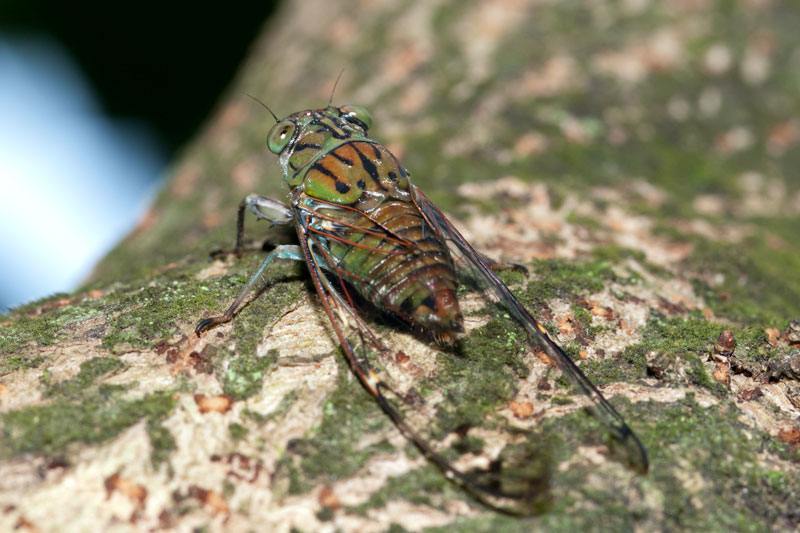
Along the boardwalk, it was the first time for many of our visitors seeing a cicada. Many people often confuse the sound cicadas produce with crickets. The cicada was within comfortable eye viewing for the adults while the children needed a hand to get a good look at it.
Cicada
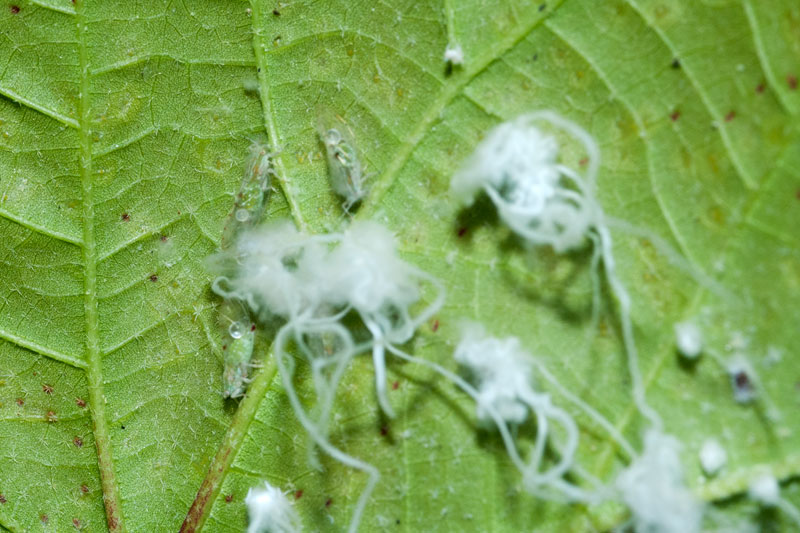
On another branch, there were clusters of mealy bug.
Mealy bug - white and fluffy
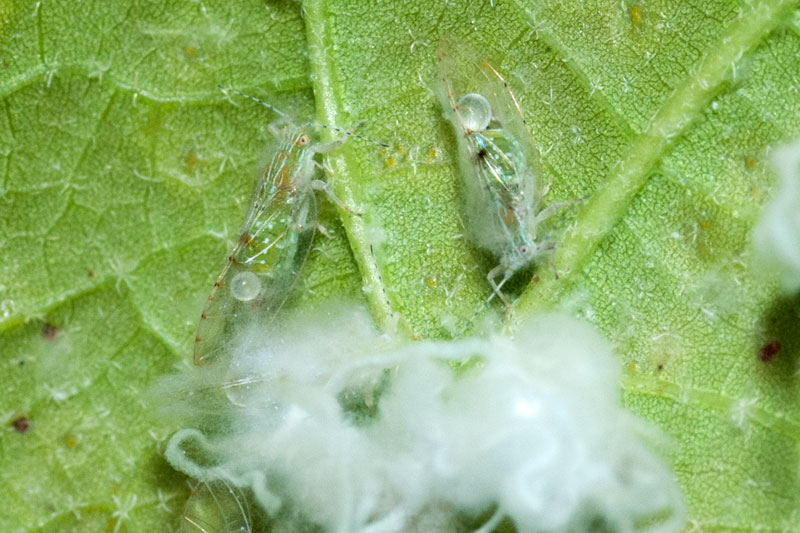
Not sure what these insects next to the mealy bugs are. Sean did mention something about them being matured form of the mealy bug? Looks like they are carrying a sap like bubble.
Matured mealy bug?
Then Sean, our ladybird expert, spots a 'white cow' ladybird which has yet to be identified. He has created A Picture Guide to Ladybird Beetles of Singapore with amazing drawings and great photos.
'White cow' ladybird
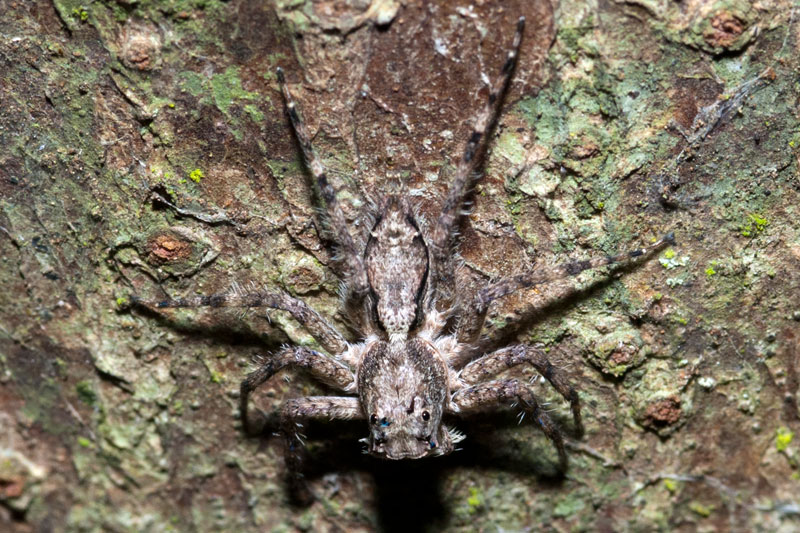
Earlier before the walk, I came early to check out the mangrove and this spider that I saw before the walk was still at the same location. I showed it to the visitors who were interested about spiders.
Spider
After the walk, I check the same tree trunk and it was still there! Sean took photos of it only find that it is a mama spider as she is now guarding her newly hatched baby spiders. (Sorry, by that time I had kept my camera.)

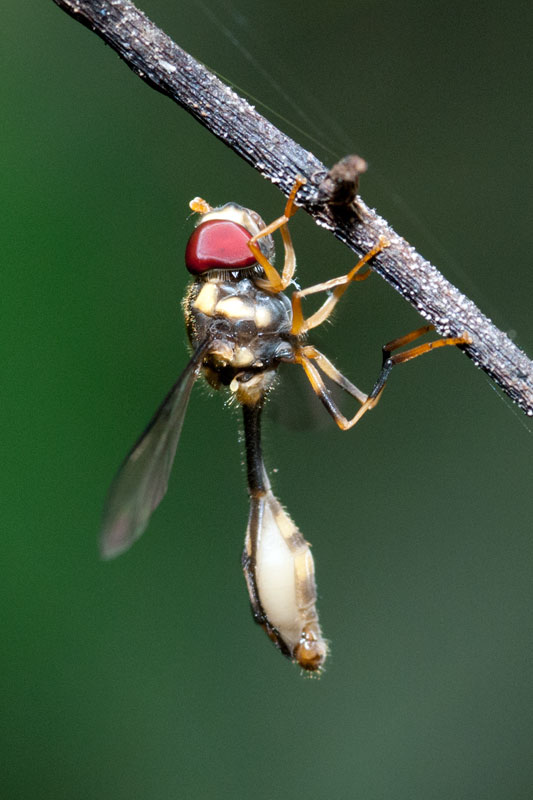
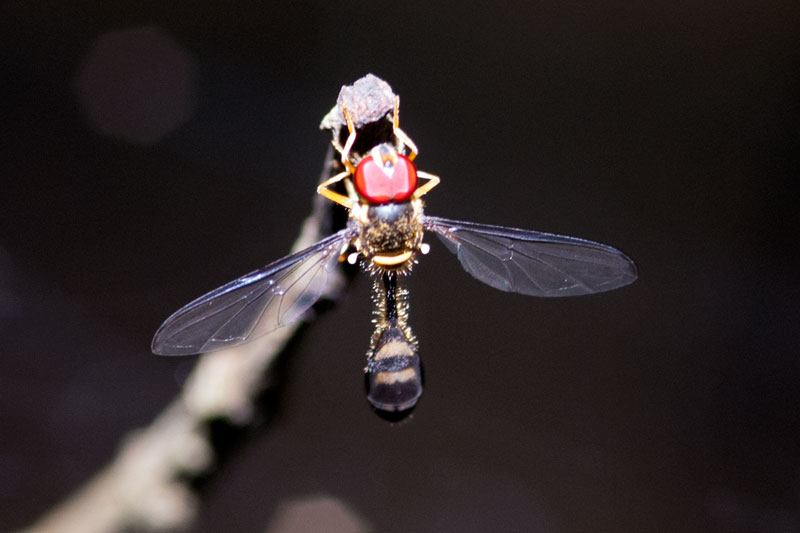
Sean and I spotted a few of these insects and he thinks that they are some kind of fly. We managed to see them at different angles.
Side profile
Overview
It was rather tricky to lean against the boardwalk railing today. The weaver ants were running around along the railing. These ants can inflict a nasty pain when they bite and they do not easily let go.
Weaver ant
How can I forget about the mangrove animals when doing a guided walk on the mangrove boardwalk?
Squirrels are not true mangrove animals but they do forage in the mangrove for food. The children are excellent at spotting squirrels and are very excited about them.
Squirrel feeding
The giant mudskippers (Periophthalmodon schlosseri) looked less lively today and there were fewer of them seen. What has happened? However our visitors were still very excited to see the giant mudskippers moving around in the mangrove. A few of them were seen in pairs. Possible mates?
Giant mudskipper
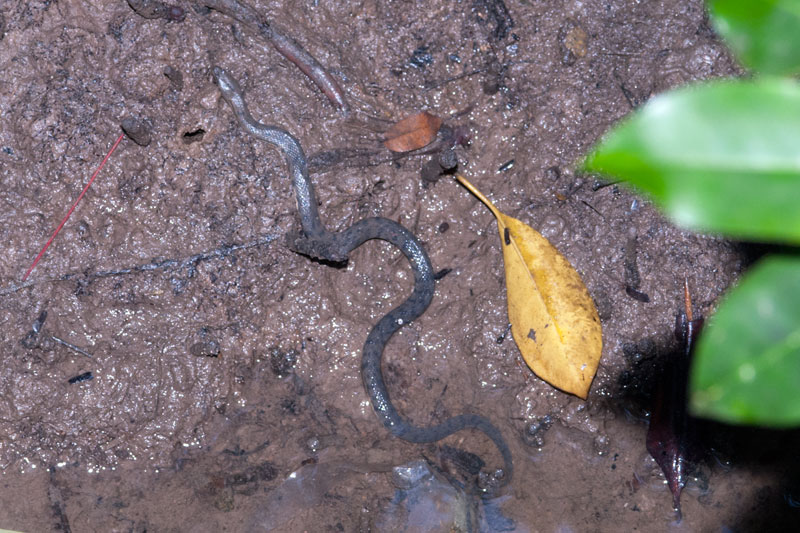
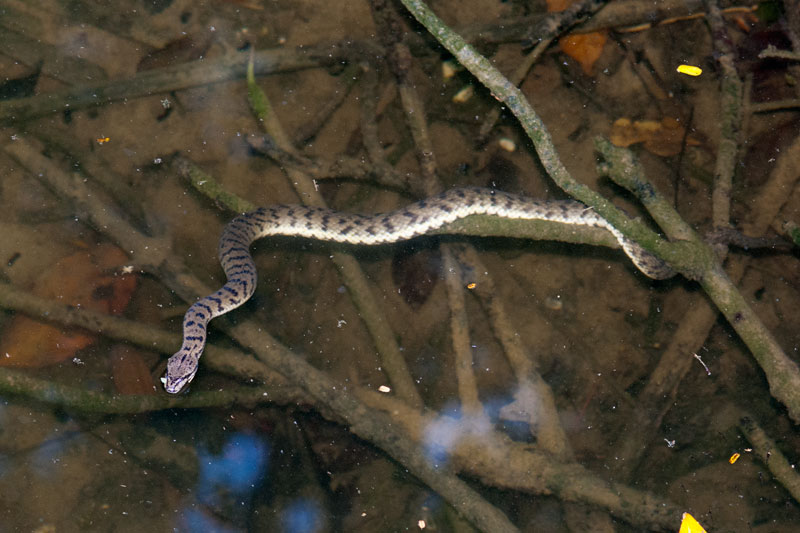
Toward the end of the walk, we spotted two dog-faced watersnake (Cerberus rynchops) at the water's edge. They look slightly bigger than a juvenile size. It a good sign for Pasir Ris mangrove.
Dog-faced watersnake 1
Dog-faced watersnake 2
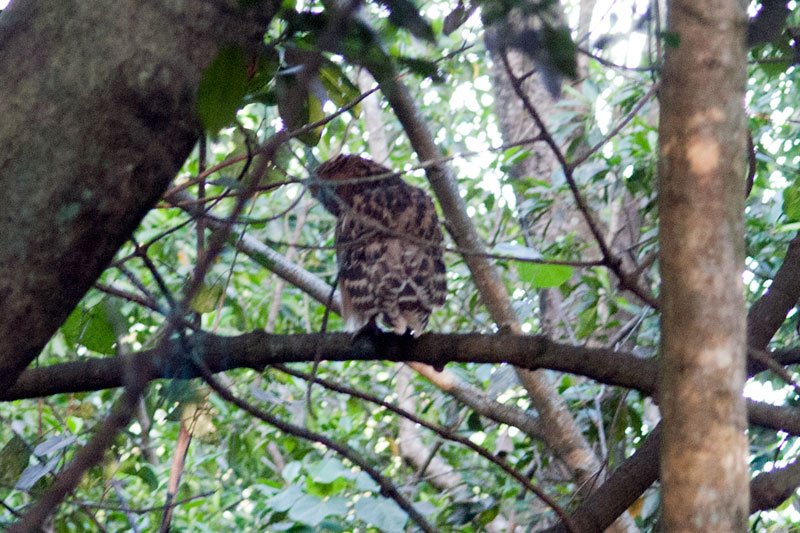
Suddenly, a large flying animal caught my attention as it landed on a tree branch. It was an owl, the Buffy fish owl. This shy bird stayed long enough for everyone to admire it.
Buffy fish owl turning its head to have a look.
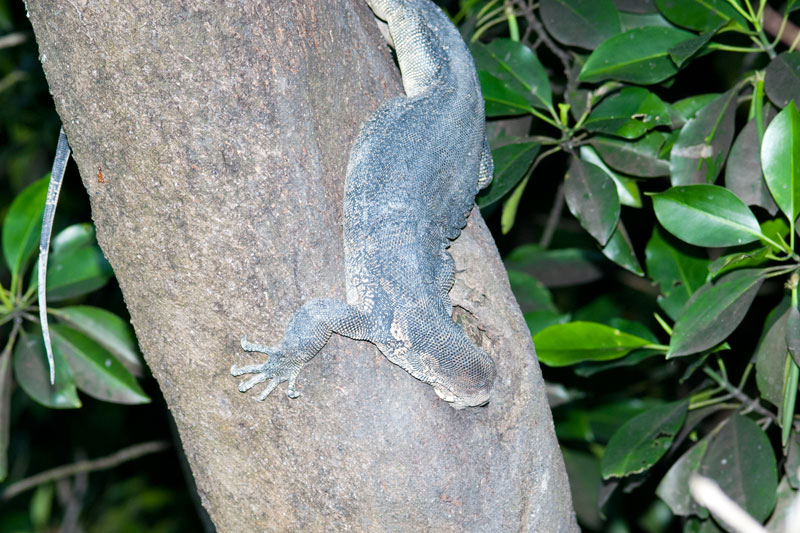
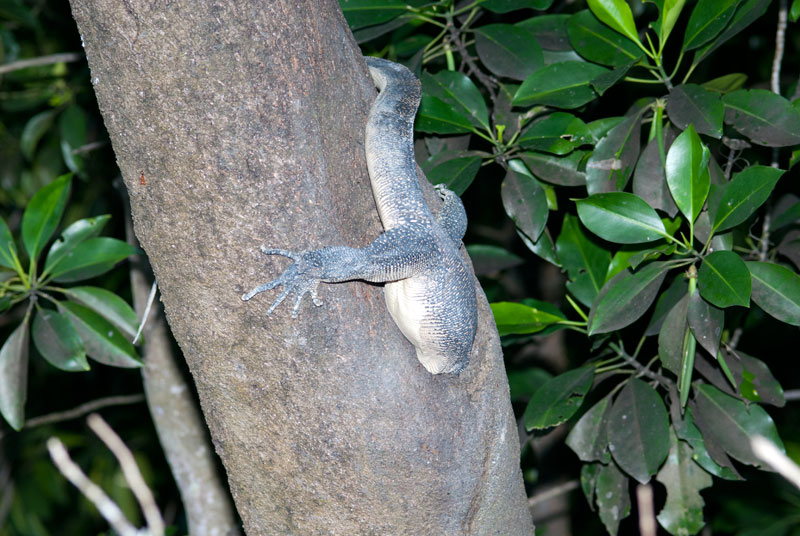
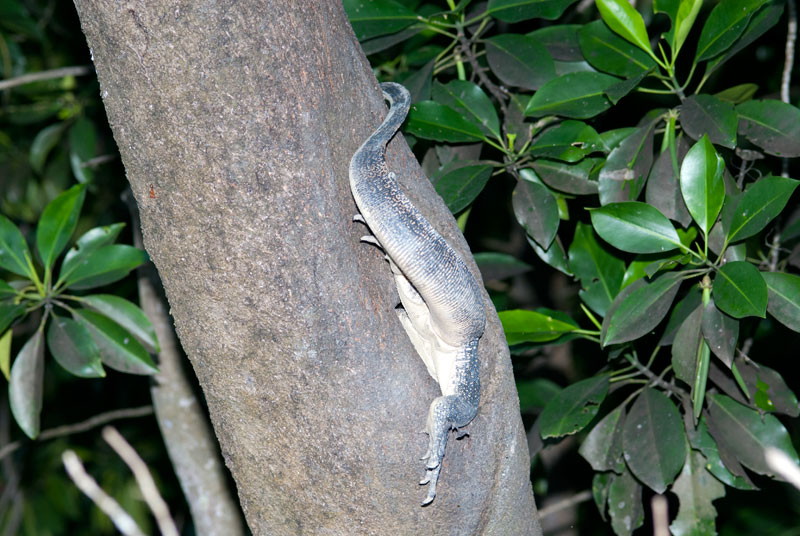
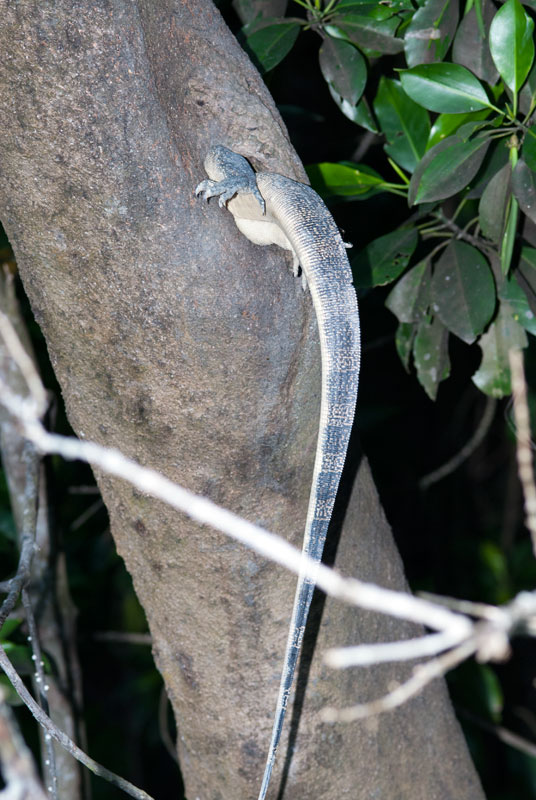
As we end our walk at the lookout hut to Sungei Tampines, one of our alert mummies spotted a juvenile water monitor lizard and... we finally witnessed how the water monitor appeared in the hole of the tree trunk. For the many trip we have done we always encounter the juvenile water monitor lizard's head taking a peek from the tree trunk's hole.
Moving to the hole.
Checking out the hole first
First half of lizard in
Almost there...
Just a bit more
Now to move the tail in
Sean has a wonderful video of the lizard moving into the hole and listen to the interesting comments in the background.
 

As we head back to the starting point with the setting sun, the guides got to witness a bit more action along the boardwalk.

I pointed out an interesting spider on a tree trunk that I spotted before the walk that is still at the same spot. Then Sean commented that the spider now seems to be guarding her babies that looked recently hatched. I only managed to take pictures of the mother spider.
Taken before the walk.
Taken after the walk.
At the orb spider's web, we were treated to some prey catching action as a dragonfly flew into the orb spider's web. Sean managed to capture it on video.


The Pasir Ris Park mangrove boardwalk is opened all day and it is very interested to visit the mangrove after sunset. 
Tuesday, September 10, 2013

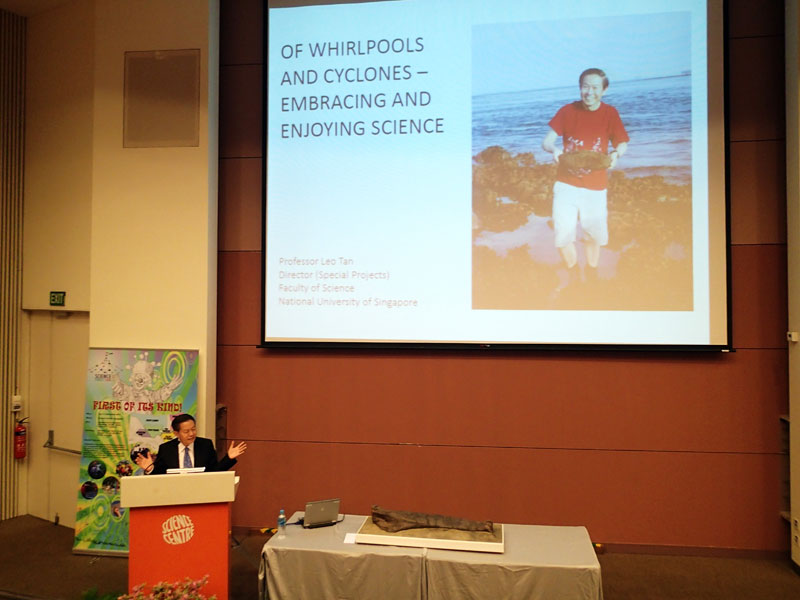
Of Whirlpools and Cyclones - Embracing and Enjoying Science by Prof Leo Tan

This morning, I attended a distinguished science lecture series organised by the Science Teachers Association of Singapore (STAS) and the Singapore Science Centre. This happened to be the first lecture series organised by STAS. The guest speaker to kick start the inaugural lecture series is Professor Leo Tan.
The first Distinguished Science Lecture Series.
Prof Leo Tan is a professor of Biological Sciences, Director of Special Projects, Faculty of Science, National University of Singapore. He is also a Fellow of the National Academy of Science, Singapore.
The topic for today's lecture is "Embracing and Enjoying Science".
"Of Whirlpools and Cyclones - Embracing and Enjoying Science"
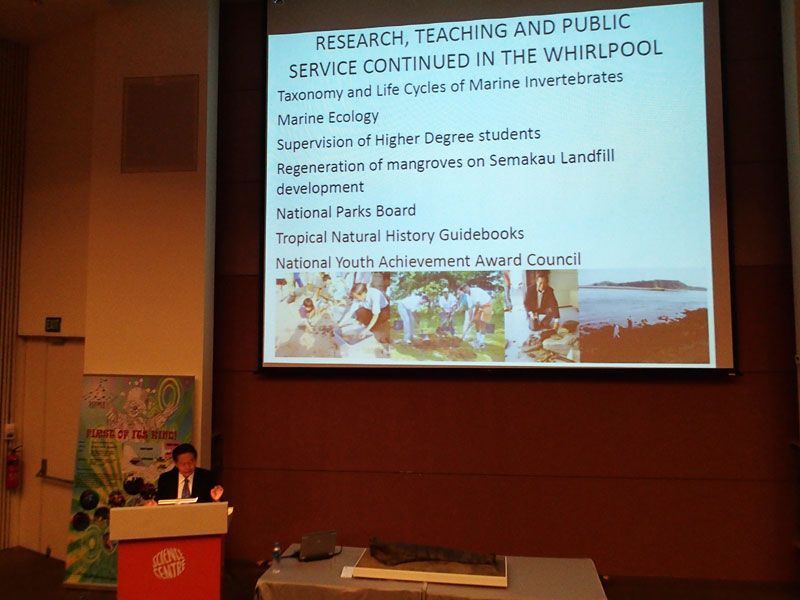
Prof Tan shared with the audience about the many difficulties and challenges he faced in the world of science since he was an undergraduate till now and he describes them as whirlpools and cyclones.

He first talked about the meaning of science for different groups.

Then Prof Tan shared about the challenges he faced from the life of an undergraduate to PhD  at University of Singapore. Then, Prof Tan had a dream. His dream was to become a marine biologist. Marine biology was not well developed at the then University of Singapore that time and the job prospects was minimal but Prof Tan did not give up on his dream and he persevered.
When Prof Tan became a lecturer at the university, he was asked to teach topics outside of his area of study. The audience of science teachers could relate to this very well as we often face this challenge in schools. This is especially true when teaching lower secondary students as the syllabus covers the 3 sciences (Biology, Chemistry and Physics) and science teachers would have to teach at least one science out of their specialised science(s). Prof Tan did not object to these assigned lectures. He took it up as a challenge to read beyond his field and this made himself indispensable in the department.

At the same time, he lost his research site at Tanah Merah due to land reclamation for Changi Airport's second runway and all the marine animals got buried under the sand. Furthermore he witnessed the lost of many beaches around Singapore as industrialisation began and land reclamation happened in full force to expand Singapore's land area.

In this first part, Prof Tan highlighted a few lessons learnt.
  1. Be courageous, persevering and imaginative
  2. Believe in what you do 
  3. Be curious, passionate, resilient, questioning, risk taking
  4. Create value
  5. Make mistakes
  6. Rally allies
Of the points he covered, I remembered two points deeply - questioning and make mistakes. Questioning in terms of "Why", "How", "What". With continual questioning, either at yourself or others, there is a strong will to get the answer to the questions and this is how many people succeed. Though the process of obtaining the answer may be of great challenge, difficulty and may not be instantaneous, you will eventually get the answer. Asian parents like to ask their children "Have you...." or "What did you....", which does not allow children to think deeper in their reasoning or answers. Why not change to "Why does it happen this way?", "How is it possible." or even "What happens if I do it this way?"

Everyone makes mistakes and there is nothing wrong with making mistakes. Each of us grow and develop ourselves through the mistakes made. Prof Tan made a very valid point in this talk, "Make mistakes, but never make the same mistakes again. Make NEW mistakes.". It is through new mistakes that you and I realise that certain methods, procedures or technique is not acceptable or does not work in various context. And we understand from our mistakes where we have gone wrong and try to improve ourselves. It may take a very long time to reach the end point but in every tiny step is a learning experience that can benefit yourself and/or everyone around us and eventually it will lead us to the end point.

Prof Tan's first whirlpool experience happened when he was asked to lead the Singapore Science Centre. It was a whirlpool for Prof Tan as the Science Centre then was not well established and many did not recognise the value of it. The public did not think highly of learning science in a non-formal manner.
First whirlpool - Leading the Singapore Science Centre
However Prof Tan took up this challenge and viewed Science Centre as a new platform for learning and enjoying science in an unconventional way. The Omni Theatre and Planetarium was built under his leadership and activities such as science fairs, projects, camps and demonstrations were organised to create experiential learning for visitors. Prof Tan valued partnerships of public, people and private industry. I learnt that Science Centre grew in popularity as a place for learning and enjoying science not through hard selling and publicity, but through word of mouth of visitors and it is a very powerful tool.

His second whirlpool came after serving 10 years at the Science Centre and was asked to lead the National Institute of Education (NIE) where he served for 18 years. In NIE, he created new beginnings for the professional development of teachers, introduced the Bachelor's degree in Education (Science or Arts), changing mindsets of staff and paradigms of teaching/ learning among others.

The whirlpools continued as Prof Tan was asked to serve in other organisations and handled other responsibilities or projects. I could understand that despite being thrown into whirlpools after another, Prof Tan had always believed in himself and think about the positive things he is going to achieve each day at work. He was able transform the whirlpool into his playground.

Everyone has a dream. The dream may change from time to time, or new dreams are formed when the old dreams gets fulfilled. At each part of the journey, Prof Tan had a dream. Currently, he is working on fulfilling one big dream that he had - restoring the Raffles Collection.
"I had promised myself in 1974, when I was appointed Lecturer in Zoology
at the then University of Singapore, that one day the Raffles Collection
would regain its rightful place in Singapore's heritage, culture and education.
I am happy I could, with the help of fellow Singaporeans, deliver on the promise."
He then shared the history of Raffles Museum of Biodiversity Research (RMBR) since it was established in 1823. There was a period of time from 1972 to 1988 where Raffles Museum was "Homeless".
Journey of RMBR
The current location of RMBR at the Faculty of Science, NUS is getting too small for its growing population of specimen collections. Furthermore the public gallery could only display a tiny fraction of the museum's collections. With the new Lee Kong Chian Natural History Museum in construction, the museum's collections will be housed in a larger building where more specimens can be displayed for public viewing, including three dinosaurs which Prof Tan and his team fought very hard to raise money to purchase them.

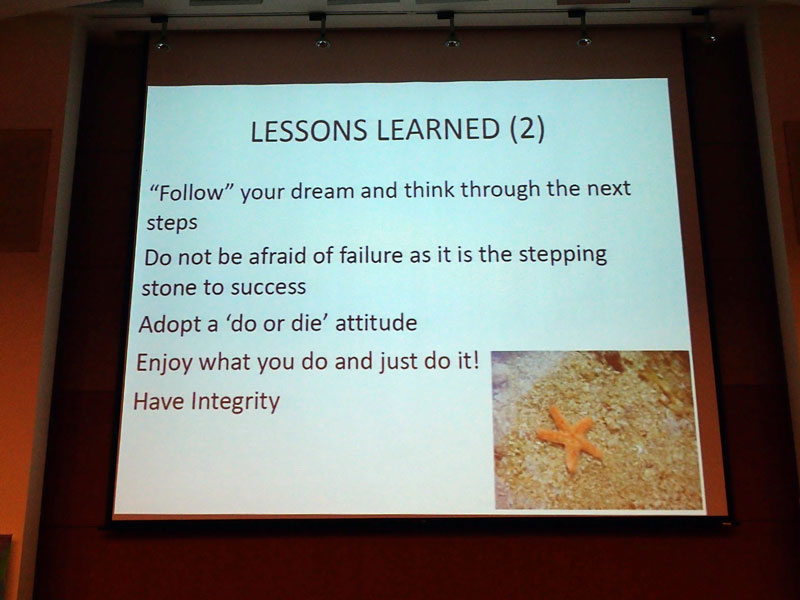
So, part two of lessons learnt:

  1. "Follow" your dream and think through the next steps
  2. Do not be afraid of failures as it is the stepping stone to success
  3. Adopt a 'do or die' attitude
  4. Enjoy what you do and just do it!
  5. Have integrity
Towards the end of the talk, Prof Tan gave some "advice" to his audience of science teachers:

  • Ignore the standard texts
  • Read journals, prints and online media
  • Discuss the issues
  • Learn by doing (experiential learning)
  • Undertake projects, summer programmes, field work, internships, etc
  • Share stories
  • Ensure your students reflect and think
I think I need to work harder on some areas. In December last year, I did a Teacher's Work Attachment with RMBR and you read about it here. I must say that it takes great effort to excite students close to the same level as you have about doing something, but it is not impossible. There will be students who will never show the slightest interest in your very passionate sharing with the class. They are not in the same interest frequency as you are. This year I tried exposing my class to Singapore's marine biodiversity through verbal sharing and videos. I just have to talk about the interesting parts/ facts or observations and I would say that majority of them enjoyed it. Some may have be inspired by the sharing I did in class.

On the parting note, Prof Tan commented to the audience, "I have a new dream... I hope you have one too!"

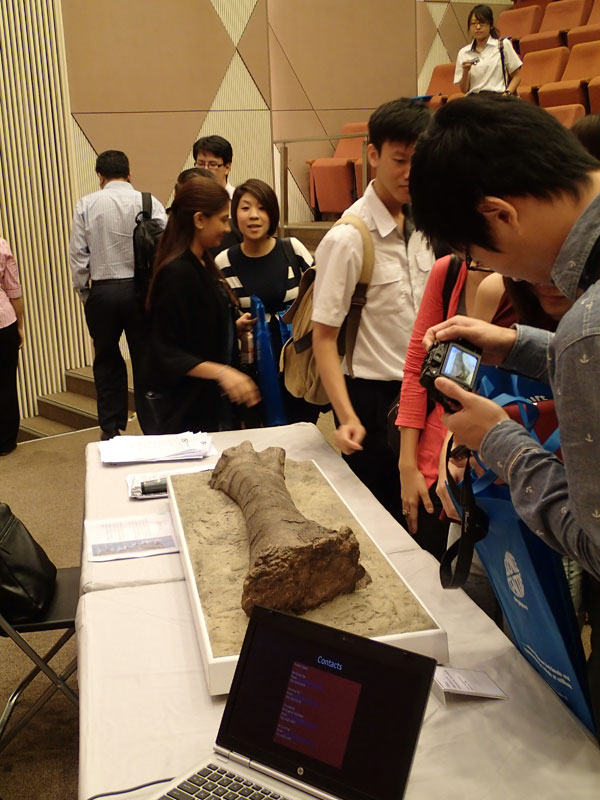
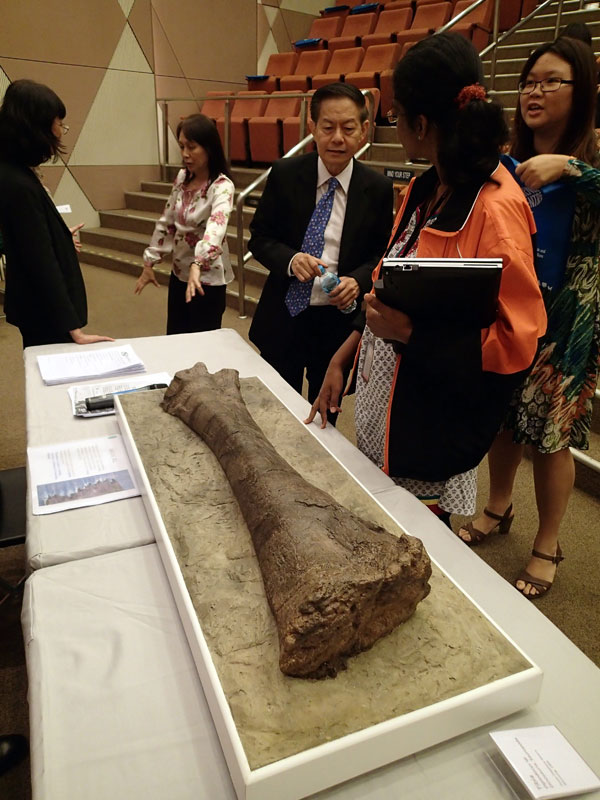
At the end of the talk, everyone is welcomed to feel and take photo of the dinosaur bone on display. The bone on display is a Tibia bone of Diplodocus sp. (Dinosauria, Sauropoda) from Howe-Stephens Quarry, Wyoming, 1994. It is a 160 million years old bone, much older than the one I helped to assemble in the museum's public gallery (65 million years).
Having a feel of the bone
Taking photos of the bone
Scale of the tibia bone
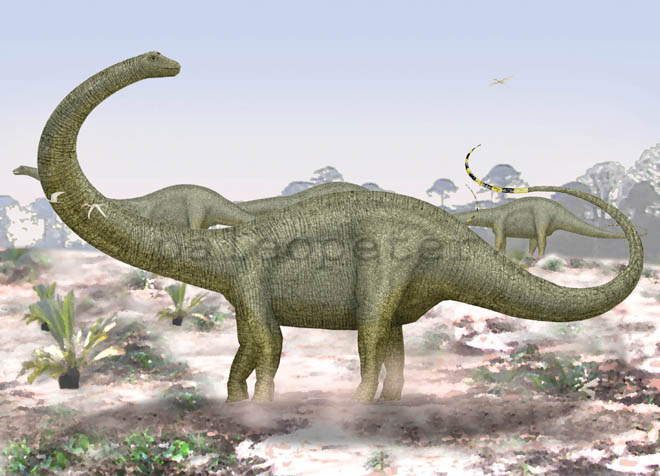
This is probably how the dinosaur looked like.
Illustration of Diplodocus sp.
It was a very inspiring talk by Prof Leo Tan.

Actually, I did not know about this talk until  Dr Tan Swee Hee from RMBR emailed to inform me about this talk by Prof Leo Tan. I was not a member of STAS so I did not receive information about their Distinguished Science Lecture Series. After the talk, I found out that there was a reason to why Swee Hee informed me about the talk - they had a photo of me speaking to the President at the recent Festival of Biodiversity in one of the slides.

Unfortunately, I did not have a photo of that slide but the image used was something similar to this.
Speaking to the President during the recent Festival of Biodiversity 2013.
As I am typing this post, his comment sets me thinking... What is my dream?
I do have one in my mind now and this dream was set after my work attachment ended - I would like to work at the Lee Kong Chian Natural History Museum.
Whether this dream will come true or not is not a big deal. Remember, THINK POSITIVE!
Of course, I have other dreams and they are kept somewhere in my mind. Some dreams may have been lost, some require deeper retrieval and some may need some modifications.

What is your dream?

Saturday, September 7, 2013

Running allowed at Chek Jawa?

While waiting for the monthly Naked Hermit Crabs guided walk to begin at Chek Jawa's information kiosk, some of us noticed runners donned in lime green t-shirts running into Chek Jawa Wetlands. They turned into the steep down sloped gravel terrain, which leads them towards the Tg Chek Jawa Muslim Cemetery and the back mangrove.

Running down the gravel slope.
Some runners were blasting music away as they entered Chek Jawa and running pass right in front of us. They took it as a joke when told to off the blasting music.
Runners running into Chek Jawa
There were some directional makers tied to trees to indicate the running route. The logo reads "K5 Kampung Run".
Directional signage.
It was simple to do a search and obtain information about this race. A search on Google brings me to a Facebook page for this event. You can read more about the event here.
Print screen of the page.
Here's a quote from the page about the event:
Back by popular demand, K5 KampungRun (Pulau Ubin) is a road and trail run specially designed to promote the love of kampung life, community bonding and runners who want a city getaway to experience the lost nature of Singapore. 
Proudly organized and guided by Team Kikikukiki, the route will bring participants thru the time tunnel into the 60’s where Atap houses are powered by diesel operated generators and drinking water from the wells. Paved forest trails at certain point of the run where you may see school of wild boars lazing around and through Chek Jawa’s boardwalk, Ubin’s enchanted mangrove swamp.

Do join us and invite your friends to enjoy the lush greeneries and freshness of the nature while running it Kampung style! 

Do join us and invite your friends to enjoy the lush greeneries and freshness of the nature while running it Kampung style! 
A photo posted on the page shows the route covers a loop round Chek Jawa, entering from the mangrove boardwalk and out the coastal boardwalk.
Running route.
Chek Jawa may not be a nature reserve, but it is one of the places where visitors come to enjoy and appreciate the flora and fauna of the place.

There are some points which I wish to highlight and question:

  1. With runners running through Chek Jawa, they frightened many animals away and some animals may not come out of their hiding place for a long time. 
  2. Will the boardwalk able to withstand such impacts from the runners running on them?
  3. What about the safety of the visitors along the boarwalk? The mangrove section of the boardwalk do no have railings and I have experience how aggressive runners can be when you get in their way.
  4. Do the organisers have the permission to allow this event to take place in Chek Jawa?
  5. Have the organisers thought of the possibility of disturbing the animals in Chek Jawa?
  6. Were there measures to educate runners of proper running etiquette (e.g. blasting of music, talking loudly... etc)?

Even at this very moment on Facebook, there is a group of concern people raising issues regarding The North Face 100 Singapore Run, which passes through the central catchment nature reserve with an overnight running event. 
Here's the screen shot of the feedback raised by the concerned people.
From TnF100 Facebook page
There have been 31 shares of this image to raise the awareness among friends how destructive to the environment this race can be. It was this very image and hit the nail on my head and made me thinking how destructive running events can be. Thinking about the trampling of soil (which is compacts the soil and stops vegetation from growing), littering along the route, loud music and shouting pass the animals quiet home, and many more. I hope you can help to spread the awareness too.

Do we want to continue having such activities in our precious nature?

Anniversary walk at Chek Jawa

Today marks a special milestone for the Naked Hermit Crabs. The volunteer group is celebrating 6 years of guided walk at Chek Jawa! I may not be a 6 years old nature guide with them but I'm glad to be part of this "celebration" right here at Chek Jawa.

I'm the crazy person looking into the binoculars on the extreme left.
[Photo by Ria Tan]
We did not have a large group of visitors today. On average, the visitor to guide ratio is estimated to be about 4 to 1. Visitors were separated into 3 groups and were privileged to have at least 2 experienced guides with each group. The guides in each group took turns to speak so what we would not tired ourselves along the walk.

Today was my first time seeing the back mangrove filled with water, probably through the combination of in-coming tide and the heavy morning downpours these few days. Just before we reached the Jejawi tower, the usually dry patch of mud nearby was flooded and I noticed many groups of tiny dots on the water surface.
Possible frog eggs
They could be the eggs of the crab-eating frog (Rana cancrivora). The crab-eating frog is an exception of the amphibians as it is among the few that is tolerant of salt water conditions.

Up on the Jejawi tower, I spotted a Crimson sunbird next to the Jejawi tree just before I was about to make my way down. However the bird was perched rather far away for my lens.
Crimson sunbird
Back on the mangrove boardwalk, it was rather quiet apart from the large swarms of mosquitoes pestering me throughout the boardwalk. Both my arms provide evidence that I have done my part in blood donation to nature.

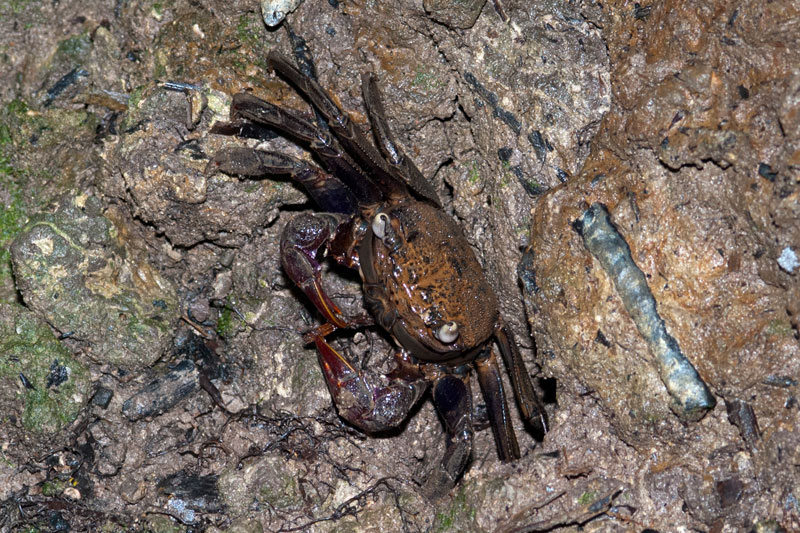
The group came across may tree-climbing crabs, a few spiders, mudskippers and mangrove fiddler crabs.
Tree-climbing crab
Spider
The highlight of the whole guided walk for me was to see a white-bellied sea eagle landing on a dead mangrove tree along the coastal boardwalk. Just nice, there was good clearing view for the group to view this majestic bird perched on the tree. My 105mm lens could not get a decent shot of this bird so I roped in my binoculars and compact camera instead.
White-bellied sea eagle
We were fortunate to have great weather today. The sky was cloudy with slight breeze and a bit of sun.

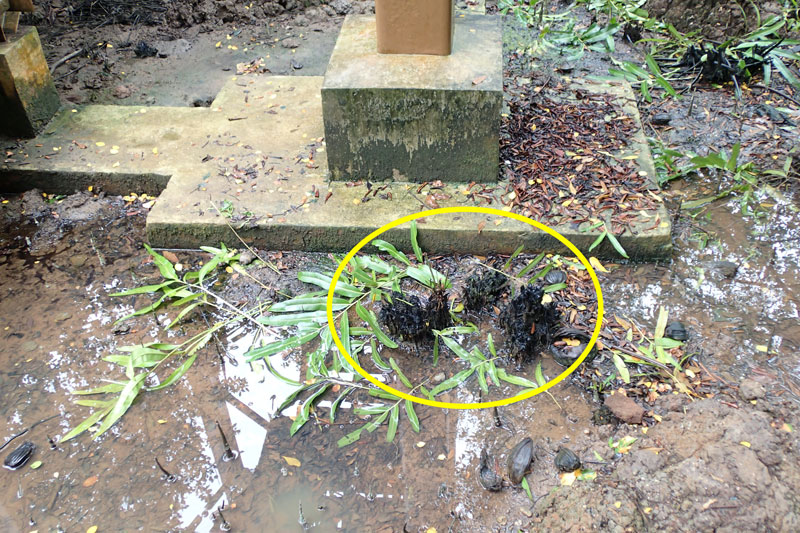
On the not-so-happy side, Ria and I noticed that the mangrove fern at the base of Jejawi tower has been deliberately cut. The cut leaves were thrown and scattered around that area. What is going on?
Yellow oval shows where the mangrove ferns used to be growing. On the left are some of the cut ferns,
To the right where the ferns were growing, the scattering of cut ferns.
We also notice cutting of trees along the mangrove boardwalk, resulting in some small sections of the boardwalk to be brighter than the whole mangrove.

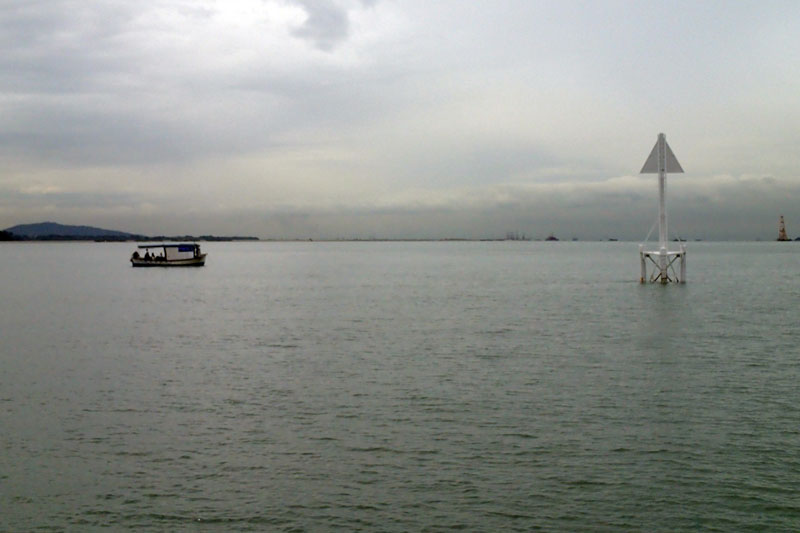
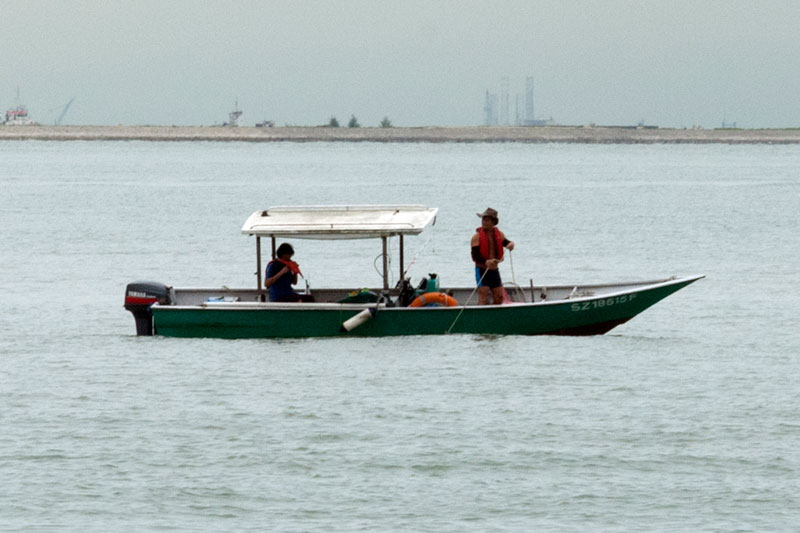
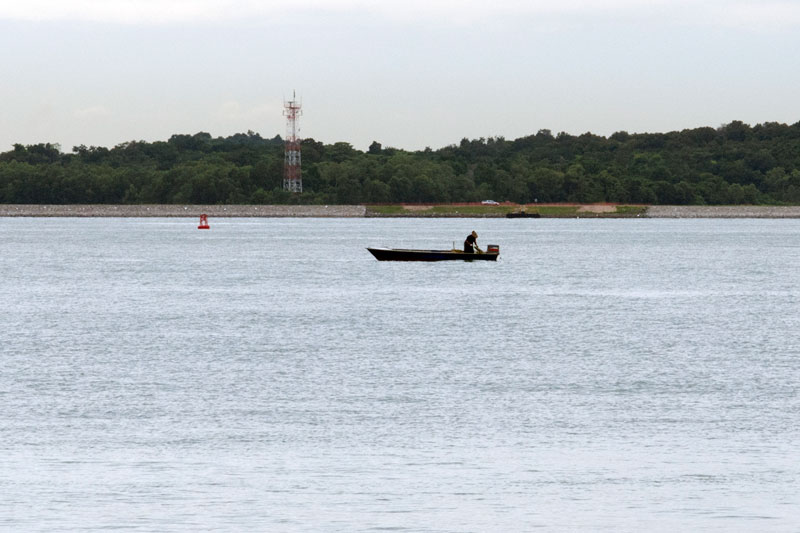
On the shore side of Chek Jawa, there were 3 fishing boats spotted within the boundary of Chek Jawa and a speedboat was passing through between the coastal boardwalk and the Chek Jawa front beacon. On the NParks' website, there is a "Notice to Vessels" link which downloads a letter informing the shipping community on the boundary of Chek Jawa Wetlands and practices to be observed. 
Fishing boat neat the Chek Jawa beacon
Speedboat passing behind the beacon, in front of boardwalk.
Another fishing boat neat the beacon
Fish boat some distances from the pontoon.
One of the practices not allowed states "There shall be no collection of any organism (including remains of an organism) or use of rods, lines, hooks, nets and traps within Chek Jawa Wetlands".

Sigh...

I'm glad the visitors had enjoyed themselves throughout the walk despite the ferocious attacking mozzies along the mangrove section. I don't even want to count the number of marks I have on both my arms. There's just too many to count.

Happy 6th anniversary to the Naked Hermit Crabs and wishing many more years to come!

Other posts about this trip:

LinkWithin

Related Posts Plugin for WordPress, Blogger...