Sunday, May 12, 2013

Seahorses and Giant clam at Big Sisters Island

Another great day out in the field today as we explore Big Sisters' Island.
As soon as we started, Ria found a pair of Tiger-tail seahorse (Hippocampus comes).
Tiger-tail seahorse (Hippocampus comes)
They stayed very still for us to take turns to photograph them before moving somewhere else when the water level got too low. Here's a video of the seahorse during the outgoing tide.

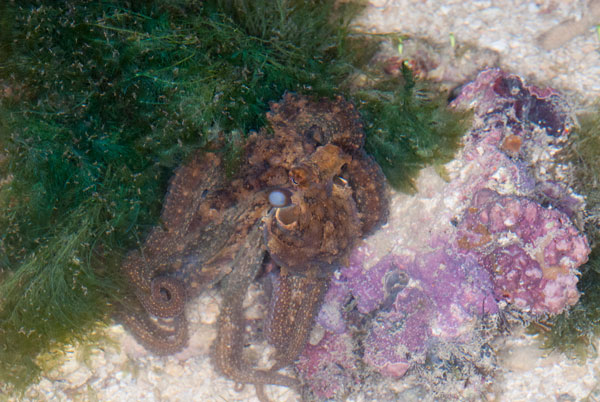
A reef octopus came out to say "Hi" to me before scrambling into hiding. It is not easy to spot a reef octopus as they can blend into the surroundings very well. Most of the time, we spot the reef octopus when they are moving about.
Reef octopus

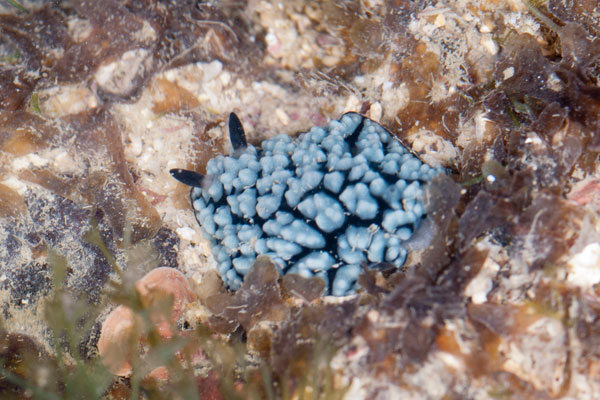
There were a few flatworms spotted seen, such as the Spotted black flatworm (Acanthozoon sp.) and the Blue-spotted flatworm (cf Pseudoceros indicus). Flatworms are very delicate marine animals and their body tears easily if mishandled. So it is best to just leave the flatworms alone.
Spotted black flatworm
Blue-spotted flatworm
The commonly seen phyllid nudibranchs in various colours and patterns were seen too. In this trip, I saw the Black phyllid nudibranch (Phyllidiella nigra) and the Pimply phyllid nudibranch (Phyllidiella pustulosa).
Black phyllid nudibranch
Pimply phyllid nudibranch
The other sea slug seen would be the Black-margined nudibranch (Glossodoris atromarginata). There were a few spotted today.

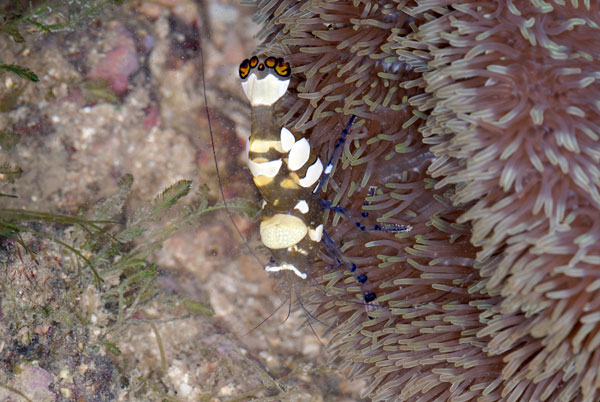
At the only Giant carpet anemone (Stichodactyla gigantea) that I saw, I could not find any wriggling signs of the False clown anemonefish's (Amphiprion ocellaris) presence but I did find the Five-spot anemone shrimps (Periclimines brevicarpalis).
Five-spot anemone shrimp on Giant carpet anemone
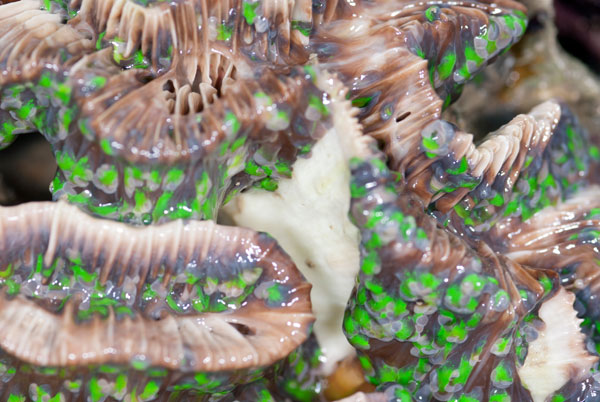
I find the Brain anchor coral (Euphyllia ancora) interesting. It is a hard coral with long polyp tentacles, each with a U-shaped tip. You will not be able to tell that this is a hard coral when the polyps are fullt extended. However at low tide, part of the coral is exposed and the polyps retract, exposing the branching corallites with deep valleys between corallites.
Brain anchor coral, with polyps extended.
Brain anchor coral, with corallites exposed and polyps retracted.
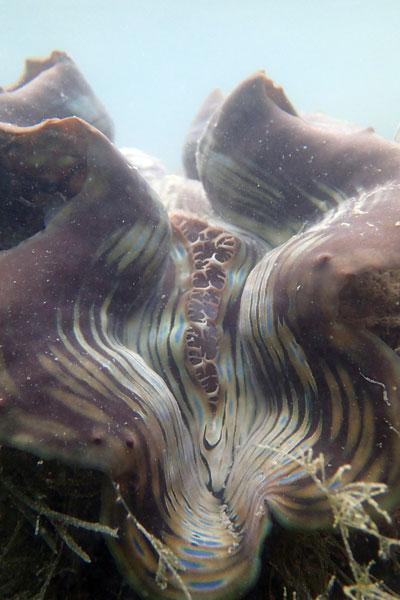
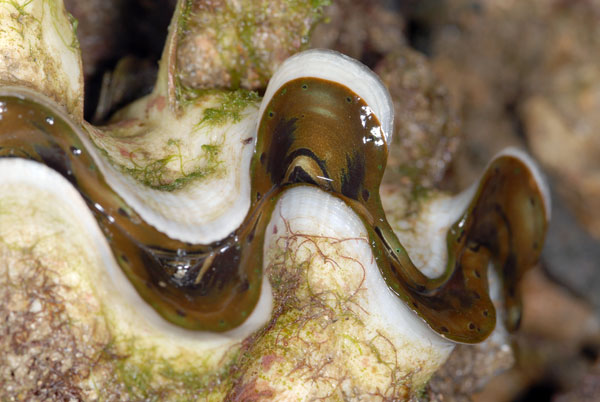
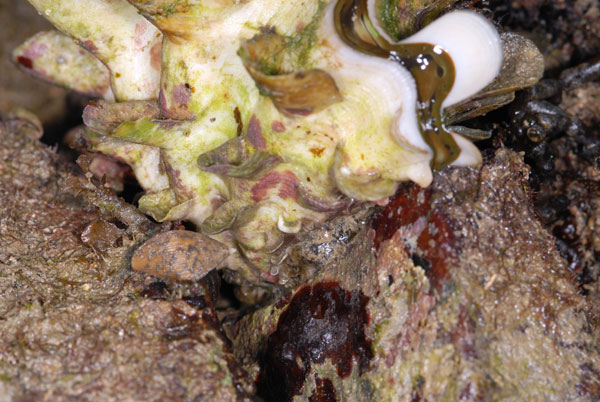
Other special finds included a Fluted giant clam (Tridacna squamosa), which Mei Lin was surprised as she said that the tracked Giant clam had already be relocated elsewhere. This new found Giant clam was quite some distance away from the tracking marker. I wonder how it got away unnoticed when we frequent this lagoon the most number of times in a year.
Fluted giant clam
Underwater view of the giant clam
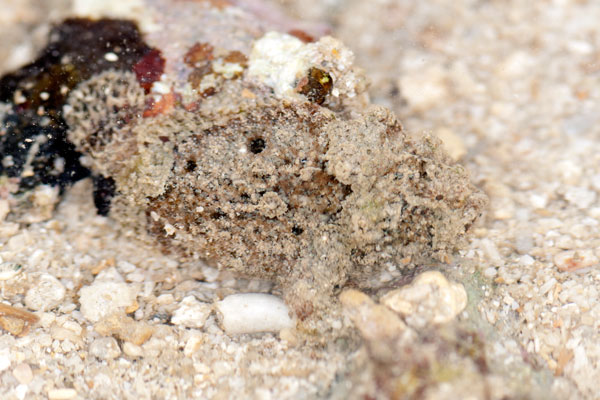
Mei Lin spotted a cute tiny Spotted-tail frogfish (Lophiocharon trisignatus), or rather, the frogfish appeared to her. It was a very active frogfish and it took quite some time to settle down nicely on the sandy substrate for us to photograph.
Spotted-tail frogfish
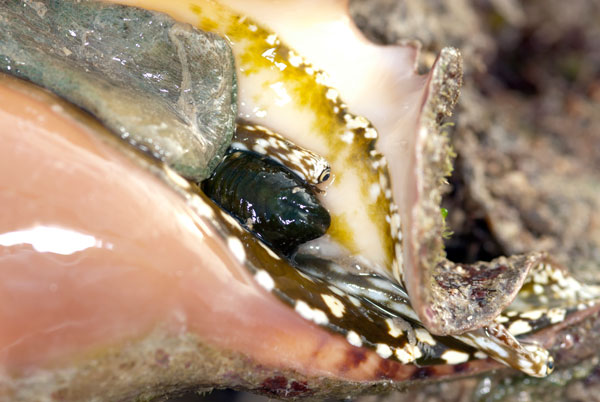
Nearby the frogfish, there was a Spider conch (Lambis lambis) and I caught a video of it trying to flip itself around and moving away.
Closeup overview of the Spider conch, with its eye out.
Closeup underside view.

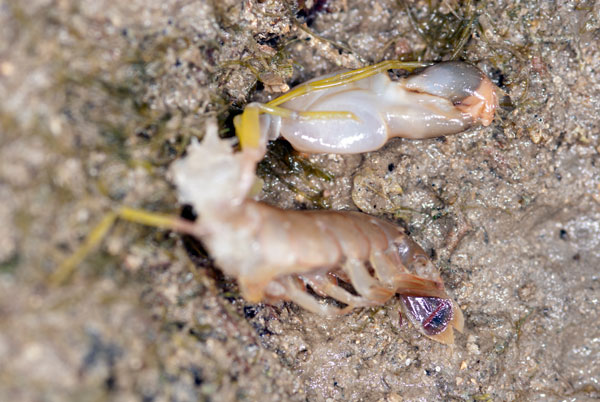
Oh no, this poor Smooth snapping shrimp (Alpheus sp.) has be decapitated. I wonder what happened to the shrimp?
Decapitated snapping shrimp
Today I had some time to venture along the seawall outside the lagoon and I found a Sally-light-foot crab (Grapsus albolineatus). It is my first time seeing this crab. The crab lays close to the surface and stays motionless. It is not easy to spot the crab as does blend in well into its surroundings.
Sally-light-foot crab
Towards the end of the trip, I managed to located one of the seahorse again. With the help of the sunlight and incoming tide, I took another video of the seahorse.

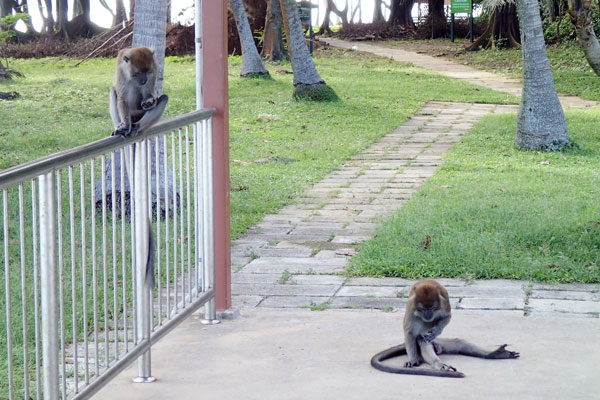
It was a great trip at Big Sisters despite having been here a few times. Every trip brings new surprises and excitements. Ending of the trip, the male long-tail macaques joined the team at the jetty, threatening to take our belongings.
Male lone-tail macaques
You can check out my YouTube channel for more other videos of Singapore's Biodiversity. I'm slowly building up the videos in my channel.

Saturday, May 11, 2013

Giant Clam and Handsome Shrimp at Pulau Hantu

It was a great day at Pulau Hantu this morning. The team found about 5 giant clams growing on the outer reef patch!
Photo by Kok Sheng on his Facebook.
However I only see one giant clam with the help of Marcus.
Giant clam, with my size 8 booties as size reference.

It was great to find out from Mei Lin, who studies giant clams, that these giant clams settled naturally on our reefs and they look they are growing well. How exciting. Their shells looked rather white and clean when they are still young.
Overview of the giant clam.
Closeup of the clam.
Attaching well onto a surface.
What other interesting animals did I see today on the reef?

I saw a few Yellow-banded damselfish (Dischistodus fasciatus). Night time provided a good time for me to document fish as they are rather still.
Yellow-banded damselfish
I also had a very clam encounter with a Longspined scorpionfish (Paracentropogon longispinis). It was my first time encounter a real scorpionfish on the intertidal reef. However I had encounter a rather huge scorpionfish during my recent dive last month in the waters of Pulau Hantu.
Longspined scorpionfish
This suspicious blob with tiny bumps on the surface is actually the Alicia anemone (Alicia sp.) when contracted.
Alicia anemone
It looks like the Alicia anemone is in season lately with frequent sightings of it recently. In fact, I saw another larger Alicia anemone towards the end of the trip. Initially, I thought it was a nudibranch but on closer observation it turned out to be the Alicia anemone.
A slightly bigger Alicia anemone.
The Alicia anemone contains stinging cells and its sting can be rather powerful. So far, none of us had experience with the stinging cells of the Alicia anemone so we are not able to describe how painful it is.

The other anemone that delivers a powerful sting is the Haeckel's anemone (Actinostephanus haeckeli). We also refer this anemone as the "Darth Vader anemone".
Haeckel's anemone
This cute octopus was waving at me when I approached it.
Octopus
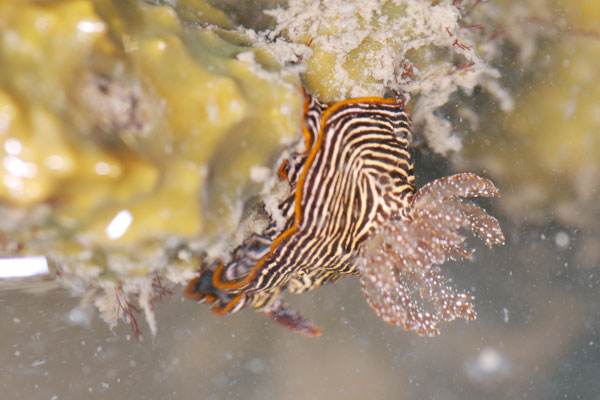
I only managed to take a shot of this Line chromodoris nudibranch (Chromodoris lineolata) on a sponge before it fell into a crevice and unable to be found. It was my only find for nudibranch but the rest of the team saw many other nudibranchs.
Chromodoris lineolata
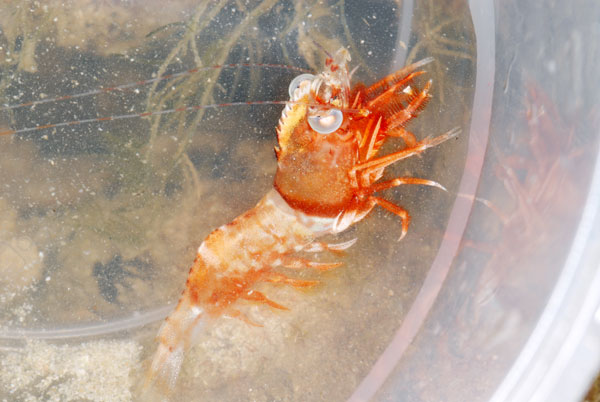
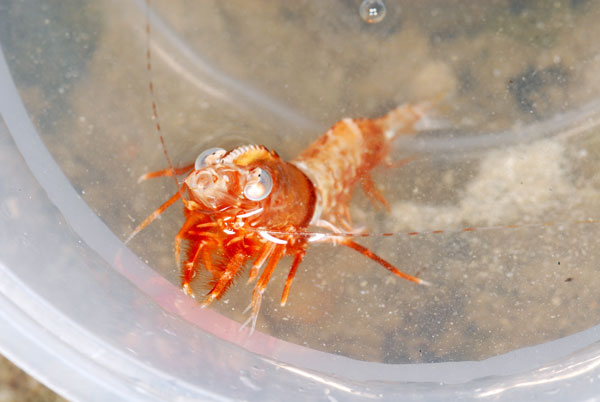
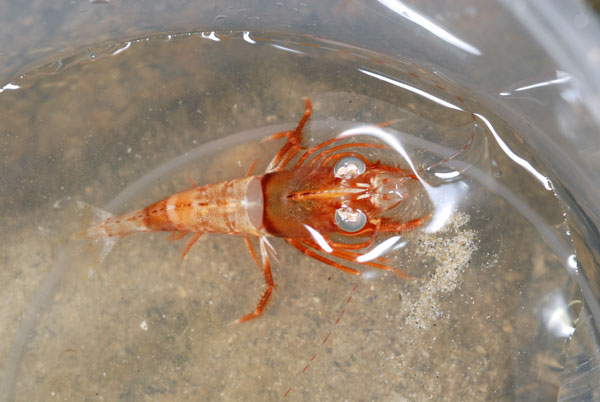
A special find for this trip was this handsome looking burrowing red shrimp.
Red shrimp
The identity of the shrimp is unknown but it possibly be a Sicyonia sp.. I did not have good profile images of the shrimp as it was too active moving around in the container. Neither did I have it in situ, which I kind of regret it now. Here are some of the profiles of the shrimp I got.


On this trip, I only managed to spot one False clown anemonefish (Amphiprion ocellaris). It was so shy that it only appear long enough for me to take two quick shots. Most of the time, I could only see the wriggling activity in the anemone.
False clown anemonefish
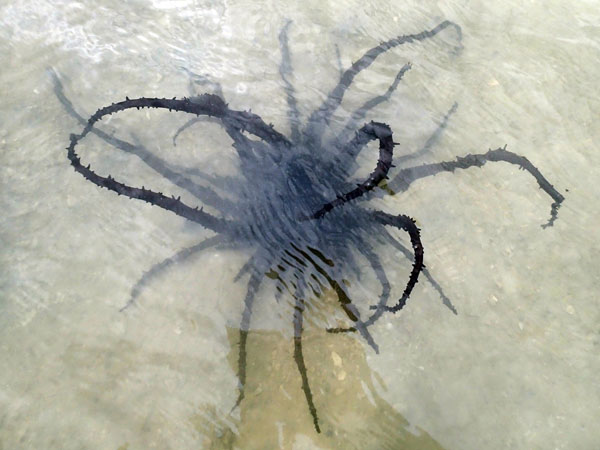
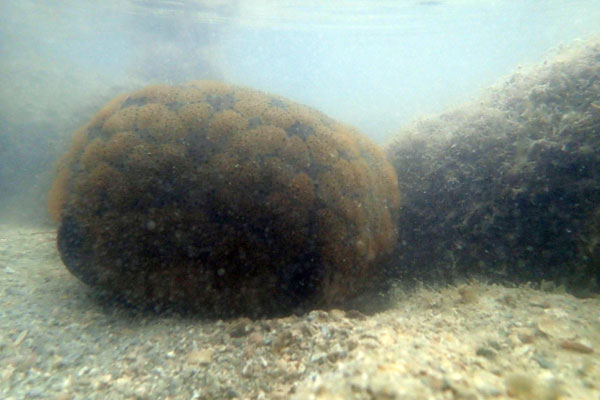
Another special find of the day is the young Cushion star (Culcita novaeguinea).
Cushion star.
Here's view of the Cushion star underwater.
Underwater view
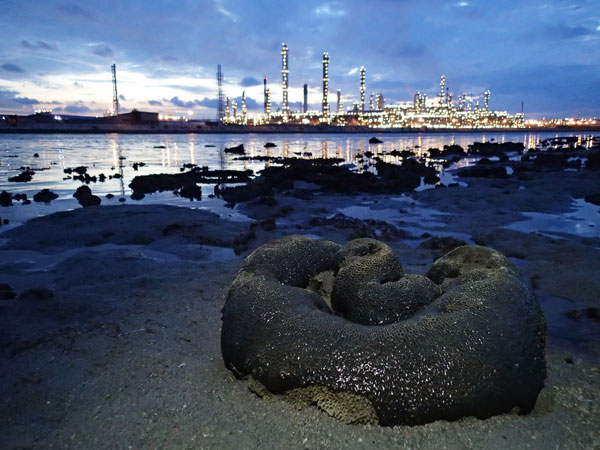
As the team was checking out the shore, the sky brightens up behind the refinery island.
Dawn from Pulau Hantu
Pulau Hantu reef in the foreground of the refinery island.
Sunrise at Pulau Hantu.
It was a great trip. Though I saw little, they were very special finds.

Post by others on this trip
Ria - Nudis, Nemos and more at Pulau Hantu

Saturday, May 4, 2013

Another great day at Chek Jawa with the Naked Hermit Crabs

It is the first Saturday of the month again. The Naked Hermit Crab had another great guided walk with our visitors at Chek Jawa this morning. Despite the hot and humid weather our visitors sure had fun and enjoyed themselves looking the critters of Chek Jawa. We had a great turnout of about 80 visitors, with some joining the walk on the spot.

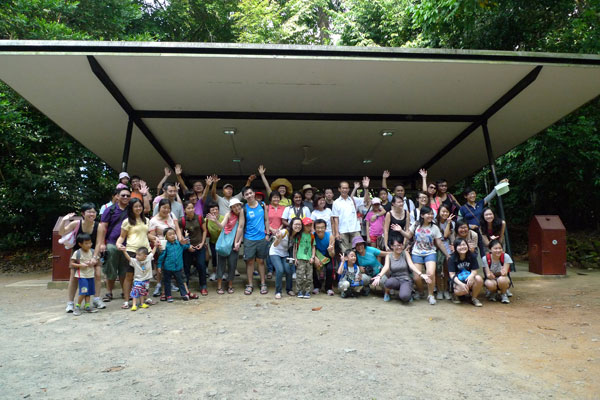
As usual, a group photo of our visitors before the walk.

Before the walk began, I checked out the areas near the information kiosk and found some interesting critters.

Was looking out for weaver ants' nest when I chanced upon a few leaves with the weavers ants on the underside. Not exactly sure what the ants were doing but when I was processing the photos, I noticed that the tiny black specks were insects of various shapes and sizes. Not sure what the ants were doing with them.


Then a cheerful singing of a bird caught my attention and it is a male White-rumped shama (Copsychus malabaricus). In fact, I saw another shama flew from a nearby tree and landed on the gravel path for a brief moment. 
White-rumped shama
At the same spot where I hear the shama, I also heard loud sounds of knocking on tree. I figured a woodpecker could be nearby but I did not have the time to search further as the walk was about to begin.

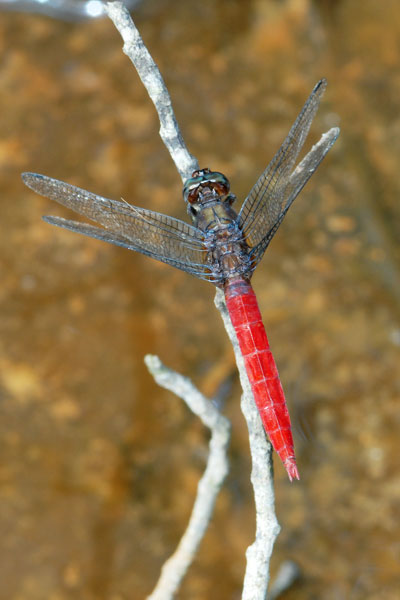
My sharp-eyed adult visitors spotted this pretty dragonfly at the base of the Jejawi tower. I think it is a Spine-tufted skimmer (Orthetrum chrysis). I have not shot and identify dragonflies for a long time. Getting rusty on matching my image to identified images.
Spine-tufted skimmer
The usual critters of Chek Jawa mangrove were seen: tree-climbing crabs, fiddler crabs, mudskippers, giant mudskipper. The resident mudskipper at the first rest hut is, as usual, out today.
Mudskipper
My visitors sure had a great time. They love to watch the fiddler crabs on the shore.

Along the coastal boardwalk, the tide was outgoing and the visitors got a chance to see the seagrass lagoon of Chek Jawa. We saw a few swimming crabs and one carpet anemone. Ley Kun's group saw an octopus! Great!!!

With the outgoing tide, the grills on the boardwalk became very useful in allowing visitors to see under the boardwalk.
Looking through the grills to see beneath the boardwalk.
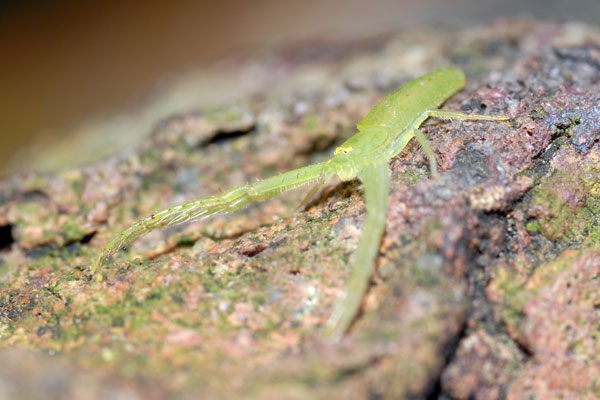
At the end of the walk, we had a spider hitchhiker. It is a Green crab spider (Dieta virens). My first time seeing such a pretty spider.
Dorsal view
Green crab spider
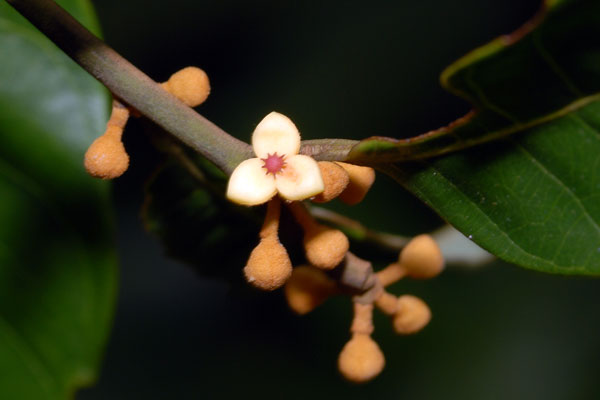
Ria noticed this flower of the seashore nutmeg. She is not sure if it is the male flower. It was very tricky to photo this flower as the petals gets overexposed very easily.
Male flower? of seashore nutmeg
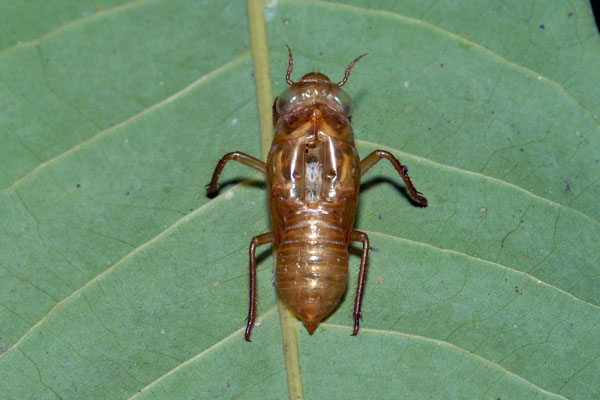
Nearby, Ivan found a moult of a cicada.
Cicada moult
Our children visitors had great fun too. Ria commented that they were great spotters for critters. Some of our visitors were actually repeated visitors these two children below. They and their parents joined us for the Pasir Ris Park mangrove boardwalk guided walk before and today they joined us in the Chek Jawa walk. 

It is heartening when families sign up for our guided walks again or they share their experience of the guided walk with their friends and encourage them to sign up for it.

While waiting for the van to arrive, I checked out the rotational image information cubes at Punai Hut. The photos are actually related to the hut's name - Punai birds.
Different species of Punai birds
No crabs for lunch today as the two sisters' restaurant was packed with customers. Instead, we had yummy ayam penyet at Changi Village Hawker Centre.

You can also read about the critters Ria's group saw today on her blog - Naked at Chek Jawa Again!

LinkWithin

Related Posts Plugin for WordPress, Blogger...